Zionist soldier, while laughing in an Interview with the Israeli channel Hot 8:
"We put Palestinians in cages and killed them. One of us raped a sixteen-year-old girl; some of us ran after them with flame throwers and burned them."
israël is the only country in the world that practiced The "Breaking Bones Policy" as a military directive using hammers instead of bullets against 1555 Palestinian kids in 1988 !
It’s even more crazy how Iran fired thousands of “cheap” drones and missiles at several countries from thousands of miles away but not once accidentally hit a school, a university or a hospital.
It’s almost like their goal was defense & deterrence -not terror & ethnic cleansing.
🔹 The struggle between Iran and the United States is far from over, but this particular round was destined to end with a phased agreement—one built on gradual steps and verification at every stage.
🔸 What’s striking is that the agreement—without delving into unpublished details—is balanced in its overall framework.
🔸 Unlike the 2015 deal, verification of the other party’s compliance will now be bilateral. In other words, unless Iran confirms that Washington has met its obligations, it will not begin / continue with the second phase.
🔸 This is immensely significant. The very issue Washington prioritized most—the nuclear file—has been postponed to second-phase negotiations. Washington must first implement the first phase to even reach what comes next.
🔸 This is a new formula Tehran is using to ensure the agreement is implemented and its fruits are realized. I don’t see Iran abandoning this approach in future stages: gradual progression, ensuring Washington’s commitment at each step, and only then moving to the next.
🔸 One of the most important features of such an agreement is that for Iran, committing or stepping back is far easier than it was in 2015. Tehran has tied its own commitment directly to Washington’s. Opening or closing the Strait of Hormuz—unlike resuming enrichment—requires neither massive effort nor a long time.
🔸 We are facing a fundamental shift, born of war, resilience on the ground, and steadfastness in the streets—and it builds on all of them. Any retreat from commitments will now be bilateral. No more one-sided withdrawals, as happened in 2018.
Have you noticed ???
Dozens of helicopters and US planes have been downed by Iran.
Every time they are allegedly rescued.
US soldiers (officially) never die.
US propaganda works with the zombified masses
if this is what people can achieve while under sanctions, occupations, invasions, and economic warfare, then the post-imperial future is going to be more beautiful than we can currently imagine.
Having forced a retreat on Israel and the United States in Lebanon, Iran now moves to manage two battles that Washington itself initiated:
1. The Blockade: Any violation of Iranian ships will be met with an equal or harsher response. The goal is to prevent the imposition of a fait accompli.
2. Hormuz: Iran is responsible for security in the Strait. Any targeting of its administrative structures there or any attempt to destabilize it will be met with a swift and costly response. The goal is to consolidate the outcomes and gains of the war.
In the same context, Iran is shifting from a policy of tit-for-tat retaliation to a new phase defined by a stronger, broader response aimed at achieving deterrence.
Tehran provides Washington with two options only: either accept the outcomes of military failure peacefully, or move towards a new war. There won’t be a third option in between.
I have been a scholar of Hizbullah for over three decades, and throughout that time I have been repeatedly asked when, whether, or how, it will disarm. Yet in the context of Israel's daily terrorism in the south and the Bekaa, and beyond, the question today has become even more absurd, because those who pose it somehow still fail to grasp that they aren't simply asking about an organisation, but about whether an entire people — the people of the south, the Bekaa, and Dahyeh, Lebanon’s Shia community, and a constitutive part of the Lebanese state — should willingly surrender the only means through which they have resisted their own genocide. And the answer to that is something that rings even more true today than it has in the past--there will be no disarmament of Hizbullah's Resistance, with a capital R, or of any other popular resistance that may emerge with a lower case r, so long as the genocidal Israeli entity exists.
There’s no overstating how extraordinary this Atlantic article is, given the author and the outlet.
As a reminder Bob Kagan is:
- The co-founder of Project for the New American Century, probably the single most imperialist Think Tank in Washington (which is quite a feat)
- A man who spent his entire life advocating for American military interventions, especially in the Middle East, and a vocal advocate of the Iraq war. He started advocating for intervention in Iraq before 9/11, which speaks for itself...
- The husband of Victoria Nuland, an extremely hawkish former senior U.S. official (a key architect of U.S. policy in Ukraine, with the consequences we all witness today)
- The brother of Frederick Kagan, one of the key architects of the Iraq surge
In other words, we ain’t exactly looking at some sort of anti-imperialist peacenik. This is quite literally the guy Dick Cheney called when he needed a pep talk.
And the man is writing in The Atlantic, the most reliably pro-war mainstream media outlet in the U.S. (also quite a feat).
So when HE writes that the U.S. “suffered a total defeat” in Iran that has no precedent in U.S. history and can “neither be repaired nor ignored,” it’s the functional equivalent of Ronald McDonald telling you the burgers aren’t great: it means the burgers really, really aren't great.
Extraordinarily (and somewhat worryingly, for me), his arguments for why this is such a defeat are virtually the same as those I laid out in my article “The First Multipolar War” last month (https://t.co/tbnOpdYqux).
Here they are 👇
1) Vietnam/Afghanistan were survivable, this isn't
He agrees that this war - and the U.S. defeat - is fundamentally different in nature from previous U.S. interventions.
Where I wrote that the wars in Vietnam and Afghanistan didn’t change the equation much in terms of power dynamics (“in the grand scheme of things, the giant walked away with little more than a bruised ego”), Kagan writes that “the defeats in Vietnam and Afghanistan were costly but did not do lasting damage to America's overall position in the world.”
And when I wrote that “it’s painfully obvious that the Iran war is of a qualitatively different nature” from these, he writes that “defeat in the present confrontation with Iran will be of an entirely different character.”
Same point.
2) Iran will never relinquish Hormuz and uses it as selective leverage
When I wrote that Iran has turned “freedom of navigation” on its head by establishing “a permission-based regime” through the Strait of Hormuz, Kagan arrives at the same conclusion: “Iran will be able not only to demand tolls for passage, but to limit transit to those nations with which it has good relations.”
He also agrees that “Iran has no interest in returning to the status quo ante,” when I myself cited Iran’s parliament speaker Ghalibaf in my article, saying: “The Strait of Hormuz situation won’t return to its pre-war status.” Same point and virtually the same words.
3) Gulf states will have to accommodate Iran
He agrees that most Gulf states will have no choice but to accommodate Iran, effectively making Iran into a, if not THE, dominant regional power.
Kagan writes “the United States will have proved itself a paper tiger, forcing the Gulf and other Arab states to accommodate Iran.”
On my end, I wrote that “the Gulf monarchies will eventually have to choose between two security propositions. One where they stay aligned with a distant superpower that [can’t protect them]. The other proposition being: make peace with the regional power that just proved it can hit [them] whenever it wants.” Which is not much of a choice…
4) Military impossibility to reopen Hormuz
Kagan writes that “if the United States with its mighty Navy can't or won't open the strait, no coalition of forces with just a fraction of the Americans' capability will be able to, either.”
On my end, in my article I cited Germany’s defense minister Boris Pistorius: “What does Trump expect a handful of European frigates to do that the powerful US Navy cannot?”
The exact same argument.
5) Global chain reaction
Kagan agrees that this is a global strategic failure that fundamentally changes the U.S.’s position in the world. As he puts it: “America's once-dominant position in the Gulf is just the first of many casualties… America's allies in East Asia and Europe must wonder about American staying power in the event of future conflicts.”
You’ll have guessed it, I wrote essentially the same thing: “Think about what it says if you’re Saudi Arabia, quietly watching your American-built defenses fail to protect your own refineries. Or any European country now facing the worst energy shock since 1973, caused not by your enemy but by your ally, and realizing that said ‘ally,’ supposedly in charge of ‘protecting’ you, couldn’t even protect Israel’s most strategic sites - when it’s the country with which it’s joined at the hip. I’m not even speaking about China or Russia who are seeing their worldview being validated on almost every axis simultaneously.”
6) Weapons stocks depleted, credibility shattered
Kagan: “just a few weeks of war with a second-rank power have reduced American weapons stocks to perilously low levels, with no quick remedy in sight.”
Me: “America’s most advanced weapons systems are much more vulnerable than previously thought - not theoretically, but in actual combat.”
Kagan: “America's allies… must wonder about American staying power in the event of future conflicts.”
Me: “The U.S. security guarantee has been empirically falsified in real time.”
-----------
So, yup, Bob Kagan and I agree on nearly everything. I need a shower 🤢
Reassuringly though, we still differ on a few fundamental aspects.
First of all, arguably the most important one, the moral aspect. In typical neocon fashion, his article contains not a word about the human cost of this war - not the 165 schoolgirls, not the devastation inflicted on Iranians during 37 days of bombing, not the toll this war is taking on the entire world through its devastating economic consequences (the economic devastation on ordinary people worldwide is referenced only as a political problem for Trump). For him, this is purely a strategic chess problem, morality and people don’t figure in his mental map.
For me, the moral bankruptcy of this war isn't separate from the strategic failure - it is the strategic failure. Much like Gaza can only be a failure because of its sheer abjectness.
Secondly, there is not an instant of reflection in the article on how we got there. Which is unsurprising because he personally, alongside his wife, his brother, and every co-signatory of every PNAC letter, spent a generation pushing for exactly this kind of confrontation. The man spend 30 years advocating for military dominance in the Middle East and hostility towards Iran, thereby forging them as an adversary and facilitating this very war that he now says has “checkmated” America.
I know introspection has never been the neocon forte but at some point you have to stop setting houses on fire and then writing op-eds about how surprising the smoke is.
Last but not least, we differ on what should be done. This is the funniest part of Kagan’s article - showing that the man is decidedly beyond salvation. On one hand he calls this a “checkmate” by Iran, and a U.S. defeat that can “neither be repaired nor ignored,” yet an the other hand his solution for it is… surprise, surprise… a bigger war still!
He writes that what’s to be done is “engage in a full-scale ground and naval war to remove the current Iranian regime, and then to occupy Iran until a new government can take hold.”
The arsonist's solution to the fire is a bigger fire ¯\_(ツ)_/¯
For my end, this was the conclusion of my previous article:
"There is almost a Greek tragedy quality to U.S. actions lately where every move taken to escape one’s fate becomes the mechanism that delivers it. The U.S. went to war to reassert dominance - and proved it could no longer dominate. It demanded allies send warships - and revealed it had no real allies. It waged forty years of maximum pressure to break Iran before this moment came - and instead forged the very adversary now capable of meeting it. It started the war in part to have additional leverage over China - and handed the world the spectacle of begging China for help. The prophecy was multipolarity. Every American action to prevent it reveals it instead."
I wouldn’t change a word. The only thing that's changed since I wrote it is that even the arsonists now smell the smoke.
Src for the Atlantic article: https://t.co/ItED9WS9Kn
Thread on the Lebanese govt project to disinherit the resistance and disown the Shia:
What is even more politically destructive and unconscionable than the Aoun-Salam government’s capitulation to Israel, and its joint counter-resistance security project with it, is that this project is also striving to excise from the national body politic the Shia community itself, not as a sect in the abstract, but as a political community constituted through resistance. 1/6
Iraq’s Prime Minister-elect Ali Al-Zaidi tells President Pezeshkian that, “Iran’s power doesn’t belong to itself alone; it is the guardian and protector of all Muslims and the Shia. Iraqis will never accept Iran lose its power. Iran and Iraq are each other’s strategic depth”.
X has now removed the blue check from Iran's MFA Spokesperson’s account—after stripping the Ministry and Minister's verified badges—despite our full Premium+ payments.
This arbitrary de-verification fits X’s pattern of selective censorship and American digital piracy, aimed at suppressing the truth about the U.S.’ illegal war against Iran.
The axis of resistance is fighting for the freedom of the world and for Palestine, while the president of syria Al Joulani is out here vibing to “if you got a big… let me work it.”
I guess that pretty much tells us the whole story.
Behold, the Blessèd Revolution!
When we said Abu Nakba al-Julani would turn Former Syria into a Zionist rump colony, we didn't think he'd take the phrase literally and oversee state-mandated twerking to Missy Elliott.
Nevertheless, how refreshing to see Julani promoting the pure Saudi manhaj, not like those Majoosi Rawāfidh who busy themselves with silly things like martyrdom for the sake of liberating al-Quds and defeating Pax Judaica.
This is what a true leader, a master of strategy, playing 4D chess really looks like.
Well done to everyone who spent fourteen years inciting a sectarian civil war in the Arab world's last functioning anti-imperialist state.
“An Israeli soldier posted photos of herself inside a house in southern Lebanon. What's most painful about this image is how it makes the loss unbearably harsh. This is a house where the greenery is still there, where the lives of its inhabitants still exist, but they alone are forcibly absent. They are forbidden from returning, while a soldier from the occupation army enters the place, picks fruit, cooks, and laughs as if the house were empty. As if the fifty-five villages forbidden to the people of southern Lebanon haven't already been emptied of their inhabitants, as if all this destruction weren't enough. The scene is humiliating because it encapsulates everything: the uprooting of people from their land, then the transformation of their homes and gardens into open territory for the invaders. This is occupation and a deliberate insult to the memory of the people, their dignity, and their fundamental right to return to what they cultivated with their own hands.”
Iran and the US agreed to a ceasefire which involved a truce in Lebanon and the reopening of Hormuz.
Subsequently, Israel has blown up villages in southern Lebanon while Trump has announced that everyone except Iran can use Hormuz. Iran is even told that shipping altogether is off limits, with the US military attacking a civilian vessel.
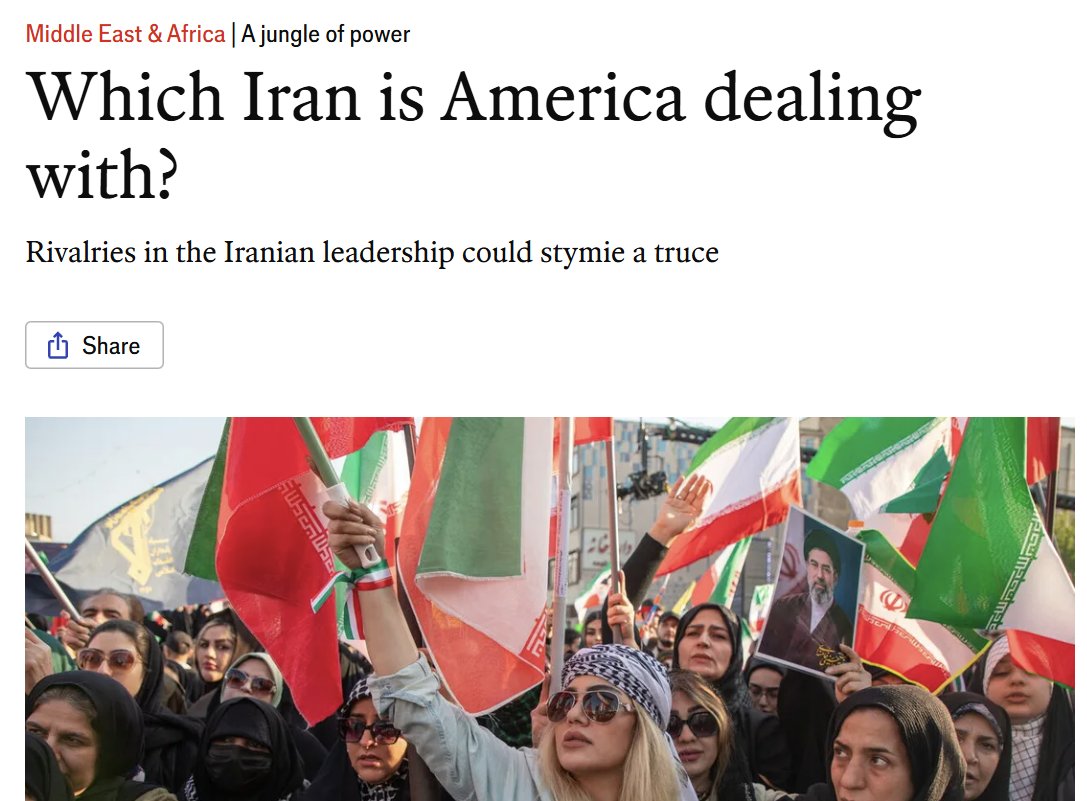
Western media's interpretation of Iran's refusal to unilaterally uphold ceasefire obligations: "Iranians are divided and you can't make a deal with them."











![RnaudBertrand's tweet photo. There’s no overstating how extraordinary this Atlantic article is, given the author and the outlet.
As a reminder Bob Kagan is:
- The co-founder of Project for the New American Century, probably the single most imperialist Think Tank in Washington (which is quite a feat)
- A man who spent his entire life advocating for American military interventions, especially in the Middle East, and a vocal advocate of the Iraq war. He started advocating for intervention in Iraq before 9/11, which speaks for itself...
- The husband of Victoria Nuland, an extremely hawkish former senior U.S. official (a key architect of U.S. policy in Ukraine, with the consequences we all witness today)
- The brother of Frederick Kagan, one of the key architects of the Iraq surge
In other words, we ain’t exactly looking at some sort of anti-imperialist peacenik. This is quite literally the guy Dick Cheney called when he needed a pep talk.
And the man is writing in The Atlantic, the most reliably pro-war mainstream media outlet in the U.S. (also quite a feat).
So when HE writes that the U.S. “suffered a total defeat” in Iran that has no precedent in U.S. history and can “neither be repaired nor ignored,” it’s the functional equivalent of Ronald McDonald telling you the burgers aren’t great: it means the burgers really, really aren't great.
Extraordinarily (and somewhat worryingly, for me), his arguments for why this is such a defeat are virtually the same as those I laid out in my article “The First Multipolar War” last month (https://t.co/tbnOpdYqux).
Here they are 👇
1) Vietnam/Afghanistan were survivable, this isn't
He agrees that this war - and the U.S. defeat - is fundamentally different in nature from previous U.S. interventions.
Where I wrote that the wars in Vietnam and Afghanistan didn’t change the equation much in terms of power dynamics (“in the grand scheme of things, the giant walked away with little more than a bruised ego”), Kagan writes that “the defeats in Vietnam and Afghanistan were costly but did not do lasting damage to America's overall position in the world.”
And when I wrote that “it’s painfully obvious that the Iran war is of a qualitatively different nature” from these, he writes that “defeat in the present confrontation with Iran will be of an entirely different character.”
Same point.
2) Iran will never relinquish Hormuz and uses it as selective leverage
When I wrote that Iran has turned “freedom of navigation” on its head by establishing “a permission-based regime” through the Strait of Hormuz, Kagan arrives at the same conclusion: “Iran will be able not only to demand tolls for passage, but to limit transit to those nations with which it has good relations.”
He also agrees that “Iran has no interest in returning to the status quo ante,” when I myself cited Iran’s parliament speaker Ghalibaf in my article, saying: “The Strait of Hormuz situation won’t return to its pre-war status.” Same point and virtually the same words.
3) Gulf states will have to accommodate Iran
He agrees that most Gulf states will have no choice but to accommodate Iran, effectively making Iran into a, if not THE, dominant regional power.
Kagan writes “the United States will have proved itself a paper tiger, forcing the Gulf and other Arab states to accommodate Iran.”
On my end, I wrote that “the Gulf monarchies will eventually have to choose between two security propositions. One where they stay aligned with a distant superpower that [can’t protect them]. The other proposition being: make peace with the regional power that just proved it can hit [them] whenever it wants.” Which is not much of a choice…
4) Military impossibility to reopen Hormuz
Kagan writes that “if the United States with its mighty Navy can't or won't open the strait, no coalition of forces with just a fraction of the Americans' capability will be able to, either.”
On my end, in my article I cited Germany’s defense minister Boris Pistorius: “What does Trump expect a handful of European frigates to do that the powerful US Navy cannot?”
The exact same argument.
5) Global chain reaction
Kagan agrees that this is a global strategic failure that fundamentally changes the U.S.’s position in the world. As he puts it: “America's once-dominant position in the Gulf is just the first of many casualties… America's allies in East Asia and Europe must wonder about American staying power in the event of future conflicts.”
You’ll have guessed it, I wrote essentially the same thing: “Think about what it says if you’re Saudi Arabia, quietly watching your American-built defenses fail to protect your own refineries. Or any European country now facing the worst energy shock since 1973, caused not by your enemy but by your ally, and realizing that said ‘ally,’ supposedly in charge of ‘protecting’ you, couldn’t even protect Israel’s most strategic sites - when it’s the country with which it’s joined at the hip. I’m not even speaking about China or Russia who are seeing their worldview being validated on almost every axis simultaneously.”
6) Weapons stocks depleted, credibility shattered
Kagan: “just a few weeks of war with a second-rank power have reduced American weapons stocks to perilously low levels, with no quick remedy in sight.”
Me: “America’s most advanced weapons systems are much more vulnerable than previously thought - not theoretically, but in actual combat.”
Kagan: “America's allies… must wonder about American staying power in the event of future conflicts.”
Me: “The U.S. security guarantee has been empirically falsified in real time.”
-----------
So, yup, Bob Kagan and I agree on nearly everything. I need a shower 🤢
Reassuringly though, we still differ on a few fundamental aspects.
First of all, arguably the most important one, the moral aspect. In typical neocon fashion, his article contains not a word about the human cost of this war - not the 165 schoolgirls, not the devastation inflicted on Iranians during 37 days of bombing, not the toll this war is taking on the entire world through its devastating economic consequences (the economic devastation on ordinary people worldwide is referenced only as a political problem for Trump). For him, this is purely a strategic chess problem, morality and people don’t figure in his mental map.
For me, the moral bankruptcy of this war isn't separate from the strategic failure - it is the strategic failure. Much like Gaza can only be a failure because of its sheer abjectness.
Secondly, there is not an instant of reflection in the article on how we got there. Which is unsurprising because he personally, alongside his wife, his brother, and every co-signatory of every PNAC letter, spent a generation pushing for exactly this kind of confrontation. The man spend 30 years advocating for military dominance in the Middle East and hostility towards Iran, thereby forging them as an adversary and facilitating this very war that he now says has “checkmated” America.
I know introspection has never been the neocon forte but at some point you have to stop setting houses on fire and then writing op-eds about how surprising the smoke is.
Last but not least, we differ on what should be done. This is the funniest part of Kagan’s article - showing that the man is decidedly beyond salvation. On one hand he calls this a “checkmate” by Iran, and a U.S. defeat that can “neither be repaired nor ignored,” yet an the other hand his solution for it is… surprise, surprise… a bigger war still!
He writes that what’s to be done is “engage in a full-scale ground and naval war to remove the current Iranian regime, and then to occupy Iran until a new government can take hold.”
The arsonist's solution to the fire is a bigger fire ¯\_(ツ)_/¯
For my end, this was the conclusion of my previous article:
"There is almost a Greek tragedy quality to U.S. actions lately where every move taken to escape one’s fate becomes the mechanism that delivers it. The U.S. went to war to reassert dominance - and proved it could no longer dominate. It demanded allies send warships - and revealed it had no real allies. It waged forty years of maximum pressure to break Iran before this moment came - and instead forged the very adversary now capable of meeting it. It started the war in part to have additional leverage over China - and handed the world the spectacle of begging China for help. The prophecy was multipolarity. Every American action to prevent it reveals it instead."
I wouldn’t change a word. The only thing that's changed since I wrote it is that even the arsonists now smell the smoke.
Src for the Atlantic article: https://t.co/ItED9WS9Kn](https://pbs.twimg.com/media/HIBa-IQacAAr9O1.jpg)


