Nodle App 4.0.18 is here 🟢
This update introduces NODL staking, @arc network support, new @xmtp_ group-chat management tools, a Roole offer for users in France, and stability improvements across the app.
Here’s what’s new 🧵
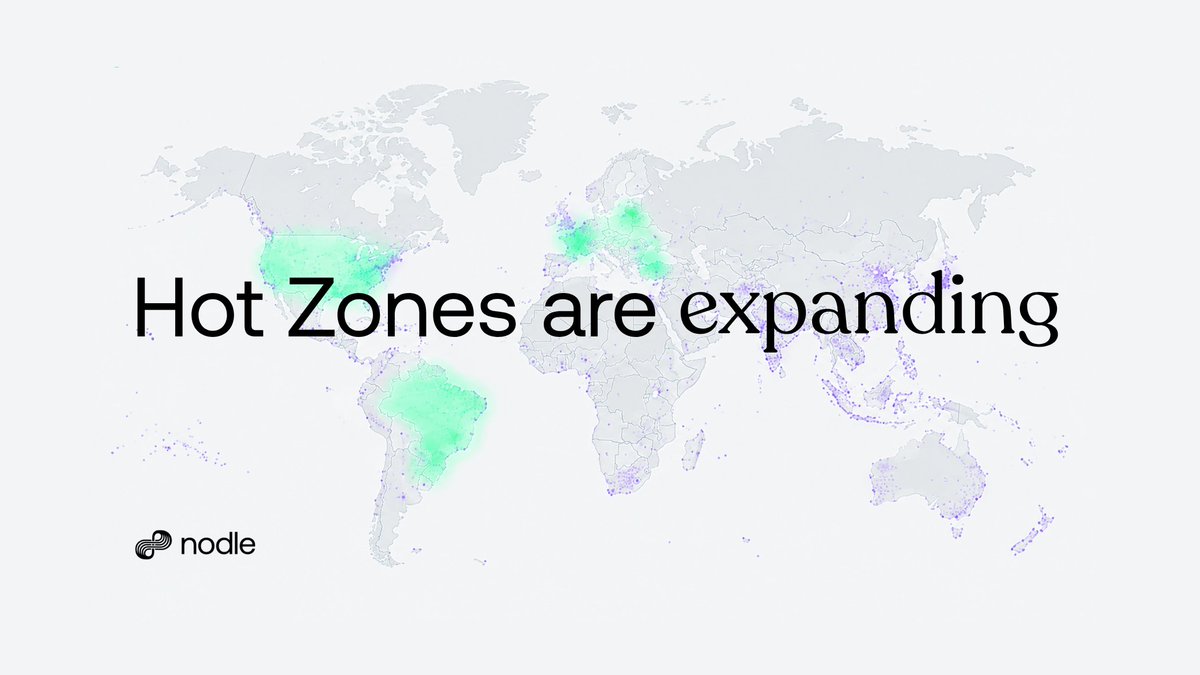
🔥 Hot Zones are expanding 🔥
Starting October 1, eligible Nodle App users in the USA, Brazil, France, Poland, Romania and Bulgaria can earn boosted Network Mission Rewards while helping grow real-world coverage.
Update your app and get ready. 🧵
Can an invisible signal inside an image help us understand where it came from?
AI watermarks are becoming more common, but a watermark alone cannot tell the full story. To build trust, we need signals that can survive transformation, explain provenance, and remain independently verifiable. 🧵
The future of trust is not proof without people.
It is proof people can inspect, question, and use on their own terms.
What is the one piece of advice you would give a person entering Web3 today?
https://t.co/EMUXQ3iFiK
A green checkmark should start a question, not end one.
What was verified? What changed? What information is missing? Who signed it?
What is your best tip for doing your own research in Web3?
https://t.co/EMUXQ3iFiK
🇺🇸 Is it getting hot in here?
🇧🇷 Está ficando quente aqui?
🇵🇱 Czy robi się tu gorąco?
🇷🇴 Se face cald aici?
🇧🇬 Става ли горещо тук?
🇫🇷 Est-ce qu’il commence à faire chaud ici ?
Not every piece of metadata should be public.
Selective disclosure means showing what supports verification while protecting what could put someone at risk.
What personal-data or privacy lesson would you give to someone new to crypto?
https://t.co/EMUXQ3iFiK
Centralized messaging and ID checks create more and more single points of failure.
Crypto 101 · e33 looks at a different path: decentralized messaging + pseudonymous identity, where you can prove you’re a real person without handing over your entire identity.
If you could go back to your first months in crypto, what would you say to yourself about security, identity, and staying safe?
👇 Let the newcomers learn from your experience
https://t.co/pAw54MvkwG
🔐 Most people hear “encrypted chat” and think their messages are safe.
But the real story is in the data around your messages: who you talk to, when, how often, from where. That metadata can be more revealing than the words themselves.
Here is how @xmtp_ helps all of us in 2026 👇
No matter what any regulator decides, one thing stays true:
If you hold your own keys, no one can take away your access.
Self-custody isn't anti-regulation. It's just good hygiene.
What's your setup? Hardware wallet, app wallet, both?
https://t.co/gshiSNjiMH
Stablecoins settled $33 trillion last year.
China's digital yuan is paying interest.
The US just banned its own CBDC.
And the EU is racing to launch a digital euro by 2029.
Two very different visions of digital money are being built at the same time. Here's what separates them.
Stablecoins settled $33T last year. CBDCs are coming with full state backing and programmability.
Same goal (digital money), completely different power structures.
If you’re new to Web3, which would you trust more today — a stablecoin or a CBDC, and why?
https://t.co/YoLu1lv2ur
Stablecoins feel like “digital dollars,” but they’re actually:
A private company’s token
Backed (or not) by reserves
Living on public blockchains
If you’ve used USDT/USDC before:
What do you wish you’d known about stablecoins when you started?
Your answer might save a newcomer a lot of pain 👇
https://t.co/YoLu1lv2ur