Your PhD is about the evolution of your mindset.
It proceeds through personal research experience, mentorship and development of key skills.
This is why PhD in STEM:
- is NOT about a thesis (very few people will read it)
- is NOT about finish your advisor’s project
- is NOT about attending new courses
- is NOT to learn how to use cool instruments (although it might be handy, it is of little help in a long run)
Yes, some of it will help you get hired. BUT PhD should not be about this.
▫️
PhD is about personal development, creativity and problem solving in a highly dynamic research environment.
First of all, it is about:
- Becoming a highly critical and creative thinker
- Learning how to think independently (against the local or global mainstream)
- Learning how to “jump-start” a project and bring it to perfection
- Discovering your strengths and weaknesses as a future leader
- Learning from massive number of mistakes without big consequences
- Learning how to accept failures and move on
- Understanding the value of teamwork and collaboration
- Publishing important studies and making discoveries (especially if you plan to stay in academia)
▫️
Of course, there are some “perks” that come with it:
1. Getting a good expertise in some field
2. Getting some idea about the world of academia and how things work there
3. Learning how to use fancy tools (microscopes, spectrometers, etc)
4. Learning how to write papers, etc etc
But these are only bonuses. They should not be why you are pursuing PhD.
▫️
As a prospective PhD student, do NOT look for a supervisor who will be simply assigning tasks to you and tracking your project.
Look for a good mentor and advisor who can help you develop YOUR leadership skills.
A proper research environment and inspiration to pursue your dreams are the key ingredients.
#AcademicTwitter #AcademicChatter #phdchat
@etnaboris@INGVvulcani@INGVterremoti@INGVambiente Excellent ! We missed this when traveilng in Eolian Island. And by the way, it he vulcanology museum in Nicolosi reopened ? We were disppointed to find it closed at our last visit last year.
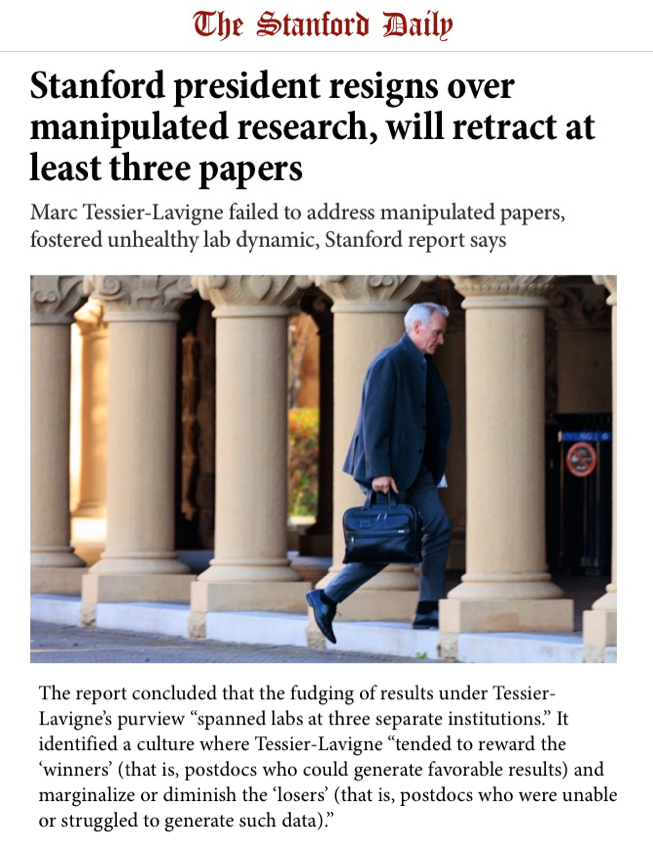
Not able to produce “favorable results” in the lab? You are a “loser”.
Stay in the shadows of those who can bring cool data to the Big Prof.
Sounds familiar? It's not only about this case at Stanford.
It's about academic culture in general:
- Keep pushing for metrics. Quantity over quality. Look for flashy conclusions.
- Skyrocket your profile. Build your research enterprise. Outcompete everyone in your field.
Isn’t it how academia works today? 🤨
▫️
Albert Einstein remarked: “An academic career, in which a person is forced to produce scientific writings in great amounts, creates a danger of intellectual superficiality”.
Peter Higgs said he could NOT replicate his discovery in today’s academic climate: “Not enough peace and quiet in the present sort of climate to do what I did in 1964”.
▫️
Wonder about the results of this “culture”?
1. Thousands of FAKE research articles are published. 30% of all scientific articles may be fake products of paper mills. There is even a special lengthy page on Wiki called “Replication crisis”.
2. Life-draining tenure requirements that fuel the rat race. Why? To ensure the university ranking and recognition is going up.
3. Most PhDs don’t see themselves in science anymore. In many places, you are not required to be creative and knowledgable. Instead, you should demonstrate you can win a race.
Everyone knows it but few things change.
▫️
I am happy that Stanford showed courage and carried out investigation. It is an excellent example of HOW to react to manipulated papers and unhealthy lab dynamic.
It's just another reminder that:
We should STOP focusing on taking “professional selfies”.
We should STOP trading our passion for glory.
Focus on science instead
#AcademicChatter #AcademicTwitter #phdchat
@hasantoxr What is the principle behind the customization with one's own pdf and files? Surely connext is not that large. Fine tuning of the model neither operational. How is the bunch of users' data processed by the model? Thanks
Reminder that my deep learning course @unige_en is entirely available on-line. 1000+ slides, ~20h of screen-casts.
Full of examples in @PyTorch
https://t.co/6OVyjPdwrC
Cher.e.s collègues d' @univ_paris_cite je vous rappelle que l'enquête sur les pratiques pédagogiques des enseignants est toujours ouverte. Prenez quelques minutes pour y répondre : https://t.co/ynQF8ChSh1
@univ_paris_cite une université écologique et responsable.
Vacataires, prestatiaires non payés, personnels surmenés, etc.. vont apprécier. Quelle honte.
Le Conseil scientifique du CNRS dénonce les « entraves administratives » à la recherche, Antoine Petit (PDG) riposte - par @mart1oeil https://t.co/QagLrr17Be via @nextinpact
@canto_sperber Initiative intéressante pour sortir des carcans du système. Mais avec tout la vigilance nécessaire. Au sein du système, les CPES peuvent voir comme une réaction interne aux attentes d'un nombre croissant d'étudiants. Meilleurs voeux.
@_rlg Je viens de compléter ma déclaration de service, qui m'a rappelé que la responsabilité d'une spécialité de M2 m'est comptée pour 12h eTD, sic. Ça occupe au bas mot 25% de mon temps de travail sur l'année. Sans compter stress et pressions de toutes part. Continuer ?
@_rlg Pour prendre les responsabilités pédagogiques au sérieux à tout niveaux, il faut arrêter de parler de "décharge". Une responsabilité de parcours est une "charge" lourde. C'est de "prise en compte de charge" qu'il faudrait parler.