Moving the world to clean, renewable energy costs less than world fossil-fuel subsidies
Worldwide subsidies to the fossil-fuel industry exceed the annual cost of transitioning the world to 100% clean, renewable energy for all energy purposes. This means that eliminating fossil-fuel subsidies more than pays for an energy transition. Let���s look at the numbers. Transitioning the world to renewables costs $6.8 trillion dollars per year. According to the International Monetary Fund, fossil-fuel subsidies alone cost $7.4 trillion dollars per year, or 6.4% of world GDP. These subsidies include $730 billion per year in explicit subsidies and $6.7 trillion per year in tax-code benefits, unpaid air pollution damage, unpaid climate damage, and other unpaid environmental and road damage. So, if we want to eliminate the over 7 million air pollution deaths per year from energy, the growing climate damage from energy, and energy insecurity arising from fossil fuels, one sure-fired way is to stop subsidizing the fossil-fuel industry.
Cost of subsidies
https://t.co/v8c1fFoPM8
Cost of transitioning world
https://t.co/c3RjxqKhcO
Video
https://t.co/d434yPOtA5
Removing all the (US) ocean monitors. Who wants to see those pesti statistics of how much the ocean is rising and in what locations. Degradation of ocean currents!
Science gasps for breath. They are removing all the ocean monitors to understand changes in currents and climate, and the excuse is a master class in obfuscation & double speak . (1/2) https://t.co/vs782YbcI3
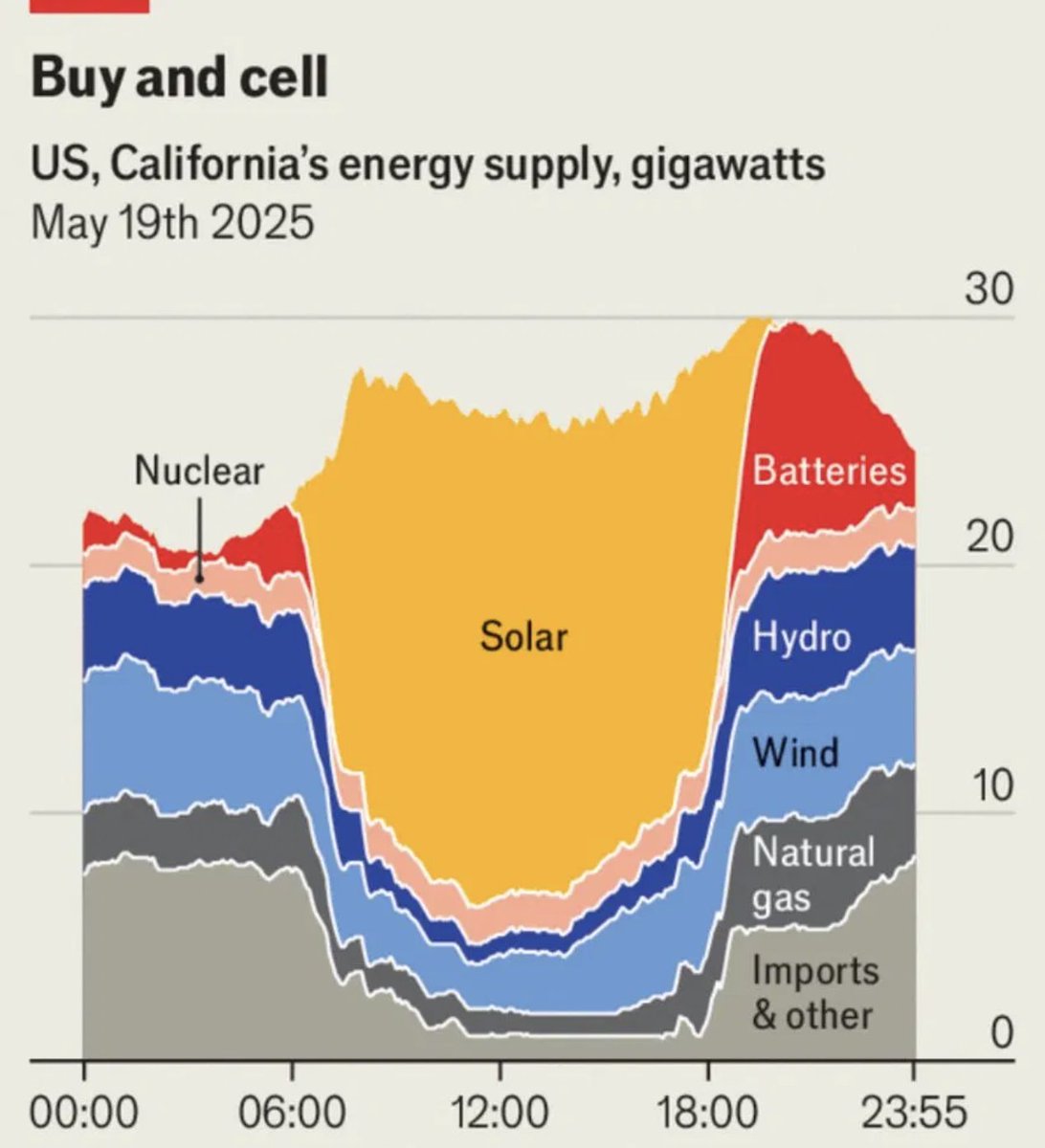
After 5 full months in 2026, WindWaterSolar supply has exceeded demand on 127 of 151 (84.1%) days, including 61 straight.
Gas use is down 61% vs 2023, supplying only 14.7% of demand during 2026, vs 37.2% in 2023.
Battery output is up 331% and solar output is up 55% vs 2023.
In-state WWS has so far supplied 56.2% of demand.
Demand is also down 1.2% vs 2023 despite CA having the 3rd-most datacenters, by far the most EVs, and large numbers of heat pumps.
While CA has high retail electricity prices due to wildfire costs, gas disaster costs, T&D upgrades, high gas prices, and high nuclear prices passed onto customers, CA is the most energy-efficient state in the U.S., so electricity bills are lower than many states, including Texas.
CA also has the most stable grid in the U.S., as evidenced by the lowest wholesale (spot) prices in the U.S.
We should all be furious that as a year of climate fueled events wreak havok on our planet more isn't being done to stem the tide.
Record heatwaves, record floods, record droughts, record wildfires. How many more records before we #ActOnClimate?
#climate#renewables
The experiment is over – we know what does and doesn’t work to address climate
If we look at what has been proposed to address global warming, air pollution, and energy security during the past 25 years, only one solution – electrification of all energy sectors and generation of the electricity with wind, solar, geothermal, and hydro sources -- has made an impact. This solution has reduced enough world emissions and technology costs for the @IPCC_CH, to eliminate its worst-case climate scenario. What are the proposed climate solutions that never worked? (1) Fossil gas replacing coal, (2) ethanol replacing gasoline, (3) carbon capture, (4) direct removal of CO2 from the air by equipment, (5) blue hydrogen, 6) nuclear, and (7) geoengineering. We knew these were poor solutions back in 2009, when they were first evaluated. But, it has taken 17 years to overcome lobbyists pushing these techs. On the other hand, electrification of world transport, buildings, and industry and using clean renewables to provide the electricity while growing energy efficiency, also proposed in 2009, has worked, as evidenced by the world growth in electric vehicles, heat pumps, electric furnaces, and clean, renewable electricity generators. All-of-the-above policies, or let’s try everything and hope something works policies, have failed. Given the short time we have, we should never see another IPCC scenario that includes biofuels, carbon capture, direct air capture, nuclear, geoengineering or their derivatives, blue hydrogen, electo-fuels, or sustainable aviation fuels. We know what works. Let's focus on that going forward.
References
Elimination of most extreme IPCC scenario
https://t.co/y2F2mAbCTU
Components of a WindWaterSolar system
https://t.co/viWz8mbv3v
2009 paper evaluating energy technologies
https://t.co/QzjG2d417e
2009 paper proposing to transition the world to 100% WWS
https://t.co/axJJKhHr5n
More details here: "Still No Miracles Needed"
https://t.co/K6Yd0rGJ9e
Video
https://t.co/2U4FMPUC6l
I try hard every day not to be paralysed by the latest publications on our cryosphere, but today I just can't.
Aaron Cremona and colleagues just published yesterday in The Cryosphere, a paper tracking daily mass balance for every single one of the 1400 glaciers in the Swiss alps from 2010 to 2024.
!! The result is heartbreaking: in 15 years, the Swiss glaciers have lost on average almost 25% of their 2010 volume. /
We are truly entering a new era in Glaciology. So much so that now it is accepted to talk about the upcoming peak glacier extinction.
In Nature Climate Change, Lander Van Tricht et al., introduce the new concept. It is basically the year in which the largest number of glaciers will disappear. At the moment, the paper says that we lose around 750-800 glaciers per year already (!). Global peak exctinction will happen somewhere between 2041 and 2055, with 4000 glaciers lost per year.
It's basically like losing all the glaciers in the Alps ever year.
But here is what is interesting, this peak extinction
depends on what we decide today.
→ At +1.5°C, peak hits around 2041 at around 2,000 glaciers per year. Nearly 50% of today's glaciers still stand in 2100.
→ At +2.7°C, roughly where current national pledges still place us only ~ 20% remain by 2100.
• At +4°C, fewer than 10% survive. In Europe, almost no glaciers would be left.
So.
There you have it.
Limiting warming to +1.5°C more than doubles the number of glaciers that survive the century.
We are starting the UNESCO Decade of Cryosphere, let's make sure it does not become the decade of peak extinction for our mountain glaciers.
A photo of the Trient Glacier, the first glacier 1 ever studied during my younger years, taken in 1891 held up at the same location on Aug. 26, 2019. Denis Balibouse, ETH Library Zurich via Reuters
Also from the @WSJ:
"Worker compensation—wages and benefits—grew 0.8% in the first quarter from the fourth, while domestic corporate profits jumped 2.7%.
As a result, labor’s share of gross domestic income (conceptually similar to GDP) sank to 51%, the lowest since records began in 1947. "
#economy #Inequality
One Day Of Extreme Heat Causes 3,400 Excess Deaths Across India
With temperatures touching 48°C (118 F) in Rajasthan, India is facing intense heatwaves driven by climate change
People are dying in these oven like temperatures
Food crops are being devastated
https://t.co/y9sLtxQvfy
MAGA HEADS ARE GOING TO EXPLODE 🤯
🚨 A new Cato study found immigrants reduced US deficits by $14.5 TRILLION since 1994.
Not increased.
Reduced.
Even undocumented immigrants were estimated to have reduced deficits by at least $1.7 trillion.
The very people Republicans keep villainizing are working, paying taxes, and helping keep the economy afloat while billionaires and corporations dodge taxes with loopholes their lobbyists wrote themselves.
UK proved something fossil & nuclear hardliners desperately don’t want to admit:
A modern industrial economy can rapidly reorganise its grid around wind, renewables, storage & flexibility faster than most “experts” predicted.
Coal collapsed. Wind took the crown. System stable.
The UK story is increasingly becoming one of the clearest examples of a real-world grid flip. Coal built the old system, gas kept it running, nuclear provided steady low-carbon baseload, then wind arrived and started reshaping the entire structure underneath it.
In 2000, the UK grid was still heavily fossil dominated, around two-thirds fossil generation, with nuclear carrying much of the low-carbon load while renewables were barely visible. Wind and solar combined were almost irrelevant. By 2024, renewables generated over half of UK electricity for the first time, fossil fell to a record-low ~32%, and low-carbon power reached roughly 65%.
The real hero here is wind. By 2025, wind became the UK’s largest electricity source for the second year running at roughly 30% of generation, overtaking gas itself. That’s the real structural shift. Not some niche green project, but an entire grid increasingly reorganising around North Sea wind.
Solar is scaling too, adding cheap daytime generation, while batteries, interconnectors and flexibility increasingly become the glue holding the whole system together. Nuclear meanwhile is sliding, but not disappearing. The old fleet is aging, output is declining and decommissioning matters. So the honest framing isn’t “renewables replaced everything,” but rather: wind and renewables overtook fossil while nuclear gradually declined.
What’s fascinating now is that the UK conversation itself is evolving. Renewables are no longer being framed purely as climate policy.
Increasingly they’re being framed as:
👉 energy independence
👉 national resilience
👉 insulation from global gas shocks
👉 decentralised infrastructure
👉 strategic security
That shift became even clearer recently with the proposed “Energy Independence Bill” emerging from the King’s Speech 2026, explicitly linking homegrown renewables, grid infrastructure and energy security together.
The old system concentrated fuel dependency, commodity volatility and geopolitical exposure through imported fossil fuels and large centralised infrastructure. The newer system increasingly spreads it across offshore wind, solar, batteries, distributed generation and interconnectors.
The UK grid didn’t merely transition. It crossed a system threshold. Coal built the old Britain. Wind is increasingly rebuilding the next one, with the grid reorganising itself around an entirely different energy logic.
Kalifornien lädt mittags die Sonne in Batterien und versorgt abends die Städte.
Reiche regelt lieber Solar ab, weil die Netze zu alt und Speicher zu klein sind.
Und tut so, als koste das 3 Mrd. € Abregelung.
Falsch: Der Großteil sind Reservekraftwerke. 🔋
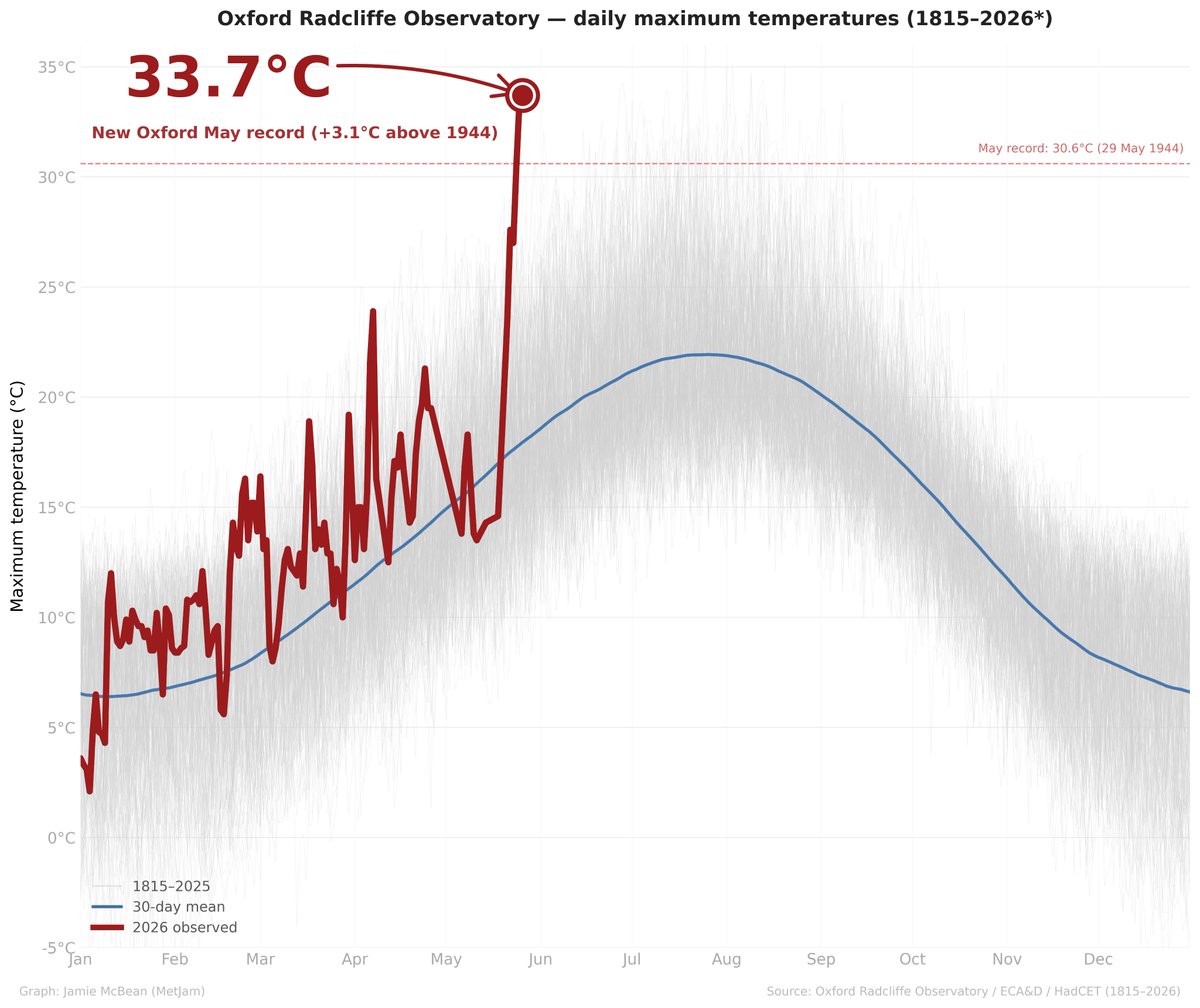
Oxford, the longest running continuous weather station in UK history, with temperature observations stretching back to 1815, has preliminarily broken its maximum temperature record for May yesterday by OVER 3ºC with a temperature of 33.7ºC. Unprecedented in its 211-year history.
World's largest battery-electric container ship (127.8 m x 21.6 m; 19,600 kWh of battery storage) launched.
"the most noticeable change...is the lack of noise"
"the torque output of electric propulsion motors is linear and instantaneous. Acceleration and deceleration are smooth and highly responsive"
"we manage to achieve zero pollution throughout the entire process of transportation, ranging from navigation and berthing to loading and unloading"
https://t.co/VLwaMvMTxk
Scientists are now tracking a major shift deep inside the Pacific Ocean and it could reshape global weather over the next few years
After years dominated by La Niña conditions, powerful signs are emerging that the planet may be heading toward a possible Super El Niño by late 2026 or early 2027
Massive amounts of trapped heat beneath the Pacific are moving eastward through powerful underwater Kelvin waves, driven by intense westerly wind bursts along the equator. In some areas, this warm water stretches hundreds of feet below the surface, silently storing enormous energy
When that heat reaches the eastern Pacific, it rises into the atmosphere disrupting weather systems worldwide
Scientists warn this could trigger:
• Extreme rainfall and flooding in some regions
• Severe droughts and heatwaves in others
• Unstable monsoon patterns affecting food and water supplies
• Sharp spikes in global temperatures
Researchers stress that climate systems remain highly complex, and forecasts are still uncertain. But the current ocean patterns are beginning to resemble the early stages of some of the strongest El Niño events ever recorded
The Pacific Ocean may already be preparing the planet for a dramatic climate shift
Europe is swinging from Arctic frosts to near-35°C heat within days. Some parts will warm by ~15°C in a week. Agriculture does not thrive under violent thermal instability. Ecosystems depend on stability, not a whiplash. This is what climate instability looks like in practice.
China switched on the world’s largest open-sea offshore solar farm in late 2025.
2.3 million solar panels.
2,934 steel platforms.
11,736 piles driven into the ocean floor.
Generates ~1.78 TWh annually, enough to power around 2.67 million people.
Built to survive force-11 gales and sea ice while sitting nearly 8 km offshore.
Oh… and they’re farming fish underneath it too.
Solar above. Food below.
Fossil fuels increasingly looking like old industrial scaffolding from a previous civilisation.
New data from Ember: When renewables drive gas below a 20% grid share in Britain, wholesale power prices crash from £130 down to £60/MWh, a 54% drop
>We're finally breaking the power that volatile natural gas prices have held over electricity bills in so many countries for decades
>Because of marginal pricing rules, the most expensive power plant needed to meet demand sets the price for the whole grid. So gas dictated everything. But superior renewables technology and zero-fuel-cost physics are completely disrupting that system
>When wind and solar surged in Britain last year and pushed gas down to less than 20% of the electricity mix, wholesale electricity prices plummeted to an average of £60/MWh
>When fossil gas ran the show at over half the mix, the price was £130/MWh
>Right now, 15% of Britain's electricity generation has completely decoupled from gas volatility. It's locked in under the Contracts for Difference scheme across 10 GW of operating wind and solar assets
>By 2030, that number jumps to more than a third of the grid. That means 36 GW of clean capacity acting as a permanent, iron-clad shield against international fuel price spikes
This isn't just a British story. It's a blueprint for energy planners anywhere in the world, from Berlin to Jakarta: If your grid relies on commodities shipped across oceans or through pipelines, you don’t have an energy strategy, you have a security threat while handing a blank check to foreign cartels
The Pacific Ocean is sending a powerful warning signal.
Scientists are closely monitoring rapidly rising ocean temperatures across the equatorial Pacific, as forecasts increasingly point toward the development of a potentially historic Super El Niño event.
Some climate models now suggest conditions could rival — or even surpass — the legendary 1877 El Niño, one of the strongest climate events ever recorded.
A major El Niño can disrupt weather patterns worldwide, increasing the risk of: • Extreme flooding
• Dangerous heatwaves and droughts
• Stronger storms and wildfires
• Crop losses and food supply problems
• Serious damage to marine ecosystems
With the planet already experiencing record global heat, experts warn that the next few years could bring unusually intense and chaotic weather across multiple continents.