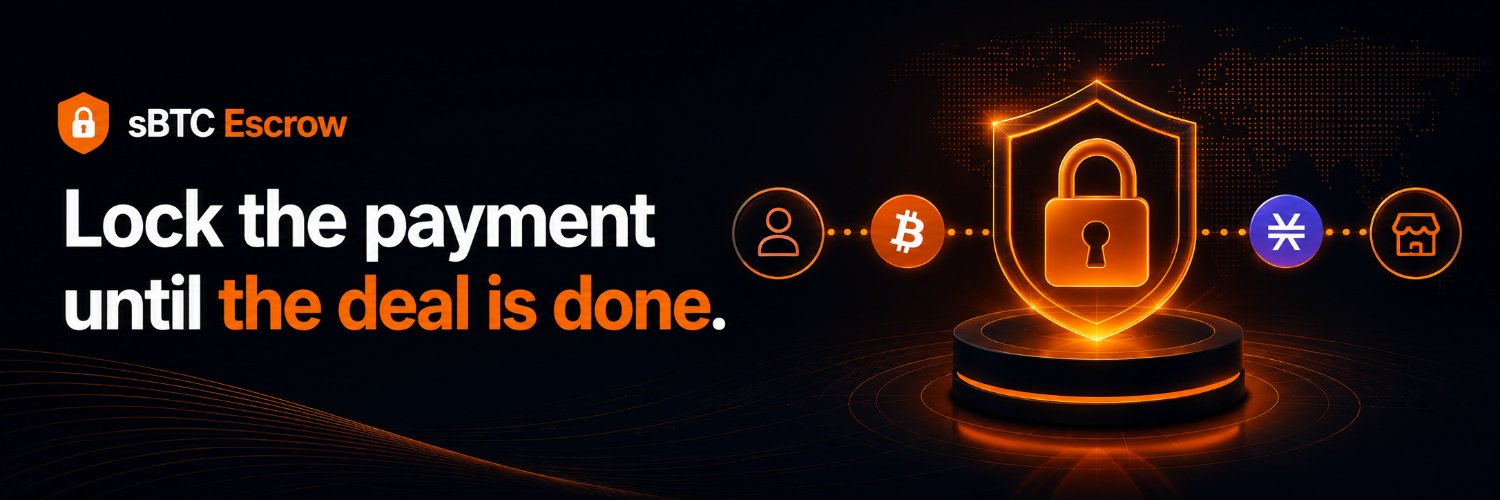
Stacks' Q3 report is mostly earn: 735 BTC into staking, and already earning in the apps. Earning is half of it. The other half is paying people you've never met, and that's the part we build: the payment waits in a contract on Stacks until the deal says it can move.
The Q3 Ecosystem Report is out.
Bitcoin Staking went live, 735 BTC entered across two bonding periods, and Bond 2 filled almost entirely through liquid staking. The staked BTC is already being used and earning in the apps on Stacks.
Full report 👉 https://t.co/4RNhlOTn4p
Earn and borrow had the stage all week. This one's about the third word: paying someone you've never met. The money waits in a contract on @Stacks , and it can only ever go to the buyer, the seller, or the fee fixed when the escrow opened.
@Stacks@muneeb Earn and borrow get the stage time. Transact is where a lot of people actually start: paying a freelancer, or buying from a seller they've never met. That's the part we build on Stacks, with the payment held in a contract until the deal says it can move.
@Stacks sBTC holders at an all-time high is the line we watch. More holders means more people paying each other in sBTC, and some of those payments are between strangers. That's where escrow earns its keep.
@muneeb@Stacks Safety has an everyday version too. When someone pays a person they've never met, the money should wait somewhere both of them can see and neither of them holds.
Non-custodial, read straight from our contract. Money in an escrow can only go to the buyer, the seller, or the fee fixed when it opened, even in a dispute. Our one admin withdrawal only sweeps tokens that were never in an escrow, and the contract checks that first.
@ericdmchugh0@Stacks@StacksEndowment@xyzerobtc Close cousin of it. Two parties who can't verify each other, and whoever moves first carries all the risk. Here the buyer still moves first, but the payment goes into the contract, where the seller can see it before any work starts and it only moves when the deal says it can.
Every deal between two strangers gets stuck on who goes first. Here the client locks the payment in a contract on @Stacks before anything else, the designer can see it's there before he starts, and it only moves when the deal says it can.
Every word on that dial is a real state in the contract, and it only moves when someone with the right to move it does. Refunded and disputed are on there too, for the deals that go the other way. STX and sBTC, on @Stacks
You set the deadline when you open the escrow. If it passes with nothing delivered, you can pull the whole amount back, fee included. And a seller who can't deliver can send it back early.
Check out sBTC Escrow @sbtcescrow
Platform fee is 0% until 30 September, then 0.5%. Only on release, never on refunds. And the rate is locked when you create the escrow, so anything you start this week settles at 0% even if it closes in October.
https://t.co/uZj7ClFbVA
Platform fee is 0% until 30 September, then 0.5%. Only on release, never on refunds. And the rate is locked when you create the escrow, so anything you start this week settles at 0% even if it closes in October.
@sfdstacks@zeroauthdao for anyone building for the scaffold stacks challenge: if your dApp needs a payment held until delivery, you don't have to write the escrow.
npm i sbtc-escrow-sdk, STX and sBTC, mainnet and testnet, MIT. reads need no key, writes take a private key or a browser wallet.
Applying for a Q3 Stacks Endowment grant? The call asks teams to build on what grantees have already shipped, not duplicate it.
If your product needs a payment that releases on delivery, that part is done. Take ours.
npm i sbtc-escrow-sdk
Applications close Sep 23.
Paying a stranger online means somebody has to go first. sBTC Escrow lets the contract go first. The payment waits on-chain until the deal is done.
Live on Stacks.
Set a 30-day deadline on an escrow here, and it expires in 30 days.
We count Bitcoin blocks, not Stacks blocks.
~144 Bitcoin blocks a day, at roughly 10 minutes each.
The deadline means what the screen says it means.
To be clear about the arbiter's limits:
It can only act on an escrow that's actually in dispute, and it can only send funds to the buyer or seller. Nowhere else.
If we never respond, funds don't get stuck. Time-based fallbacks are enforced on-chain, not promised.
Escrow is easy to explain when the deal works. Here's the path when it doesn't.
Either side can dispute; buyer or seller, before or after delivery. The funds stay locked where they are.
An arbiter reviews it and can release to either side, or split it.