Judging by my tl there is a growing gap in understanding of AI capability.
The first issue I think is around recency and tier of use. I think a lot of people tried the free tier of ChatGPT somewhere last year and allowed it to inform their views on AI a little too much. This is a group of reactions laughing at various quirks of the models, hallucinations, etc. Yes I also saw the viral videos of OpenAI's Advanced Voice mode fumbling simple queries like "should I drive or walk to the carwash". The thing is that these free and old/deprecated models don't reflect the capability in the latest round of state of the art agentic models of this year, especially OpenAI Codex and Claude Code.
But that brings me to the second issue. Even if people paid $200/month to use the state of the art models, a lot of the capabilities are relatively "peaky" in highly technical areas. Typical queries around search, writing, advice, etc. are *not* the domain that has made the most noticeable and dramatic strides in capability. Partly, this is due to the technical details of reinforcement learning and its use of verifiable rewards. But partly, it's also because these use cases are not sufficiently prioritized by the companies in their hillclimbing because they don't lead to as much $$$ value. The goldmines are elsewhere, and the focus comes along.
So that brings me to the second group of people, who *both* 1) pay for and use the state of the art frontier agentic models (OpenAI Codex / Claude Code) and 2) do so professionally in technical domains like programming, math and research. This group of people is subject to the highest amount of "AI Psychosis" because the recent improvements in these domains as of this year have been nothing short of staggering. When you hand a computer terminal to one of these models, you can now watch them melt programming problems that you'd normally expect to take days/weeks of work. It's this second group of people that assigns a much greater gravity to the capabilities, their slope, and various cyber-related repercussions.
TLDR the people in these two groups are speaking past each other. It really is simultaneously the case that OpenAI's free and I think slightly orphaned (?) "Advanced Voice Mode" will fumble the dumbest questions in your Instagram's reels and *at the same time*, OpenAI's highest-tier and paid Codex model will go off for 1 hour to coherently restructure an entire code base, or find and exploit vulnerabilities in computer systems. This part really works and has made dramatic strides because 2 properties: 1) these domains offer explicit reward functions that are verifiable meaning they are easily amenable to reinforcement learning training (e.g. unit tests passed yes or no, in contrast to writing, which is much harder to explicitly judge), but also 2) they are a lot more valuable in b2b settings, meaning that the biggest fraction of the team is focused on improving them. So here we are.
@zachmstuck Product wise MER report for last 6 months.
Tells you which products are losing money.
Works better when you can fetch the product wise spend from DPA campaign using the Ads Reporting tool in our Ad Account.
None of this shows up in any course or certification.
You learn it by watching $60K disappear between midnight and 6 a.m. and asking yourself how that happened when the dashboard said performance was strong.
That's the difference between knowing about scale and operating at it.
"Just trust the algorithm."
That advice made us money at $5K/day. At $300K/day, it cost us six figures in a single week before we caught the problem.
Here's how Meta's automation actually behaves when budgets get large:
The operator's rule at scale:
Let automation optimize within the boundaries you set.
Set the time windows.
Set the bid limits.
Set the consolidation structure.
Set the measurement checkpoints.
Then let the machine work inside those walls. That's where automation is powerful and bounded, not blind.
Over the next week or so, I'll be sharing specific operating lessons from managing Meta spend at a level I genuinely didn't expect to reach.
No client names. No dashboards. No hype.
Just what I learned and what I think is worth knowing if you're building toward scale.
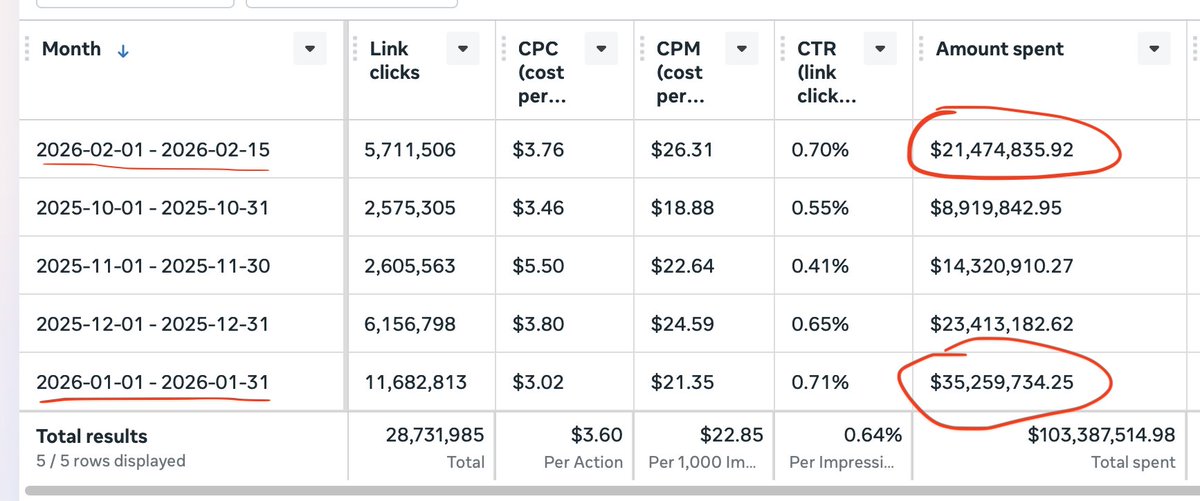
Most Meta ads advice is written by people managing $500 to $5,000 a day.
That's where most accounts live, and the playbook for that level genuinely works.
But the math changes completely when you cross into six and seven figures of daily spend.
Here's what I mean:
I'm sharing this because most content about performance marketing is either:
— Generic playbook advice that works at low scale
— Screenshots with no context
— AI-generated noise
The gap between what's discussed online and what actually happens at scale is enormous.
I want to close that gap a little.