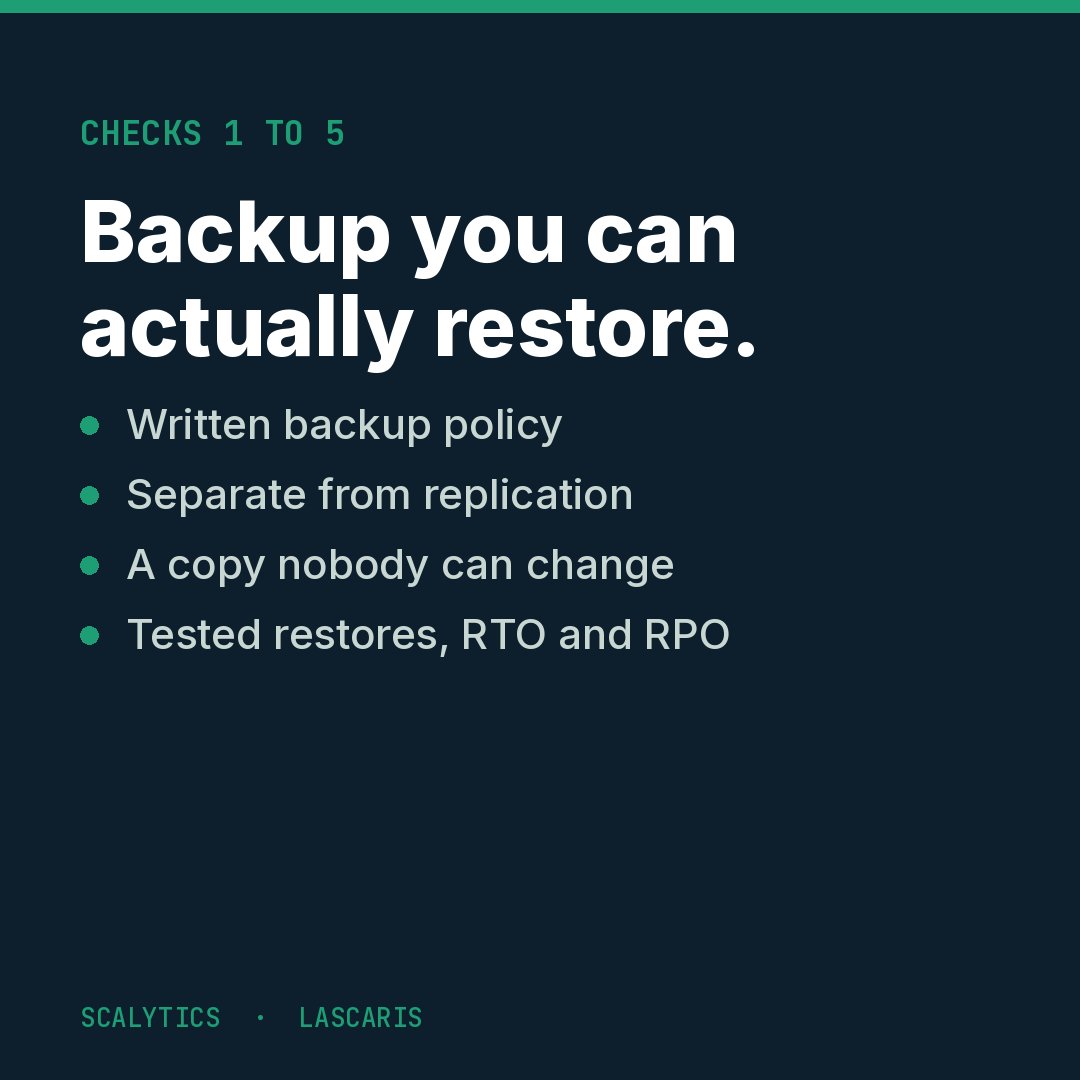
DORA tip: Article 12 asks for backups production can't change, segregation, and tested restores.
Check one thing today: can your production credentials reach your Kafka backup? If yes, it fails segregation.
https://t.co/RMSKNSbHXN
Before your first AI agent goes live, answer 4 questions:
1. Who stops a bad action?
2. Can you show why it acted?
3. Where does your data go?
4. Can you leave?
Our answers: https://t.co/sAke3n9AT9
A bug ships at 09:14 and corrupts events for 47 minutes. Your standby is corrupted too.
With Lascaris you restore the topic as of 09:13 into a new topic, check it, then move consumers over.
https://t.co/ChjBCbOGDt
Your Kafka is replicated. Is it backed up?
Delete a topic and your standby deletes it too. Two clusters, no data.
4 tests a real backup must pass: https://t.co/GloVdVZ8Kt
Every AI agent action should answer 4 questions:
What did the source say?
What is true enough to decide now?
May this decision be made here?
What changed, and who allowed it?
IBM + Confluent Kafka is where those answers live: https://t.co/tOxNrgX6f1
Myth: our Kafka standby is our backup.
Fact: a standby mirrors your mistakes. A misfired topic delete or a leaked producer key reaches it too.
A backup needs a locked copy prod credentials can't touch:
https://t.co/ChjBCbOGDt
@IBM + @confluentinc bring live data to AI.
Before an agent acts, it should answer 4 questions: What did the source say? Is the state fresh? Is it allowed? Who approved it? Lascaris runs all 4 on your Kafka today.
https://t.co/tOxNrgX6f1
Agents that act can also act wrong.
Lascaris runs every action through Sense → Decide → Check → Record on your Kafka. Policy first. Full audit log. Zero bytes leaving your network.
https://t.co/sAke3n9AT9
Your AI agent just blocked a payment.
Can you show what it saw, what it decided and which rule allowed it?
Chat logs are not an audit trail. How we do it: https://t.co/sAke3n9AT9
Agent Level - the agent with database access must not give a full answer set. It’s in topics and KafGraph - the brain. Agents audit other agents responses.
Giving AI agents direct database and API credentials creates unmanageable risk. Learn how to authorize capabilities safely using an event-driven Kafka pattern, Read the full post at https://t.co/LoB9HPrvAs
Traditional ROS-to-Kafka bridges lose operational context. Discover why Lascaris provides the edge-adjacent backbone needed for governed autonomous fleets. Read the full post at https://t.co/17bAAa4brr
Copying live data just to run AI? You're paying a massive storage tax.
We built a 45-second architecture diagnostic for Kafka and Confluent teams.
No fake ROI calculators, just a hard score on your data-movement bottlenecks.
Test your stack: https://t.co/SQjKZOkp1N
Connecting an AI agent to Kafka via MCP provides data access but lacks a governed runtime. Learn why autonomous systems need durable decision state to act safely. Read the full post at https://t.co/02F40g6vIy
Giving an AI agent the right facts does not mean you control what it does next. Because prompts rely on hope rather than enforcement, production AI requires strict execution boundaries.
https://t.co/BrT2ksEhaw
Deep search AI for operations needs current evidence, active policy, and replayable decisions. This essay explains when search is enough and when a stream-edge runtime is required. Read the full post at https://t.co/4bXF8NnLvn
AI fabric is not another data catalog. It is the runtime that keeps context, policy, lineage, and replay attached to each AI decision, so actions stay explainable after the demo ends.
Read:
https://t.co/1xRBa5DuhN
Self-hosting open models works until multiple teams need shared context, prompts, and audit trails.
That's why enterprise LLMs need a runtime, not just a model.
https://t.co/PjEYqD3Ljo