Scamtopsy #3: Binance, 29 Oct 2026.
About $6.34 billion left Binance hot wallets on 11 blockchains in under four hours. The largest theft in crypto history, per Chainalysis.
No smart contract was hacked. No signature was forged. Binance's own signing service, the system that stamps every withdrawal, signed for the thief.
How did they reach it? A tampered installer, a fake job interview, and an internal AI tool, over four months.
On Ethereum they didn't just take money. They took the wallet: 50 signed EIP-7702 notes, one for each of 50 numbers on its counter. One fit, and the attacker's code sat inside the wallet for 3 h 49 m.
Unique or not? North Korea and fake recruiters are nothing new. The size, the AI-tool pivot and the 50-note trick are new.
Not financial advice.
#Scamtopsy #Binance #CryptoSecurity
Scamtopsy #5: Optimizely, 16 Nov 2026.
Neither Optimizely nor Ledger has an official token cashtag. We are not inventing one.
Report URI found malicious JavaScript in 188 of 1,611 Optimizely snippets, at 178 organisations, including Zoom, the BBC, CNN, Salesforce, GitLab, IKEA, HSBC, Equifax and Ledger.
The sites' own code was not changed. A testing script they already trusted was. The attacker wrote a loader into Optimizely Project JavaScript, still served from Optimizely's own servers. Optimizely later said a vulnerability in its Experimentation account signup flow was used to add that code, and that it has fixed the path and notified affected customers.
The payload swapped crypto addresses (including on the clipboard), skimmed cards typed into a site's own forms, stole readable cookies and a screenshot, and on iPhones delivered exploit-kit routers. Hosted payment fields, such as Stripe or Adyen, were out of its reach.
Report URI's wallet snapshot at 19:25 UTC was about $7,040. That is not a complete loss figure. Unique or not? Trusted third-party JavaScript is an old door. This kit, and the signup-flow path, are new.
Not financial advice.
#Scamtopsy #Optimizely #CryptoSecurity
Sources for Scamtopsy #5, Optimizely, 16 Nov 2026. Primary sources only.
Report URI, Scott Helme, 16 Nov 2026
https://t.co/887GmgRs9o
Optimizely status, 17 Nov 2026, 01:02 UTC
https://t.co/mut74V7OQa
Optimizely statement, via BleepingComputer
https://t.co/eItloFBfQl
Salesforce Trust Status, 17 Nov 2026, 03:29 UTC
https://t.co/I1wl9vY1uV
Reuters, via CNA (Equifax comment)
https://t.co/CVdhszdzpA
Hudson Rock, 16 Nov 2026
https://t.co/4NFwpM0dTp
StepSecurity, 17 Nov 2026
https://t.co/Sf7sh3d8Bm
Amirul Cyber, OPTIMJACK, 16 Nov 2026
https://t.co/OdBucWoV9X
Sansec, https://t.co/pnUWpxx9PF, June 2024
https://t.co/hWRGzfYQiy
UK ICO, British Airways penalty notice
https://t.co/cYWK71WNtj
Ledger, Connect Kit incident, Dec 2023
https://t.co/nmZpI5kxIw
On-chain checks: 17 Nov 2026, 06:32 UTC, against the addresses those researchers published.
Scamtopsy #5: Optimizely, 16 Nov 2026.
Neither Optimizely nor Ledger has an official token cashtag. We are not inventing one.
Report URI found malicious JavaScript in 188 of 1,611 Optimizely snippets, at 178 organisations, including Zoom, the BBC, CNN, Salesforce, GitLab, IKEA, HSBC, Equifax and Ledger.
The sites' own code was not changed. A testing script they already trusted was. The attacker wrote a loader into Optimizely Project JavaScript, still served from Optimizely's own servers. Optimizely later said a vulnerability in its Experimentation account signup flow was used to add that code, and that it has fixed the path and notified affected customers.
The payload swapped crypto addresses (including on the clipboard), skimmed cards typed into a site's own forms, stole readable cookies and a screenshot, and on iPhones delivered exploit-kit routers. Hosted payment fields, such as Stripe or Adyen, were out of its reach.
Report URI's wallet snapshot at 19:25 UTC was about $7,040. That is not a complete loss figure. Unique or not? Trusted third-party JavaScript is an old door. This kit, and the signup-flow path, are new.
Not financial advice.
#Scamtopsy #Optimizely #CryptoSecurity
We re-checked the replacement addresses researchers published.
On 16 Nov, the Bitcoin, Litecoin, Ethereum and TRON addresses received funds. The Solana, TON, Bitcoin Cash and Dogecoin addresses are still empty. BNB Smart Chain (same 0x address): Report URI listed 82 USDT; we could not reconstruct that history. By the morning of 17 Nov, the Bitcoin and Litecoin balances, and the remaining TRON USDT, had been moved on.
Report URI's about $7,040 at 19:25 UTC on the 16th is a snapshot, not a total. Some earlier activity on the Ethereum and TRON wallets predates this campaign and is not counted with it. Cards and cookies do not appear on-chain.
Ledger's website was on the list; we found no official Ledger statement, and no evidence that Ledger devices or seed phrases were affected. Equifax, via Reuters, said it had ceased using Optimizely and found no evidence of a compromise to its systems.
The case stays open: the snippets were cleaned, the full impact has not been counted.
Not financial advice.
Scamtopsy #4: $LIT, Lighter, 16 Nov 2026.
About $10.39 million USDC left Lighter's Ethereum contract in one withdrawal. That figure is on-chain, not a total published by Lighter.
The protocol was not hacked. Official SDKs were not hacked. A trader's unofficial signing code reused a secret number, a "nonce", in two signatures. Because those signatures were public, anyone could calculate the API key.
An API key can't withdraw to a stranger, only back to the owner's own wallet. The attacker opened a public pool from the victim account, moved the funds in so the pool shares rose in value, then redeemed those shares and withdrew.
Lighter paused withdrawals, and its Security Council returned about $5 million USDC. Unique or not? The math is old: it broke Sony's PS3 in 2010. The pool path is new.
Not financial advice.
#Scamtopsy #Lighter $LIT #CryptoSecurity
Deposits and withdrawals are back to normal following the deactivation of Guardian Mode by the Lighter Security Council.
More details on what happened: https://t.co/HLIw6E7UdO
Scamtopsy #4: $LIT, Lighter, 16 Nov 2026.
About $10.39 million USDC left Lighter's Ethereum contract in one withdrawal. That figure is on-chain, not a total published by Lighter.
The protocol was not hacked. Official SDKs were not hacked. A trader's unofficial signing code reused a secret number, a "nonce", in two signatures. Because those signatures were public, anyone could calculate the API key.
An API key can't withdraw to a stranger, only back to the owner's own wallet. The attacker opened a public pool from the victim account, moved the funds in so the pool shares rose in value, then redeemed those shares and withdrew.
Lighter paused withdrawals, and its Security Council returned about $5 million USDC. Unique or not? The math is old: it broke Sony's PS3 in 2010. The pool path is new.
Not financial advice.
#Scamtopsy #Lighter $LIT #CryptoSecurity
How the money left, and how it ended.
At 10:11 UTC (18:11 Manila/China time), Lighter's Ethereum contract paid 10,393,056.79 USDC to the wallet Lighter later named. Within six minutes, 10.36 million of it was sold for ETH.
Lighter paused withdrawals at 11:02 UTC (19:02). That evening it said about $5 million USDC had been returned, and at 18:21 UTC (02:21, 17 Nov, Manila/China time) deposits and withdrawals were back to normal.
Slide 7: the math is old (Sony 2010, Android 2013). The public-pool workaround is new.
The case is still open. $LIT
Not financial advice. @scamtopsy
Scamtopsy #3: Binance, 29 Oct 2026.
About $6.34 billion left Binance hot wallets on 11 blockchains in under four hours. The largest theft in crypto history, per Chainalysis.
No smart contract was hacked. No signature was forged. Binance's own signing service, the system that stamps every withdrawal, signed for the thief.
How did they reach it? A tampered installer, a fake job interview, and an internal AI tool, over four months.
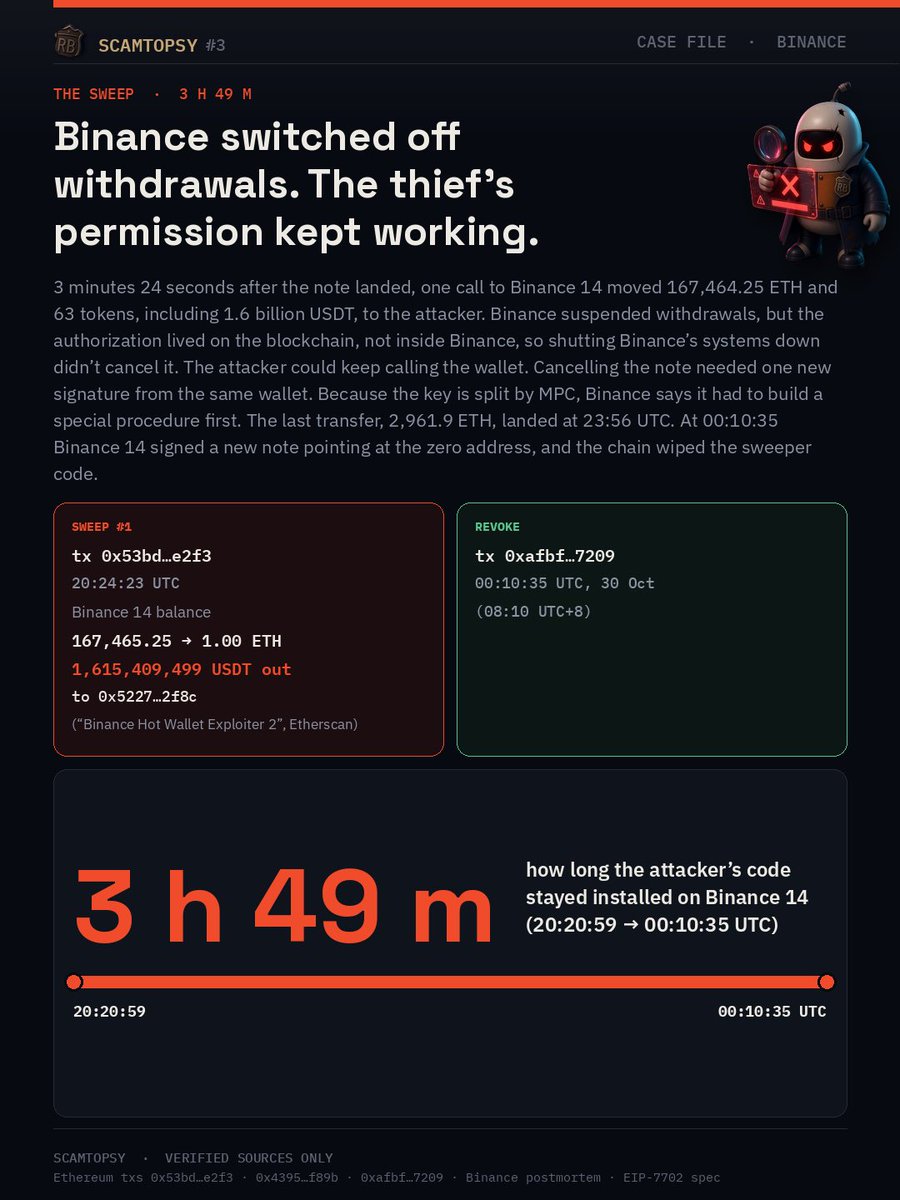
On Ethereum they didn't just take money. They took the wallet: 50 signed EIP-7702 notes, one for each of 50 numbers on its counter. One fit, and the attacker's code sat inside the wallet for 3 h 49 m.
Unique or not? North Korea and fake recruiters are nothing new. The size, the AI-tool pivot and the 50-note trick are new.
Not financial advice.
#Scamtopsy #Binance #CryptoSecurity
How the wallet itself was turned, and how it ended.
EIP-7702 lets a wallet sign a note: "run this code as me." Each note only works if its number matches the wallet's counter. The attacker had 50 signed, 18,914,775 to 18,914,824. The one ending in 809 fit.
3 min 24 s later, one call took 167,464 ETH and 1.6B USDT. Switching off withdrawals didn't cancel the note. Binance revoked it at 00:10 UTC (08:10 Manila/China time).
$2.85B frozen or intercepted, per Binance. The FBI blames North Korea's TraderTraitor. Slide 7: what's new and what isn't.
Not financial advice. @scamtopsy