A Lord of the Shadows & Algorithmic Image Interpretation Machine (ie, a Radiologist). 100% human. No AI/ML.
Stray dogs are a public health menace in India.
First time seeing so much police presence in Salem new/omni bus stand. Efficient and courteous handling of drop offs. Kudos Salem Police @Salemcitypolice
Rs 85,000. For a sticker that measures your face and calls it your brain.
I am a Cardiothoracic Surgeon. Every day I hold a human heart in my hands and I fight to keep blood flowing to the brain. So when I see a device that claims to measure BrainFlow from your temple, I cannot stay silent.
Because what Temple is measuring is not your brain. It is your scalp. And that difference is not small. That difference is everything.
Let me make it simple for you.
Put your finger on your temple. Feel that pulse.
That is your superficial temporal artery.
That artery is a branch of the EXTERNAL carotid artery. It sits OUTSIDE your skull. Its job is to supply blood to your scalp, your temple, your face, your ear.
Your brain does NOT run on this artery.
Your brain runs on the INTERNAL carotid arteries and the vertebral arteries. They go deep inside. They are protected by bone, by muscle, by dura.
So when someone tells you a sticker on your temple is measuring your BrainFlow, I have to ask - how?
Temple uses PPG. Photoplethysmography. The same light-based technology in your smartwatch.
It shines light into the skin and sees how much blood is moving under it. At the wrist, it measures the wrist. At the temple, it measures the temple.
It cannot magically see through skin, scalp, temporalis muscle, skull bone, meninges, and then tell you what is happening inside your cortex. Light does not work like that. If it did, we would not need MRI, CT angiography, transcranial Doppler, or invasive monitoring in cardiac and neurosurgery.
In the OT, when I want to know cerebral perfusion, I do not put a sticker on the temple. I rely on validated monitors, on blood pressure, on cardiac output, on cerebral oximetry that has been tested in thousands of patients.
Because brain blood flow is not the same as scalp blood flow.
When you are embarrassed, your face flushes. Your temporal artery dilates. Does that mean your brain just got smarter?
When you drink coffee, when you exercise, when you get angry, when you stand up from a chair - your scalp flow changes. Your brain flow, thankfully, stays remarkably stable because of autoregulation. That is how we survive.
So if scalp flow and brain flow move together during exercise, that does not prove you are measuring the brain. That just proves both went up because your heart is pumping harder.
This is what we call correlation without causation. And with only 23 healthy volunteers in an unpublished, company-funded preprint, that is not validation. That is a pilot study. In medicine, we do not sell a pilot study for Rs 85,000 ($904 USD).
And then there is this new word - Entropy. A score from 1 to 250 to tell you the cost of being alive.
I can tell you, there is no validated medical biomarker called Entropy that you can measure from your temple and use to predict ageing, longevity, or brain health.
Metabolic carts, VO2 max testing, lab-based calorimetry - these took decades of validation. You cannot replace them with a proprietary algorithm and call it a discovery.
Now, Mr. Goyal says - Temple is not a medical device, it is a wellness device.
Then why call it BrainFlow? Why talk about brain ageing? Why talk about gravity ageing hypothesis? Why talk about cerebral blood flow?
You cannot market like a medical breakthrough and then hide behind a wellness disclaimer when doctors ask for proof.
And the argument - If it does not work, people will return it in 14 days, so it cannot be a scam.
Sir, with respect, a patient cannot know in 14 days if his brain blood flow measurement is accurate. He has no gold standard at home to compare it with. He will see a number go up and down, he will feel reassured, he will think he is tracking his brain. That is exactly the danger.
A 14-day return policy is not peer review. Spending 30 million dollars is not peer review. Having a good reputation in food delivery is not peer review.
In medicine,we have a simple rule. First, do no harm. Second, prove it before you sell.
வாசிப்பு என்பதொரு அனுபவம். அது ஒவ்வொரு வாசிப்பிலும் மாறும். ஒரே புத்தகத்தை மறுமுறை வாசிக்கும்போதே மாறியிருக்கும். ஒரு புத்தகத்தை வாசித்த அனுபவத்தை இன்னொருவரிடம் பகிர்ந்துகொள்வதே இன்னுமொரு தனி அனுபவம். யார் எழுதிய புத்தகம் என்பதுகூட முக்கியம் இல்லை. @paval
https://t.co/RlzqN42Bh1
"AI will replace radiologists." So why did the toppers pick it?
Every radiologist my age has heard it at least once: "AI will replace you."
Among doctors in their 40s and 50s, it is the worry I hear most often. Now look at what 28,000 young doctors just did in NEET PG 2026 Round 1
The numbers
Radiology opened at rank 7. Of the top 100 who took a seat, 28 chose Radiology. Of the top 1,000, 299 did.
Half of all Open MD Radiology seats in the All India Quota went within rank 635. The last one closed at 3,058, the tightest of any major branch.
Within the top 10,000, 1,154 seats went to Radiology. Half of those were DNB or diploma. Toppers were willing to take any route in.
The NBEMS Radiology diploma opened at 1,534 and closed at 15,479, ahead of MD seats in six other branches.
352 doctors took Radiology in deemed universities, paying deemed university fees for it.
Nuclear Medicine, the other imaging branch, closed at 838 for MD.
If the AI threat were real in their eyes, this is not what the list would look like.
What do they see that we are missing?
My reading, as a radiologist and a teacher of 26 years:
1. They see AI as a tool. This generation grew up with software doing half the work. To them, an AI that drafts a report is like a calculator. It makes the radiologist faster, not unnecessary.
2. They know who gets replaced. It is the radiologist who refuses to use AI.
3. They see where medicine is going. More and more clinical decisions now pass through an image. More scans, more follow ups, more screening, more interventional work.
4. They value the life it offers. Teleradiology, flexible hours and a skill that travels across cities and borders.
So is the new generation right?
I think they have sensed something many of us are still debating. The fear was that AI would make radiologists irrelevant. The young doctor's bet is that AI will make good radiologists indispensable.
Data: MCC provisional allotment, NEET PG 2026 Round 1. Open seats.
#NEETPG2026 #Radiology #AIinHealthcare #MedicalEducation #FutureOfMedicine
My dear friends, please, I hope to demand your absolute attention to this matter:
In 2018, my junior from St. John’s Medical College, Bengaluru, Dr. Randall Sequeira (middle in the pic), trekked up a steep, bauxite-rich plateau in Odisha to hold a monsoon health camp in the indigenous Kutiya Kondh village of Kutrumali.
In a piece he wrote then titled "Kutrumali’s Demons," Randall described sleeping under a dripping school roof in freezing fog, borrowing utensils from a local health worker to cook khichdi, and waking up at 6 AM to a line of tribal mothers. He wrote with heartbreak about treating malnourished toddlers with protruding bellies and visible ribs, listening to stories of stillbirths and chronic fevers, while noticing the shiny new solar lights installed by a mining conglomerate eyeing the aluminium ore beneath the villagers' feet.
Comparing his small medical team to hobbits sheltering in the night, Randall worried about the outside forces coming for that fragile village.
Randall stayed with the tribal/ adivasi community to serve them. After St. John’s and an MD in Internal Medicine from SMS Jaipur, he gave up every comfort of urban medicine to live in Kalahandi, recognizing that clinical prescriptions are meaningless when indigenous communities are stripped of their forests, water, and dignity.
On the night of October 16, Odisha police picked up Dr. Randall Sequeira and Dalit activist Laxman Naik at 11 PM from his home in Bhawanipatna. A gentle physician who has spent years trekking up hills to save tribal children is now locked in Rayagada sub-jail under frivolous but draconian charges (attempt to murder, dacoity), simply for standing with Adivasis peaceful protesting the mining of their sacred hills in Sijimali and Kutrumali.
https://t.co/PsxZZCngyV
Odisha Govt. said it will cut down forests to connect tribal villages. But it was a way to bypass green laws and fast track London based Vedanta’s, and Adani's mining plans. Local organisations estimate that around 45 villages depend on these hills and would be affected.
https://t.co/0pATUIYADm
The state has answered with repression rather than dialogue. In the last three years, at least 43 police cases have been filed and over a hundred Adivasis and Dalits, both women and men, have been incarcerated in Odisha jails. For example, from In March and april 2026, 8, 2026, to April 8, 2026, within one month, 24 people were sent to jail, 217 were made accused, and the number of “others” total 1,140. An activist who was not named in the original FIRs, but has since been implicated in about 12 cases, so that bail in one case is followed by arrest in another. This pattern of capture and releases have been used to crush rational dissent.
Dr. Randall understood that being a good doctor means understanding that prescriptions cannot compensate for the denial of land rights, that surgery cannot undo displacement and that no medical can substitute for the basic infrastructure a government has failed to provide.
https://t.co/fOC9AU3jaR
To my fellow medical fraternity, and every citizen with a conscience: a kind physician who embodies the highest ethics of our profession is being criminalized to clear the way for bauxite mining. Please do not let his voice be buried in a sub-jail.
Amplify this, demand due process, and demand the immediate release. Please sign in this form to show solidarity: https://t.co/cgLIoEXExG
If anyone can help out in this situation please reach out to Medico Friend Circle - https://t.co/OT2D2E3DuW
பழம்பெரும் பதிவர் நண்பர் @paval எழுதிய எண்பது சொச்சம் குறுங்கதைகளில் மிகச் சிறந்தவற்றைத் தொகுத்து புத்தகமாக வெளியிட்டிருக்கிறார். அவர் தினமும் எழுதி பதிவிட்ட கதைகளை நாள் தவறாமல் படித்து ரசித்த வாசகனாக இந்தத் தொகுப்பை எல்லோரும் வாங்கிப் படிக்கப் பரிந்துரைக்கிறேன்
#BookReco 📚
நண்பர் @paval எழுதிய 'குறுந்தொகை குறுங்கதைகள்' சிறுகதைத் தொகுப்பு மின்னங்காடி பதிப்பகத்தால் பதிப்பிக்கப்பட்டுள்ளது. குறுந்தொகை வரிகளையும் தாண்டி இன்றைய வாழ்வின் குறுக்குவெட்டுத் தோற்றத்தை படம் பிடிப்பதே இந்தத் தொகுப்பின் முக்கியத்துவம். பரிந்துரைக்கிறேன்.
https://t.co/ROt9Pvtih3
For any athlete or fan, nothing is more satisfying than seeing your country’s flag on top! 🇮🇳
- Just look at the raw emotions of India’s 4x400m Gold-winning team! 🥹🥇
Kiran, from Haryana ran in a village where girls didn't
Poovamma,36, feared she was too old
Prachi wanted a DSP uniform
Vithya, to hear the 🇮🇳 anthem
An team greater than the sum of its parts united to beat Asia's best & win 4x400m relay🥇at Nagoya2026
https://t.co/iD8Wu83Ork
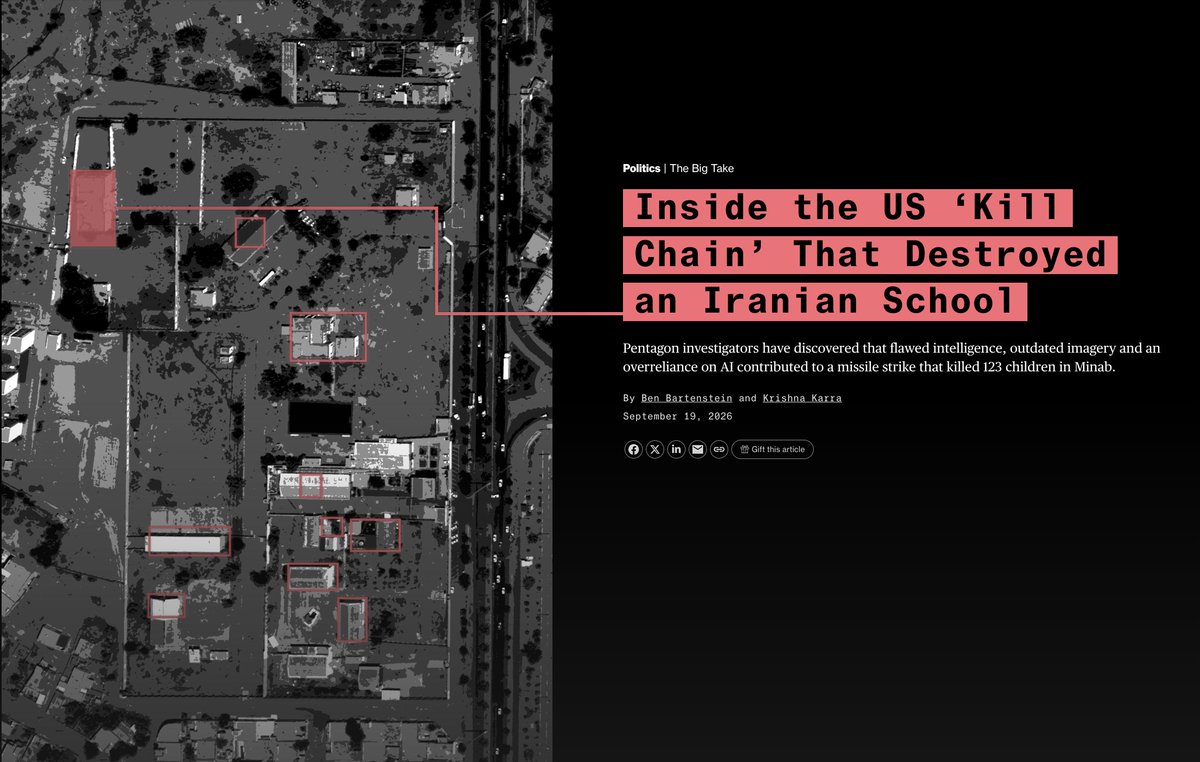
Bloomberg just dropped the most disturbing investigation I have read this year, and every AI builder should read it and take it seriously.
On February 28, two Tomahawk missiles hit an elementary school in Minab, a small town in southern Iran. 156 people died. At least 123 were children. The Pentagon knew within hours that it had bombed a school.
The school had its own website. It was labeled on Google Maps. You could see the soccer pitch from a satellite view. You could see the brightly painted walls. Any 12-year-old with a browser could tell what the building was.
The AI system could not.
Inside US Central Command, personnel were using Palantir's Maven Smart System. It is an AI targeting platform running on a $1.3 billion Pentagon contract, and embedded inside it is Anthropic's Claude.
On day one of the war, more than 1,000 targets went through it in 24 hours. Work that used to take a team hours per target got compressed into minutes.
The satellite imagery Maven was pulling from was seven years old. The site was still tagged in the database as an Islamic Revolutionary Guard facility.
The system spat it out as a recommended day-one target. Humans signed off. The first missile flew. Then a second one landed minutes later to hit the people who came to help.
Investigators later found that some Central Command staff had assumed Maven would flag stale intelligence for them. It did not. Nobody had told it to.
Palantir told Bloomberg the government is responsible for the underlying data. The Pentagon's civilian harm mitigation team, the people whose actual job is to catch a target like this, had been cut back before the war started.
This is not AI going rogue. This is the opposite.
This is AI doing exactly what it was built to do at exactly the speed it was built to do it. And a school full of little girls got vaporized because the humans in the loop trusted the machine more than they trusted their own eyes.
I keep thinking about the version of this story that comes next. What happens when the system is faster. When the target list is not 1,000 in a day but 10,000. When "review" becomes a button the operator has three seconds to hit before the next target loads. When there is no human left slow enough to notice that a soccer pitch is not a helipad.
We are not talking about a spam filter mislabeling an email. We are talking about a system that turned a seven-year-old database entry into two cruise missiles landing on children in the middle of a morning class.
A UN-backed panel has now called it a potential war crime.
In terms of children killed, it is the deadliest American targeting error of the entire 21st century. And according to Bloomberg, some of Defense Secretary Hegseth's own advisors are worried that too much public scrutiny of Maven might slow down its adoption inside the Pentagon.
Read that last line again.
If you build this stuff, you own what it does. You do not get to hide behind "the government owns the data." The whole pitch of your product is that speed and integration save lives. When it takes them instead, that is also on you.
I am not against AI in defense. I am against AI in a hurry. Speed is the entire mechanism that made Minab possible. Every guardrail we already know how to build takes time, and time is exactly what the system was designed to eliminate.
So here is the question I have not been able to stop asking, and I genuinely want to know what you think.
If a piece of software helped kill 123 children in a single morning while behaving exactly as designed, what does "responsible AI" even mean anymore?
El discurso de Alexander Zverev que tenés que escuchar. ❤️
🗣️ “Quiero agradecer a una persona más. Alguien que nunca ve realmente mis partidos, pero que es la persona más importante de mi vida tenística y de mi vida en general.
Cuando tu hijo de 4 años es diagnosticado con diabetes y los médicos te dicen que su vida y su práctica deportiva serán muy, muy limitadas, hace falta una madre muy fuerte para salir de ese consultorio y decir:
‘Mi hijo estará donde quiera estar. Si quiere ser tenista, será tenista. Si quiere hacer otra cosa, hará otra cosa. Pero esta enfermedad no nos va a definir’.
Mi madre es la persona más importante y fuerte que conozco. Hace falta una mujer increíblemente fuerte para hacer lo que ella hizo”.
Professional racing driver Ollie Millroy thanks competitor Loek Hartog for saving his life after getting into a fiery crash over the weekend in China.
Millroy says he'd be dead if Hartog hadn't jumped out of his car to pull him out of his burning car.
"I am still alive tonight, entirely thanks to one man. Loek Hartog stopped instantly with no flag marshalls or fire crews in sight, and risked his own life to get me out of the car."
"I don’t remember anything between 30 seconds before the crash and 1 hour after it, but I will remember his incredible act of bravery for the rest of my life..."
"I’m laying here tonight with 5 broken ribs, broken collar bone, broken hand and finger and a bruised lung, but it could have been much worse."
"Thank you Loek. I owe you my life for your selfless act today."