Şu #indikatör'ü #ücretsiz paylaştım :)
#Twitter'da karşıma ücretli #indikatör reklamları veya paylaşımları çıkınca sinir oluyorum :) Millet bir umut alayım da kullanayım belki işe yarar diyor, sonuç hüsran...Yazıktır be...Piyasanın durumu belli, para kolay kazanılmıyor...#Teknik #Analiz bilmeyen herkes çok daha büyük risk taşır. #Temel #Analiz desen #Bist'te pek işlemez...Tüm indikatörlerim ÜCRETSİZDİR...İnatla da devam edeceğim...
Claude code’s /security-review is just a Skill, and the whole prompt is in this repo
It’s p generic and imo you can tailor it to each repo to language you’re scanning to get better results
https://t.co/1a4puZSASL
In Cuba, people pay one dollar for a USB stick.
What is on it: all of Wikipedia. Every article. Every image. 7 million entries.
In North Korea, the same kind of stick is smuggled across the border in plastic bottles.
In US and European prisons, inmates use it because they cannot touch the open internet.
The software that makes those sticks work is called Kiwix. A Swiss developer named Emmanuel Engelhart wrote it in 2007 in Lausanne because four billion people on Earth cannot read Wikipedia. Nineteen years later he is still shipping. Mostly unpaid.
The repo:
→ 5,613 stars across the org
→ GPL-3.0 licensed
→ 100+ languages
→ 4 million users worldwide
How it compares:
ChatGPT Plus → $240/yr, online only, blocked
Britannica → $74.95/yr, online only, blocked
Kiwix → $0, offline, works anywhere
You download one file. 109 gigabytes. It fits on a $12 USB stick. That stick now contains roughly a thousand years of human knowledge.
Here is the wildest part:
The Wikimedia Foundation reported in 2018 that 80% of Kiwix users were in emerging countries. North Korea bans the internet but they cannot ban a USB stick already inside the country. In Cuba, vendors sell weekly Wikipedia updates for one dollar. The Foundation called it "connecting the unconnected."
Engelhart's mission, written in a 2014 email:
"Our users are sailors on the oceans, poor students thirsty for knowledge, world's citizens suffering from censorship or free minded prisoners."
The honest part: 109 GB of disk space. UI looks like 2010. Updates every few months, not real time. And every byte is Creative Commons or public domain. Zero piracy. Zero DMCA risk.
Lausanne, Switzerland. One Swiss developer. Every human library, in your pocket, even when the lights go out.
A 22-year-old graduate student in Kazakhstan got so angry at journal paywalls in 2011 that she built a pirate website holding 88 million scientific papers, and last month she turned the whole thing into an AI that lets you ask one question and get the actual research as the answer.
Her name is Alexandra Elbakyan, and the website is called Sci-Hub.
The AI she just launched is called Sci-Bot. It lives at https://t.co/6w0IBtOEYB and almost nobody outside academia knows it exists yet.
Here is the story, because it is one of the strangest things to happen in science publishing in the last 50 years.
Elbakyan was born in Almaty in 1988, the year the Soviet Union started to collapse. She taught herself programming at 12. She read Soviet science books that explained things her family used to call miracles. She got into computer security at university and graduated in 2009 with a degree she barely needed because by then she was already a serious hacker.
Alexandra moved to Moscow that fall. Then Germany. Then a research internship in the United States. She was working on brain-computer interfaces, the kind of research that requires you to read hundreds of papers a year just to keep up with the field.
And every single one of those papers was locked behind a journal paywall that cost between 30 and 50 dollars to read once.
She did the math. A graduate student in Kazakhstan could not afford to read science.
The first thing she did was learn how to get around the paywalls one paper at a time. She passed the trick around to other students. They asked her for papers constantly. She got tired of doing it manually.
So in September 2011, in three days, she wrote a script that automated the whole thing. A user pastes a DOI. The script logs in through a donated institutional credential. The paper comes back free. The website caches it.
The next person who asks for that paper gets it instantly because the previous request already saved a copy.
That was Sci-Hub. Three days of code. One graduate student. Done.
15 years later, the cache holds 88 million scientific papers. Almost every piece of scholarly literature published before 2020 is sitting on her servers. Researchers in 190 countries use it. Studies in Nature have shown that roughly half of all academic paper downloads worldwide now go through Sci-Hub, not the publishers who actually own the copyrights.
Elsevier sued her in 2015 and won a 15 million dollar judgment. She did not pay. The American Chemical Society sued her and won an injunction. She did not comply. Courts in India, France, Russia, and the UK have tried to block the domain. She just moves it. https://t.co/3sAWJzNe8I. https://t.co/tGIETesZ8i. https://t.co/H5WQ1f9lqR. The site has had over 20 domains and is still up.
Nature put her on its list of the 10 people who mattered most to science in 2016. The New York Times compared her to Edward Snowden. The Verge called her the pirate queen of science.
She has not been to the United States in over a decade because she would be arrested at the airport.
The Sci-Bot launch in April 2026 is the part that nobody is talking about.
She took the 88 million paper database and put a small language model on top of it. You ask a question in plain English. The model searches the entire shadow library, pulls the relevant papers, synthesizes an answer grounded in real citations, and links you to the full text of every source. Free. No login. No institutional credential. No paywall.
Three real scientists tested it for a Chemical and Engineering News article last month. They asked it medical and chemistry questions. The radiologist said the answer he got was usable. The chemist said the gaps in recent literature were obvious but the older science was solid. The publisher community is furious.
What she built is what the paid academic AI tools are trying to build. Except the paid ones are limited to what their parent publisher legally owns. Hers is limited to almost nothing.
Alexandra still lives somewhere in Russia. She does not give her address. She does not do video interviews. She gives talks over Skype with the camera off. She runs the largest illegal library in human history from a laptop and a donation page.
A graduate student who could not afford to read science built the system the entire scientific community now quietly depends on.
The publishers have spent a decade trying to shut her down.
She just shipped an AI that makes their entire business model outdated.
A Claude Code skill bundle for bug hunting and external red-team work - 51 skills, 15 slash commands, 574+ disclosed-report patterns curated across 24 vulnerability classes, plus enterprise identity + infrastructure attack matrices. https://t.co/MpxsmCqaM3
@Nishan_011 я уже сто раз писал под такими постами и ни разу никто ничего не прислал, поэтому на каждый такой пост я буду кидать жалобу о мошенничестве.
SOMEONE BUILT THE MOST COMPREHENSIVE CLAUDE CODE SYSTEM ON THE INTERNET AND OPEN SOURCED THE ENTIRE THING.
55 agents. 208 skills. 72 slash commands.
Built and won at the Anthropic x Cerebral Valley hackathon.
10 months of daily real-world use before it was ever published publicly.
This is not a collection of prompts someone threw together over a weekend.
This is a production-grade agent harness that has been stress-tested across thousands of real sessions and refined until it works reliably at scale.
Here is what you actually get when you install it.
55 specialized agents each built for a specific function. Not one agent trying to do everything. 55 agents each doing one thing exceptionally well.
208 skills covering every repeating workflow a serious builder runs. Research. Code review. Documentation. Testing. Deployment. Content. Analysis. Each one built once and callable forever.
72 slash commands that compress complex multi-step workflows into a single word.
A security scanner called AgentShield that audits your entire Claude Code configuration for vulnerabilities, misconfigurations, and injection risks across 5 categories before you deploy anything.
Cross-harness support for Claude Code, Codex, Cursor, OpenCode, and Gemini so the investment you make in this system is not locked to one tool.
A dashboard GUI with dark and light theme so you can monitor your entire agent operation from one screen.
Memory persistence that carries context across sessions so you never start from zero.
1,282 tests. 98% coverage. 102 static analysis rules.
This is the infrastructure layer most builders are trying to assemble piece by piece from 15 different repos.
Someone already built the complete version. Won a hackathon with it. Then gave it away for free.
The builders who install this this weekend will have a Claude Code setup that took 10 months of daily iteration to build.
Installed in one afternoon.
https://t.co/2Er9PREAih
Star it. Fork it. Build on top of it.
Bookmark this.
Follow @cyrilXBT for every Claude Code repo worth your weekend the moment it surfaces.
Militant : « Vos vaches rejettent du carbone dans l'atmosphère. »
Agriculteur : « D'où le tirent-elles ? »
Militant : « Pardon ? »
Agriculteur : « Le carbone. D'où la vache l'a-t-elle tiré avant de le rejeter ? »
Militant : « En… mangeant ? »
Agriculteur : « En mangeant de l'herbe. Et d'où l'herbe l'a-t-elle tiré ? »
Militant : « Du sol ? »
Agriculteur : « De l’air. L’herbe l’a puisé dans l’air au printemps dernier. La vache a mangé l’herbe. La vache en a rejeté une partie. Il est retourné dans l’air d’où il venait. »
Militant : « Mais il finit quand même dans l’atmosphère. »
Agriculteur : « Ça y retourne. Il y a une différence entre une chose qui va quelque part et une chose qui y retourne. Vous avez décrit un cercle et cela vous effraie. »
Militant : « Alors, ne prenez pas de vache. »
Agriculteur : « L’herbe meurt quand même en automne. Elle pourrit là où elle tombe. Le carbone retourne dans l’air de toute façon, mais sans que personne ne se nourrisse entre-temps. »
Militant : « Ce n’est pas si simple. »
Agriculteur : « C’est de l’herbe, une vache, de la respiration, de l’herbe. Ou bien de l’herbe, de la pourriture, de l’air, de l’herbe. Même cycle, moins de repas. Si ça te semble compliqué, je t’conseille de ne pas t’aventurer dans le cycle de l’eau. Celui-là, il y a des nuages dedans. »
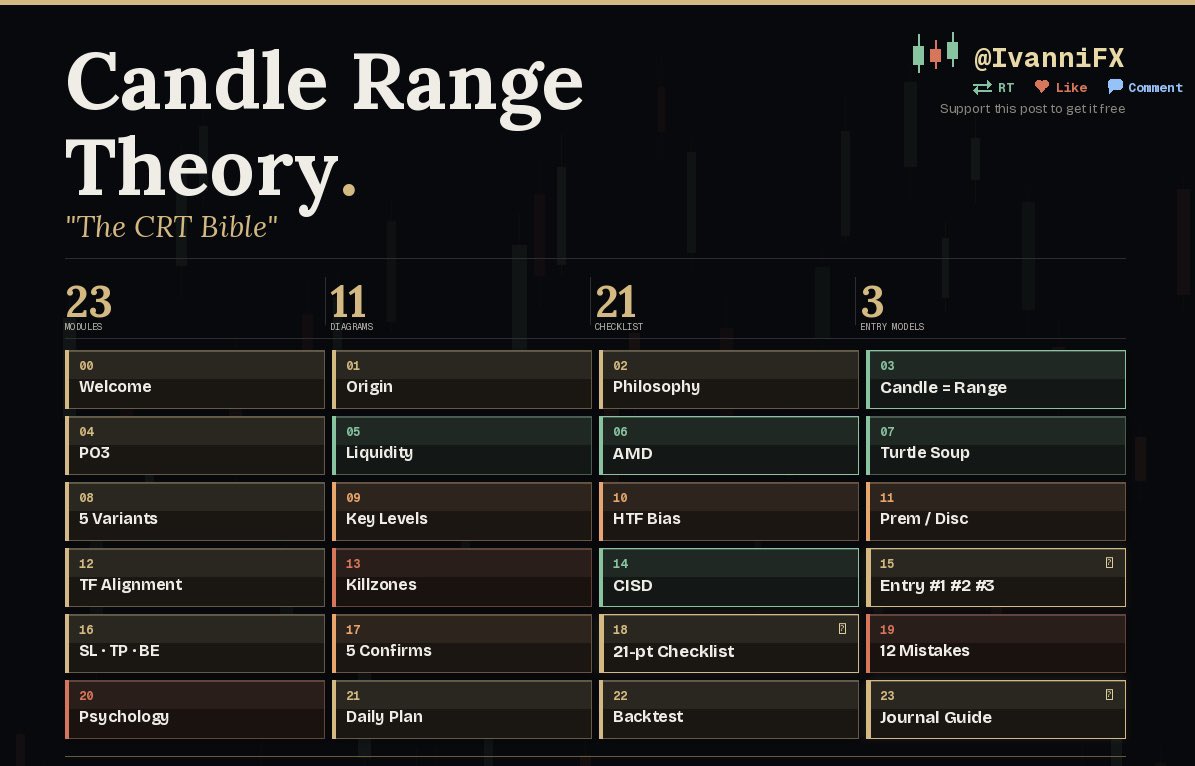
I just finished building something I wish I had 3 years ago.
A full CRT course. 23 modules. From scratch.
I’m giving it away for free 👇
What’s inside:
→ Candle as a range (the core idea)
→ PO3, AMD, Turtle Soup TWS vs TBS
→ 5 CRT variants and when to trade each
→ CISD — the concept nobody explains well
→ Entry Models #1 #2 #3 with full diagrams
→ 21-point checklist (not 21/21? don’t trade)
→ Trading psychology backed by real science
→ Journal fields guide so your data means something
23 modules. Zero filler.
I want to see the support before I drop it.
🔁 Retweet
❤️ Like
💬 Comment “CRT”
If this blows up, I release it this week.
The CRT Bible.
I'm officially a Trencher now 🔥
just locked in early access to @TrenchersAI
Let's run it up together!
join the trenches → https://t.co/nx94FJVqmc
#TrenchersAI https://t.co/9rbrivUXzd
Usage limits are up, effective today we're:
1) Doubling Claude Code's 5-hour limits for Pro, Max, Team and seat-based Enterprise plans
2) Removing peak hours limit reduction on Claude Code for Pro and Max plans
3) Substantially raising our API rate limits for Opus models
В 2008 этот ролик фактически запретили у нас в России, посчитав "слишком агрессивным" по отношению к нашим "западным коллегам и партнёрам".
Выкинули эту песню "Дискотека "Авария" из всех тогдашних "номинаций" и "хит-парадов".
Время показало, что парни были правы.
Смотрите сами.