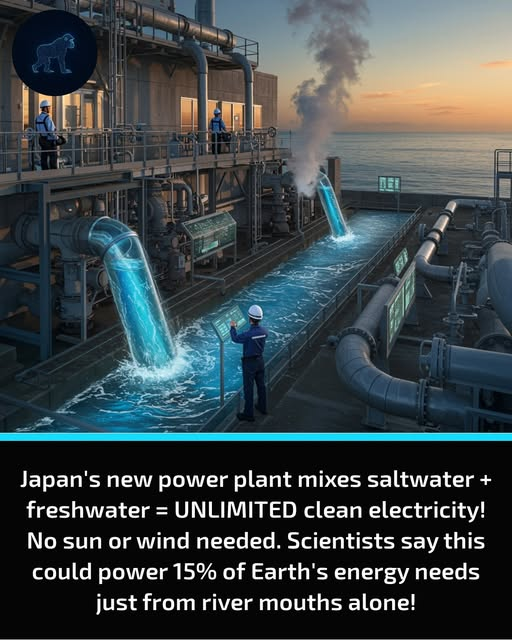
Japanese scientists have discovered a way to generate electricity by mixing saltwater and freshwater.
In August 2025, a facility harnessing the energy of mixing saltwater and freshwater, known as "blue energy," began operations in Fukuoka, Japan.
While Japan is a leader in advancing this technology, the underlying scientific principle is a long-standing concept that utilizes osmosis to generate power.
Specifically, the process is a type of pressure-retarded osmosis (PRO). It involves the following steps: a special semi-permeable membrane is used to separate two water streams with different salt concentrations. One side uses concentrated seawater, which is made even saltier by using waste brine from a nearby desalination plant. The other side uses treated wastewater with a low salt concentration.
Unlike solar or wind energy, this method works continuously, day and night, independent of weather conditions. Researchers estimate that if implemented globally at river mouths, it could provide up to 15% of the world’s energy needs — a staggering potential for clean, sustainable power.