Any remaining faith I had in our institutions is gone.
The Epstein files were the final straw for me.
For years, I’ve tried to give the system the benefit of the doubt. Assume incompetence over malice. Assume there are things happening behind the scenes. Assume eventually the truth comes out.
Cope.
At some point you have to stop lying to yourself.
When the most powerful people on earth are connected to something this dark, and the result is sealed documents, redactions, quiet settlements, and zero real accountability, you start to see the pattern.
There’s a system for regular people, and there’s a different system for the elite.
We have seen it with monetary and economic policy. Now we see it is systemic.
This isn’t about left vs. right. It’s not partisan for me. Corruption protects itself. Power protects power. That’s the constant.
And when that realization sets in, you have a choice.
You can scream about it. You can argue online. You can hope the next election fixes it.
Or you can quietly opt out where you can.
For me, that’s Bitcoin.
Not because it’s some utopia or because it fixes evil. But because it doesn’t require me to trust the same institutions that have repeatedly shown they don’t operate by the same rules for everyone.
No special access.
No closed-door monetary policy.
No selective bailouts.
Just open code and rules that apply to everyone.
Maybe that sounds dramatic. But I don’t see it as rebellion. I see it as self-preservation.
When trust erodes, capital moves. It always has.
Some people exit geographically.
Some exit socially.
Some mentally check out.
I’m exiting financially.
You don’t need to agree. But if you’ve felt that shift lately – that quiet realization that the people in charge aren’t playing the same game as the rest of us – you’re not alone.
For me, Bitcoin isn’t about getting rich.
It’s about no longer asking permission.
I want to die completely broke.
When I tell people this, I usually get one of two reactions. Either they assume I’m joking, or they assume I’ve lost my mind. Sometimes both. So let me clarify before anyone forwards this to a financial planner in panic. I don’t mean reckless. I don’t mean irresponsible. And I definitely don’t mean unprepared. What I mean is that I don’t want to die having optimized my entire life around a number that only matters when my ability to actually use it is gone.
We talk constantly about the time value of money. A dollar today is worth more than a dollar tomorrow because it can be invested, compounded, and put to work. Time increases its potential. Life, however, works in the opposite direction. Time doesn’t increase the value of experiences – it usually decreases it. Certain experiences are simply more accessible, more enjoyable, and more meaningful at specific stages of life, and no amount of money later can fully replicate them.
When you’re younger, you’re sitting on an asset that quietly depreciates every year: health, energy, physical capability, curiosity, and a tolerance for discomfort. A dollar at 35 buys a fundamentally different life than a dollar at 75. Pretending otherwise is comforting, but it’s not honest. Life has a time value too, and it doesn’t compound.
When people hear “die broke,” they often picture irresponsibility or excess. That’s not what I’m describing. I’m talking about intentional depletion – using money as a tool to maximize life while you’re able to live it, rather than stockpiling it indefinitely for a future version of yourself that may not exist in the way you imagine. Saving matters. Security matters. Optionality matters. But past a certain point, additional saving delivers diminishing returns while the cost of waiting keeps rising.
Saving for retirement makes sense. Over-saving at the expense of living doesn’t. We’re taught to treat retirement as the main event – sacrifice now so you can enjoy later. Delay life so you can eventually live it. But that framework assumes a lot: that your health cooperates, that your energy remains, that your relationships are intact, and that your interests don’t change. Most of all, it assumes experiences are interchangeable across time. They aren’t.
The trip you take at 35 is not the same trip at 70, even if it’s first class. Skiing with your kids, traveling with friends, pushing your body, starting something new – these things are perishable. They don’t age gracefully, and postponing them doesn’t preserve value. It destroys it.
There’s also a strange moral judgment baked into personal finance culture that equates delayed gratification with virtue and present enjoyment with failure. I don’t buy that. There’s a meaningful difference between consumption that disappears and spending that compounds in memory, perspective, relationships, and confidence. Experiences don’t show up on a balance sheet, but they pay dividends in ways that money never can.
Your memories are what matter in the end, not your net worth.
This way of thinking has also changed how I view legacy and what I want to give my kids. I don’t care about leaving behind generational wealth the way I once did, especially not as a lump sum that shows up only after I’m gone. If I’m going to give them anything meaningful, I’d rather do it while I’m alive – when it can actually shape who they become.
I want to use my resources earlier to give them experiences, exposure, and tools that help them build confidence, curiosity, and resilience. Travel that broadens perspective. Opportunities that stretch them. Lessons about money, risk, work, and independence learned through experience, not inheritance. I want them to understand how to create value, how to adapt, and how to rebuild if things fall apart.
I still want to leave them with enough. But “enough” isn’t a massive number waiting at the end of my life. Enough is a foundation, plus the skills to stand on their own. Unlimited money can become a crutch. Capability is freedom. I’d rather they inherit confidence than comfort – and I’d rather be around to help them learn it than hope they figure it out after I’m gone.
Everyone talks about the risk of running out of money. Almost no one talks about the risk of running out of time. And even less people talk about the tragedy of wasting valuable hours of your youth working for money that will never get spent.
What a waste of your valuable time.
We’re very good at smoothing consumption – using money, planning, and credit to keep life stable while quietly deferring the things that actually make it meaningful. From the outside, everything looks fine. Under the hood, life is being postponed.
The biggest gamble isn’t that you won’t have enough someday. It’s that someday arrives and you’re no longer capable of the life you spent decades planning for.
I want to die broke not because I don’t value money, but because I value life more. I want to use my resources to create memories while they’re available, not just affordable. To save enough to be secure, but not so much that I defer living indefinitely. To leave my kids with a foundation, not a cage.
I don’t pretend this is the right answer for everyone. I don’t even pretend it’s my final answer. But if the time value of money matters, then the time value of life matters more.
Do 4 hours of deep work per day
Walk 10,000 steps per day
Exercise 3x/week
Save 20% of your income
Sleep 8 hours
Read 10 pages per day
Do this consistently and you will be ahead of 99% of the population.
#Bitcoin
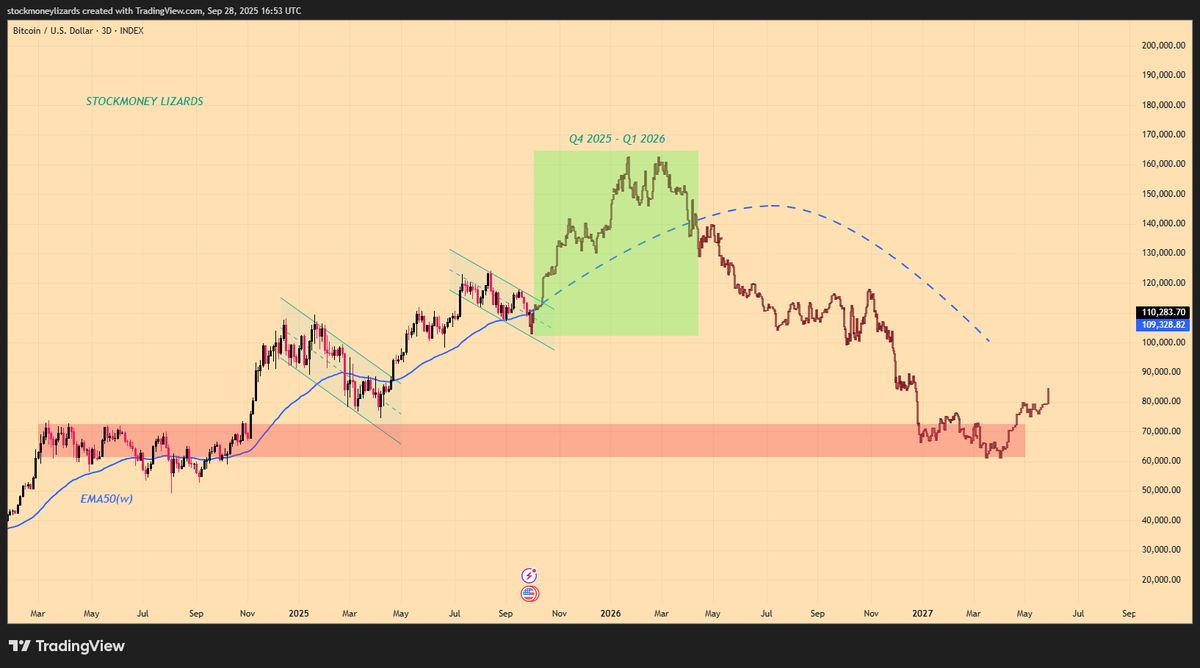
I feel like there's a lot of confusion right now (once again) regarding the current correction.
Some call it the beginning of the bear market (once again, like they did after we hit 72k; like the did after we hit 100k...). Here's my personal potential roadmap, and the reasons why I believe in this as a possibility:
- Q4 should be bullish. We are currently retesting the weekly EMA50. A pullback to around 105k wouldn’t surprise me - that level should act as solid support. From there, I expect another leg up into year-end.
Why? Because whales are still buying. Because Money has not fully rotated into Altcoins ("Altseason") yet. Because important metrics have not flipped bearish yet (e.g. MVRV Z score). Because Q4 is historically bullish. Because Money supply is increasing.
- That move could also trigger ETH/Altcoin strength and maybe the start of altseason running into Q1 2026. An extension of the bull market into 2026 is likely. BTC top for me 150 - 200k (conservative and bull case).
- After that? Probability rises for a larger correction or even a new bear phase. I don't want to make predictions now where this could end. I guess we have to look. But maybe somewhere between 60 - 80k could be a good zone next year. But this is just a guess.
let’s see how it plays out.
NFA. DYOR.
#Bitcoin
don't overcomplicate it. All you need is 2 Moving averages and the monthly timeframe.
Background:
🫴Once BTC crosses above WMA14 (monthly, red line), BTC is officially in a bull market. Just HODL or buy dips.
💸 Once BTC crosses under WMA14 --> sell signal (or HODL through the bear market if you're a no-seller ("you never sell your bitcoin")
💰Once BTC crosses under the 200w EMA, go all in (or buy at least a decent amount). Generational bottom is in (+/-10-15%)
NFA. DYOR.
Ethereum is compromised because it uses proof of stake.
@LynAldenContact explains this well:
“[staking ETH] would be like a political system where you get a vote for every hundred dollars you have, and then also get paid a dollar by the government for casting each vote. Mary the high school science teacher with $20,000 in net worth gets 200 votes, and earns $200 from the government for voting. Jeff Bezos, with $200 billion in net worth, gets 2 billion votes, and earns $2 billion from the government for voting. He’s a more valuable citizen than Mary, by a factor of a million, and also gets paid more by the government for already being wealthy.”
Proof of stake is just a recreation of the abstract power hierarchies that already exist today. The rich get richer.
You know the best thing about being a Bitcoiner?
You no longer pretend.
You stopped pretending your boss is a “mentor.”
You stopped pretending your girlfriend respects your job.
You stopped pretending stocks are “ownership.”
You stopped pretending your Roth IRA will matter in 40 years.
You stopped pretending the war is “over there.”
You stopped pretending your life was fine.
You broke the spell.
You read The Creature from Jekyll Island at 2am and couldn’t sleep.
You watched Saylor on Tucker and felt your ancestors stir.
You sat in your one-bedroom apartment with a laptop, a cold black coffee, and a cracked iPhone screen,
staring into the void, realizing you’re in a digital serfdom.
You didn’t buy Bitcoin for gains.
You bought it because your dad spent 40 years in a factory and still couldn’t retire.
Because your bank flagged a $600 Venmo transaction like you were Pablo Escobar.
Because a man in a suit on CNBC told you inflation was "transitory" while eggs hit $8.49.
Because you saw a generation laugh at masculinity while begging the government for rent relief.
Bitcoin didn’t just change your portfolio.
It REWIRED your SOUL.
You eat steak now. You lift.
You don’t trust anyone with a lanyard.
You value time, energy, freedom, and truth.
And for the first time in your life, you feel dangerous again.
Bitcoin didn’t make you rich.
It made you sovereign.
And that’s what they’ll never forgive you for.
Do 4 hours of deep work per day
Walk 10,000 steps per day
Exercise 3x/week
Save 20% of your income
Sleep 8 hours
Read 10 pages per day
Do this consistently and you will be ahead of 99% of the population.
The real luxuries in life:
time
health
a quiet mind
slow mornings
ability to travel
rest without guilt
a good night's sleep
calm and "boring" days
meaningful conversations
home-cooked meals
people you love
people who love you back
Do 4 hours of deep work per day
Walk 10,000 steps per day
Exercise 3x/week
Save 20% of your income
Sleep 8 hours
Read 10 pages per day
Do this consistently and you will be ahead of 99% of the population.
Storytime 📘
Say you bought X coin for $10 dollars
It goes to $30
You say ''i'm never selling'' so you don't sell
It goes back down to $10
You feel stupid for not selling
Well.. what if you sold it at $30 and then went to $80
You would also feel stupid for selling
Moral of the story... you're always gonna feel stupid 🤝
The problem with the world today is that intelligent people are full of doubts, not because they’re wrong, but because they understand complexity.
Meanwhile, those who lack understanding are full of confidence, and their certainty is mistaken for wisdom.
Social media amplifies this issue, rewarding boldness over thoughtfulness, making false confidence appear like truth on a massive scale.
We are caught in this massive loop where individuals with limited knowledge overestimate their competence and yet their messaging is amplified. In contrast, the true experts, aware of the complexities, leave room for error and flexibility, a trait that contributes to their expertise and yet this leads to their message to being diminished in comparison.