„Der #Iran ist in allem, was er seit 40 Jahren macht, völkerrechtswidrig“, sagt @ArminLaschet (@CDU) – und niemand habe eingriffen. Jetzt, wo dies passiere und „die Menschen im Iran auf den Straßen jubeln, fangen wir Völkerrechtsdebatten an“.
#maischberger
FRANCE 🇫🇷
The Catholic Church is launching a nationwide consultation with parishes to prepare for another RECORD surge of baptisms by young adults this coming Easter
In Nigeria werden auf alle Diözesen hochgerechnet rund 30 katholische Priester pro Jahr entführt. In Deutschland werden aktuell 27 katholische Weltpriester pro Jahr geweiht.
In Nigeria sind zwischen 2015 und 2025 mindestens 212 katholische Priester entführt worden. Das geht aus einer Auswertung der Katholischen Bischofskonferenz von Nigeria hervor.
https://t.co/cPJY3CnkOF
„Mein Herr und mein #Gott, nimm alles von mir, was mich hindert zu dir.
Mein Herr und mein Gott, gib alles mir, was mich fördert zu dir.
Mein Herr und mein Gott, nimm mich mir und gib mich ganz zu eigen Dir!“
#Nikolaus von #Flüe
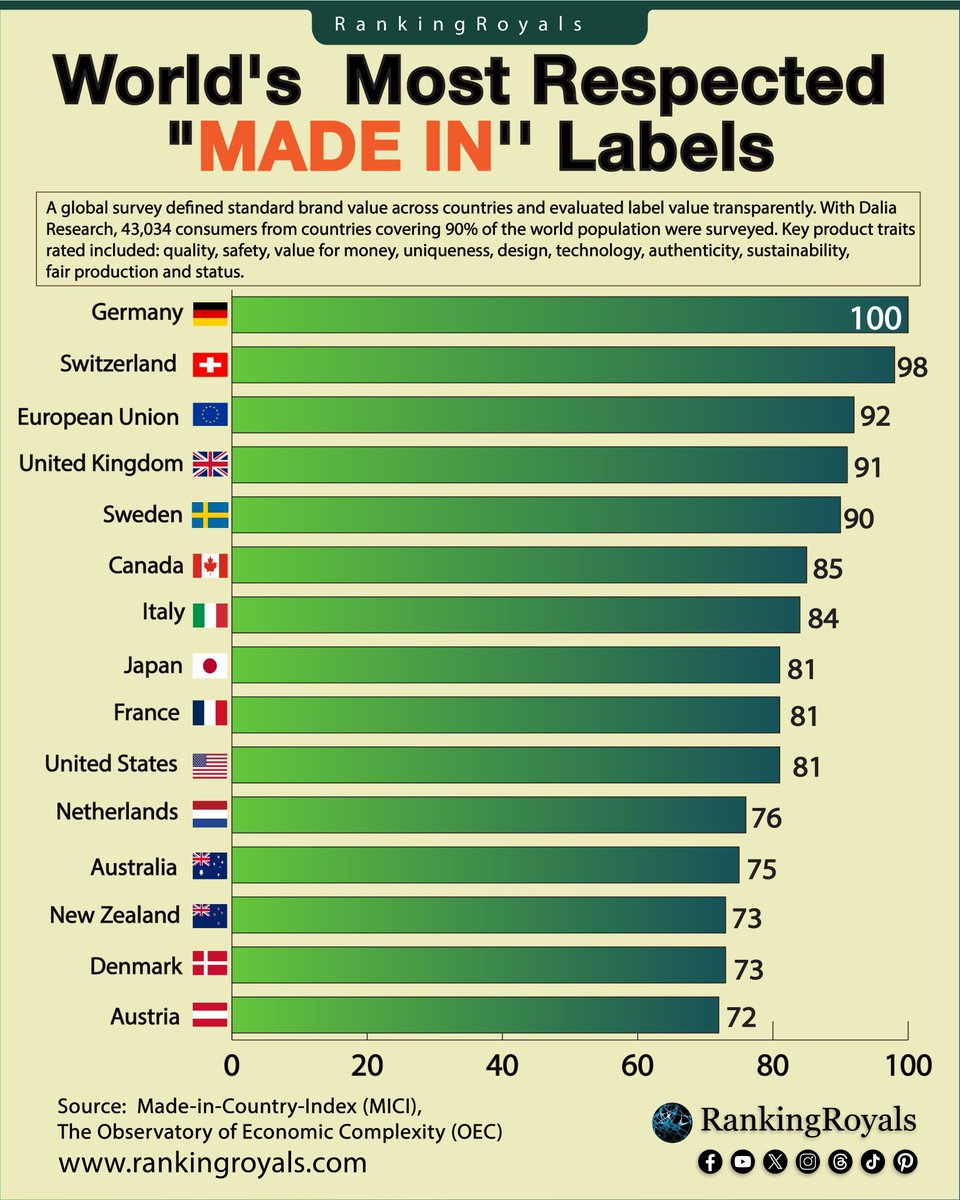
Germany has the best-skilled workforce mainly because of its strong vocational education system, advanced industry and emphasis on technical expertise as of 2024-2025. Germans are consistently rated high for skilled labor force, ahead of nations like Japan and South Korea. This system mixes classroom learning with practical training.
Germany’s workforce includes over 50 million people, and it has high employment rates and high levels of education. Major German regions like Stuttgart boast employment rates and education levels higher than the EU averages, reflecting a deeply educated labor force.
Japan is currently ranked second worldwide for skilled labor force, just after Germany. Japan’s skilled labor pool rivals those of Germany, South Korea, China and the United States with top global perceptions in areas like automation, engineering, and digital innovation.
Auch mit der neuen, strengeren Definition ist der Anteil der in extremer Armut lebenden Menschen innerhalb eines halben Menschenlebens von 43 % auf 10 % gesunken. 1,5 Mrd Menschen weniger - oder jeden Tag: 117.000. Das wäre doch eine schöne Schlagzeile, jeden Tag, 35 Jahre lang.
To track progress towards ending extreme poverty by 2030, the United Nations relies on the World Bank to estimate the share of people living below a certain threshold, called the International Poverty Line (IPL).
In June 2025, the World Bank announced a major change to this line, raising it significantly, from $2.15 to $3 per day. As a result, 125 million people who would not have been counted as extremely poor before June are now included.
But this higher estimate of extreme poverty reflects a higher poverty threshold, not that the world is poorer. In fact, the latest data accompanying the new IPL shows that incomes among the world’s poorest are actually *higher* than previously estimated.
These recent changes are small compared to the large reductions in extreme poverty over the past generation. As you can see in the chart, the global share in extreme poverty went from 43% in 1990 to 10% today. That’s 1.5 billion people being lifted out of the worst kind of poverty.
„Die Erde ist randvoll mit Himmel – und in jedem gewöhnlichen Dornbusch brennt Gott.
Aber nur jene, die sehen können, ziehen ihre Schuhe aus.
Die anderen sitzen drum herum und pflücken Brombeeren.“
#Elizabeth#Barrett#Browning
Mit einem Festvortrag des Philosophen Prof. Dr. Markus Gabriel (Bonn) und einem vom Erzbischof Dr. Udo Markus #Bentz (Paderborn) gefeierten Festgottesdienst ist heute (15. Juni 2025) die Jahrestagung der Bischöflichen Studienförderung #Cusanuswerk im niederländischen Baarlo bei Venlo zu Ende gegangen. Rund 700 Stipendiatinnen und Stipendiaten diskutierten mit Gästen aus Wissenschaft, Kirche, Wirtschaft, Politik, Kultur und Medien über das Thema #Komplexität.
Mehr lesen: https://t.co/ywBJlmFhRF
Im Schnitt verbringen Personen (> 10 J.) an 7 Tagen der Woche 6,6 Stunden mit bezahlter und unbezahlter Arbeit und Bildung, 7,7 Stunden mit Freizeit und Essen und 9,6 Stunden mit Schlafen und Körperpflege.
Im Schnitt verbringen Personen ab 10 Jahren an Wochenenden und Feiertagen 7 Stunden und 45 Minuten am Tag mit Freizeitaktivitäten. Das sind fast 2,5 Stunden mehr als unter der Woche (5 Stunden und 26 Minuten montags bis freitags). Mehr dazu:
https://t.co/5Wqu4MPMun #ZVE2022
Jetzt bewerben! 🎓 Das #Cusanuswerk fördert junge Katholikinnen und Katholiken mit Stipendien, Bildung & geistlichem Programm. Für Ausbildung, Studium & Promotion.
Infos & Fristen 👉 https://t.co/Bvp0xAKnLc
#Stipendium#Glaube#Verantwortung#Kirche
Der stärkste Rückgang der Armut wurde durch das Ende des Kalten Krieges und der Stellvertreterkriege bewirkt - durch die Liberalisierung der Märkte und durch die Entwicklung demokratischer Strukturen. Nicht gut, wenn all das zurückgedreht wird.
In 1820, 8 in 10 people worldwide lived on less than $1.90* a day, an extremely low poverty line. 200 years later, it had dropped to 1 in 10 people.
How do we know how many people were in poverty 200 years ago? Where do these numbers come from?
Learn the answers in our article "How do we know the history of extreme poverty?": https://t.co/ijda6cIMXU
*This is measured in international-$ at 2011 prices, which means it's adjusted for inflation and differences in the cost of living between countries. It's the equivalent of what $1.90 could buy in the US in 2011.
75 % der Ehemaligen des #Cusanuswerks engagieren sich ehrenamtlich, weitere 20 % (der älteren) haben das in der Vergangenheit getan - häufig mehr als 5 Stunden pro Woche. 56 % haben dabei eine Leitungs-/Vorstandsfunktion inne, 23 % gründeten eigene Vereine und Initiativen.
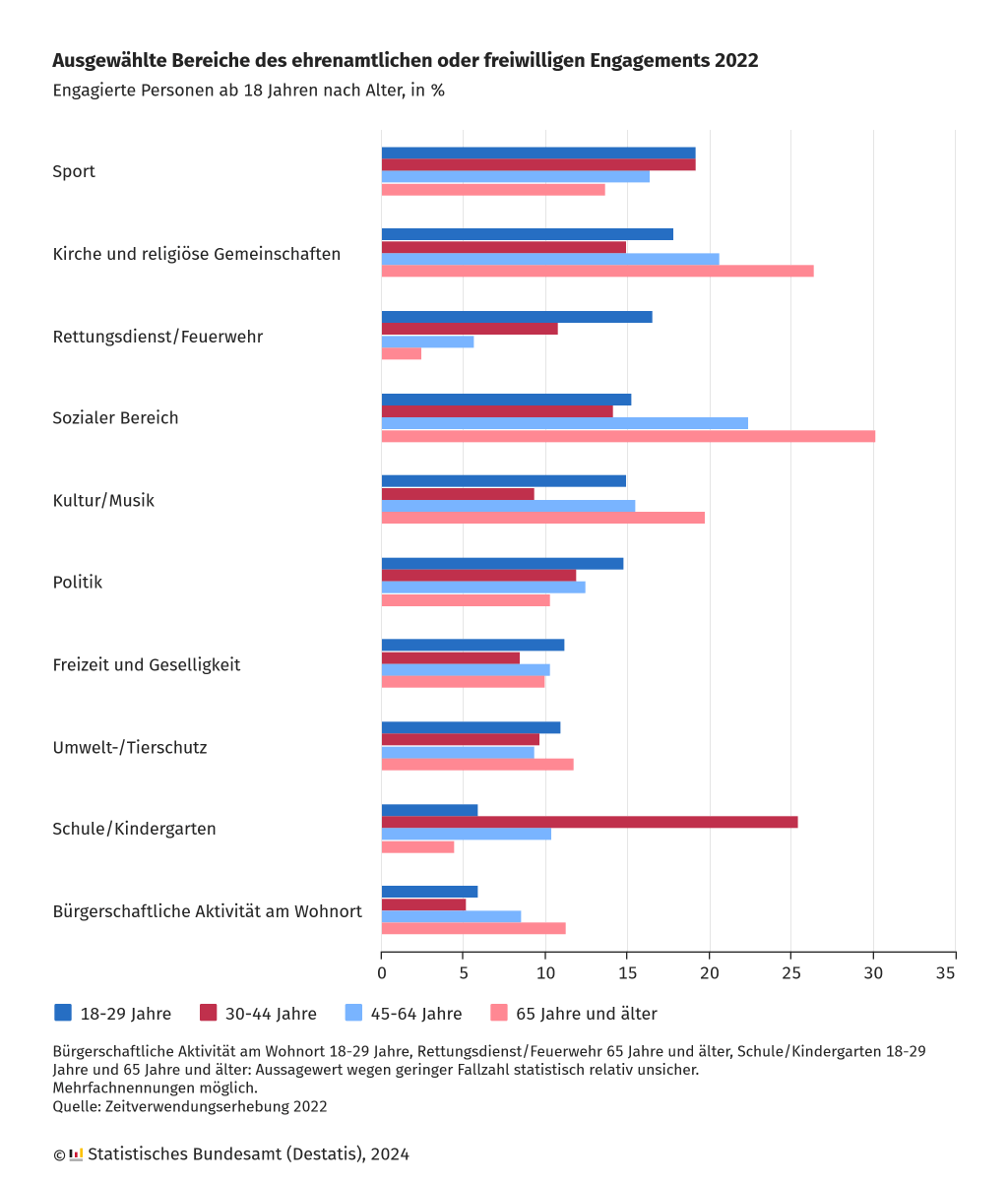
#Ehrenamt: 36 % der Bevölkerung ab 10 Jahren engagieren sich ehrenamtlich oder #freiwillig, und zwar junge Erwachsene in ähnlichem Umfang wie ältere. Deutliche Unterschiede gibt es laut ZVE 2022 aber bei der Art des #Engagement|s. 👇
„Die gütige und kluge #Liebe ist gewohnt überzuströmen, nicht auszuströmen…
Wenn du nämlich mit dir selber schlecht umgehst, wem bist du dann gut?
Wenn du kannst, hilf mir aus deiner Fülle; wenn nicht, schone dich.“
#Bernhard von #Clairvaux
Viele Länder haben ein "Wirtschaftswunder" erlebt. Es ist Leuten wie Max Roser und seinem Team zu verdanken, dass solche Entwicklungen mehr Sichtbarkeit erlangen.
In these nine African countries, average incomes have more than doubled since 1990—
(Written by Max Roser)
Economic growth is most important for the world's poorest people, and most of the world’s poorest live on the African continent. Are Africa’s economies growing?
The picture is mixed. In some countries, incomes have unfortunately declined in the last decades. This includes Madagascar, Zimbabwe, and Burundi. I have written about this in my brief explainer on extreme poverty (link in 🧵).
In today’s Daily Data Insight, I want to focus on the other side: I want to highlight the African countries that are achieving economic growth. Nine of them are shown in the chart here.
In all nine countries, people’s average incomes have more than doubled since 1990.
This made substantial improvements in living standards possible: the share of people in extreme poverty and the rate of child mortality declined in all nine countries.
„Wer einmal sich selbst gefunden hat, der kann nichts auf dieser Welt mehr verlieren.
Wer einmal den Menschen in sich begriffen hat, der begreift alle Menschen.“
#Stefan#Zweig
When asked if most people can be trusted, responses vary significantly around the world—
For decades, the World Values Survey and European Values Survey projects have examined people’s values through their surveys. One of the questions on trust asks: “Generally speaking, would you say that most people can be trusted or that you need to be very careful in dealing with people?”
This chart shows the share of respondents who answered “most people can be trusted” across different countries.
As you can see, reported trust in others varies widely from country to country. In the Nordic nations, over 60% of respondents believe most people can be trusted, while in France and Italy, this figure drops to around 26%. At the lower end, as few as 5% of people in countries like Colombia and Peru express trust in others.
It’s worth noting that interpretations of survey-based “trust” measures are complex: what people mean when they answer this question could reflect various ideas about trust, personal experiences, or cultural attitudes toward trustworthiness.
(This Daily Data Insight was written by Edouard Mathieu.)
Ein immer größerer Teil der Weltbevölkerung lebt in Städten. Mitte 2023 waren es 57 %. Bis 2030 steigt der Anteil nach UN-Berechnungen auf 60 %. Mehr zum #WorldCitiesDay: https://t.co/gQZgn7EdbY
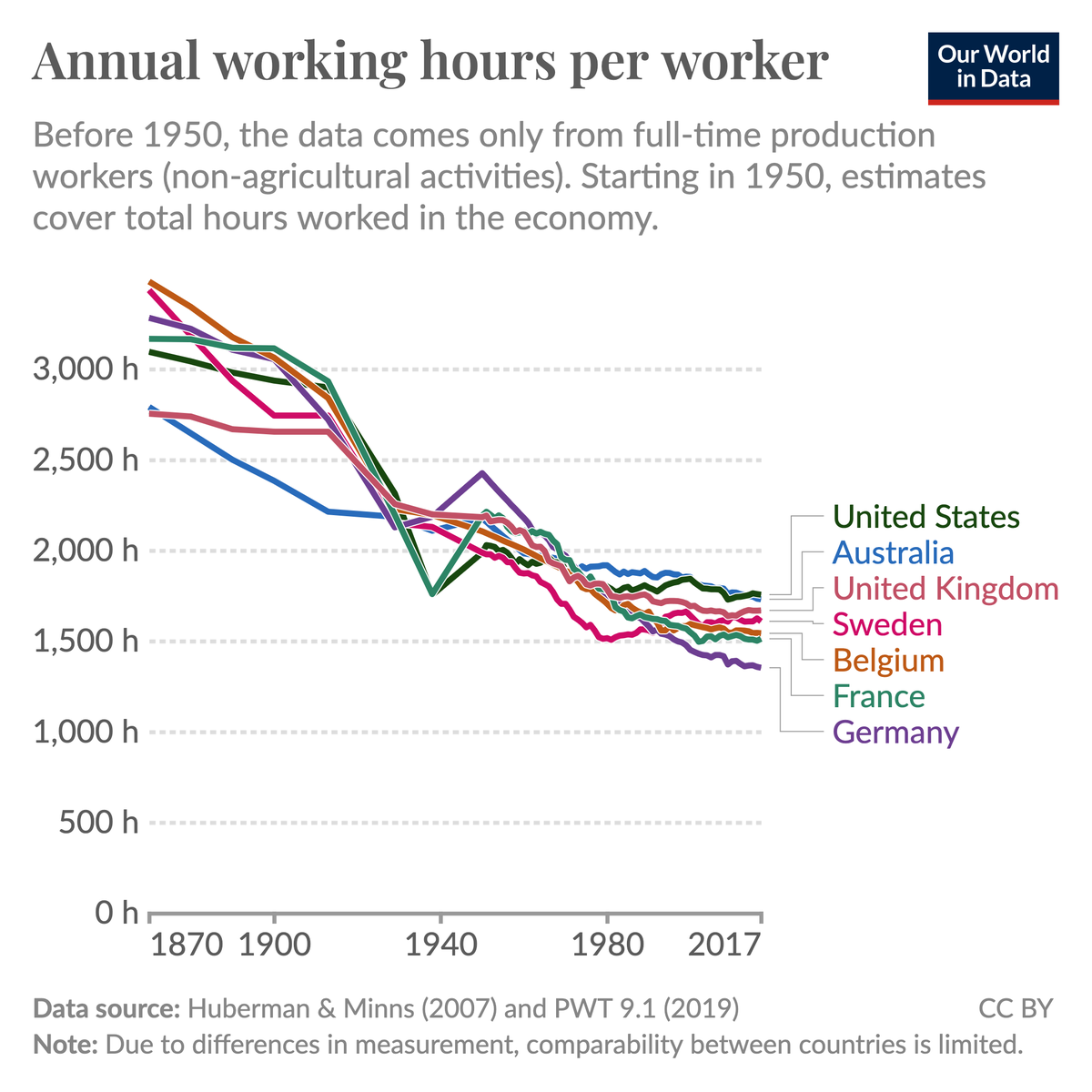
The average worker in wealthy countries now works only about half as many hours per year as in the late 19th century.
Based on data from economic historians Michael Huberman and Chris Minns, the average worker used to work between 2,700 and 3,500 hours per year, which is about 50 to 70 hours each week.
Recently, using data from the Penn World Table, workers worked about half that amount, between 1,300 and 1,800 hours a year, or about 25 to 35 hours a week.
This decrease has come from working fewer hours each day, fewer days each week, and fewer weeks each year.
(This Daily Data Insight was written by @bbherre.)