Can you grasp the day-to-day reality of your own organization?
Edgar and Peter Schein reframe leadership from a status-driven, performance-oriented approach to a technical discipline. Most leaders operate within a bubble of curated data, unaware that their own executive ego acts as a filter, removing critical situational information.
Volume 9 of Leading Readers evaluates Humble Leadership as an essential operating system for high-fidelity information flow.
Situational Humility: A trained discipline for collecting the ground-level data required for strategic execution.
The Level 2 Substrate: Whole-person connections that provide the psychological safety required for rapid truth-telling.
Process Hygiene: Eliminating the "Voting Trap" and groupthink to protect collective intelligence.
Status hierarchies frequently limit perception and suppress vital knowledge.
If you rely on solitary expertise during periods of extreme market volatility, you are choosing a massive systemic risk.
Before your next strategic update, run the Sensing Filter.
Ask if your team members feel safe enough to tell you that your current strategy is failing.
Currently Reading: Humble Leadership by Edgar Schein and Peter Schein
👉 Subscribe and join 3,600+ leaders in the Leading Readers series.
Next Saturday: Invisible Women by Caroline Criado Perez
#HumbleLeadership #ExecutiveLeadership #AlbertSchiller #LeadingReaders
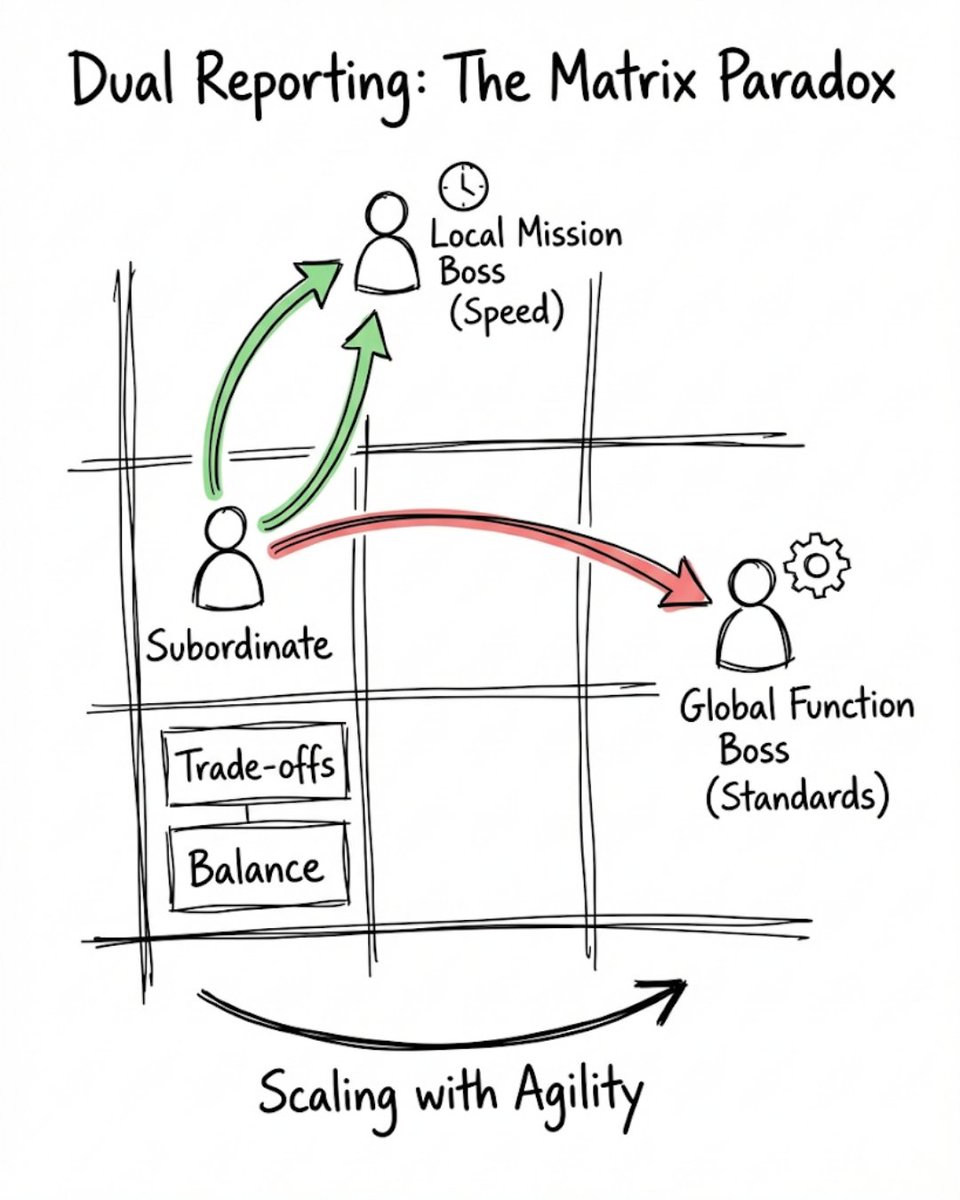
How do you scale without sacrificing mission speed or technical standards?
Traditional hierarchies often break under the weight of rapid organizational growth. Andrew Grove argues that dual reporting is not an administrative burden, but a technical necessity for high-output firms.
By utilizing a "two-boss" model, an organization can effectively balance:
Mission Speed: A local boss focused on immediate operational results and regional targets.
Functional Excellence: A global boss ensuring brand consistency and long-term professional standards.
While many fear this creates decision paralysis, the matrix paradox actually forces the resolution of critical trade-offs early. It internalizes market complexity, allowing an organization to remain agile while preserving core competencies. Mastering this balance is the primary work of the high-leverage executive.
When you stop viewing dual reporting as a defect to be corrected, you can start utilizing it as a tool for collective success.
More insights into High Output Management by Andrew S. Grove are live in Volume 8 of Leading Readers.
👉 Subscribe and join 3,500+ leaders in the Leading Readers series.
Next Saturday: Humble Leadership by Edgar Schein and Peter Schein
#HighOutputManagement #ExecutiveLeadership #LeadingReaders #AlbertSchiller
How accurately can you calculate your own leverage?
Andrew Grove treats management as a technical discipline of process engineering. Most leaders mistake personal exertion for organizational value.
Volume 8 of Leading Readers evaluates High Output Management as a framework for systemic impact.
The Multiplier Effect: Managerial output equals the results of units under your influence.
Systemic Friction: Meddling and waffling create negative leverage that halts team progress.
Predictive Windows: Leading indicators allow you to flag unhealthy departures in week two.
High leverage activities like training yield disproportionate returns on your time investment. If you apply peacetime instincts to wartime conditions, you are choosing to fail.
Before your next meeting, run the Leverage Filter.
Ask if this activity yields the highest possible return on cognitive effort.
Currently Reading: High Output Management by Andrew S. Grove
👉 Subscribe and join 3,500+ leaders in the Leading Readers series.
Upcoming Saturday: Humble Leadership by Edgar Schein and Peter Schein
#HighOutputManagement #ExecutiveLeadership #AlbertSchiller #LeadingReaders
Speed is a poor proxy for judgment when your environment is drowning in noise.
Most organizations treat reading as a static skill. They ignore the fact that the human brain was not born to read. We repurposed vision and spoken language systems to build a circuit that requires constant maintenance. When you prioritize high speed scanning over deep study, you unintentionally dismantle your infrastructure for strategy.
Volume 7 of Leading Readers deconstructs the science of the reading brain to help you reclaim your focus.
Swipe for:
The Open Architecture: Why judgment quality depends on the ongoing maintenance of your constructed cognitive circuits.
The Surplus Rule: How fluidity in decoding creates the "gift of time" required to identify contradictions and second order effects.
Synchrony Failure: Why coordination problems are usually technical breakdowns in the processing chain rather than character flaws.
If your team is acting as if your strategic constraints do not exist, they are likely trapped at the literal surface of the text. High level inference requires cognitive slack that only develops through recurring, sustained input. Occasional bursts of effort cannot maintain the architecture of attention.
Run the Inference Test in your next review:
Ask your team to identify one contradiction or second order risk in the proposed plan. If they can only paraphrase the literal surface of the document, they lack the cognitive slack required for durable judgment.
#Strategy #Execution #LeadingReaders #AlbertSchiller #Neuroscience
If no one feels safe reporting mistakes, your data is already corrupted.
Most execution systems don’t fail because targets are wrong.
They fail because the data stops being safe to report.
CFRs exist to protect honesty when incentives distort behavior.
They turn a missed target into an input, not a liability.
This note is from Leading Readers, Vol. 5, where I analyze
Measure What Matters by John Doerr and why OKRs only work when paired with CFRs.
If your numbers always look “safe,” the system is lying.
You can read the full briefing in this week’s Leading Readers newsletter.
Save this post for a moment where you need talk to someone because your delivery fell short.
#LeadingReaders #Execution #OKRs #CFRs #AlbertSchiller
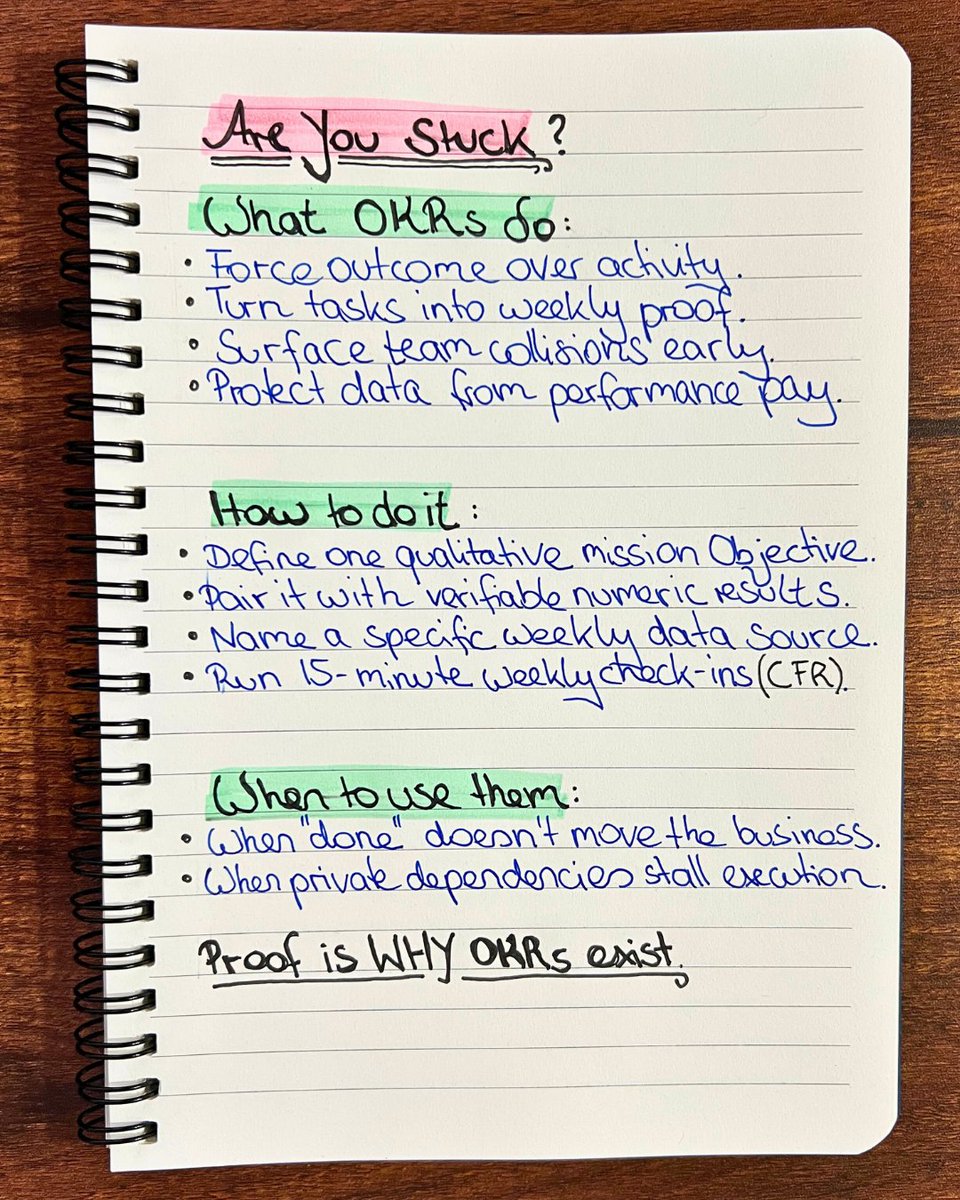
If finishing work were the same as creating value, execution would be easy.
OKRs exist to force proof, not activity.
They turn “we did the work” into “here is the evidence.”
This note is from Leading Readers, Vol. 5,
my analysis of Measure What Matters by John Doerr
and why execution fails when key results degrade into task lists.
If a “key result” cannot point to a number and a source,
you are tracking effort, not impact.
Full briefing in this week’s newsletter.
Save this post. You will need it next time your team is on track, but it makes no difference.
#LeadingReaders #OKRs #Execution #AlbertSchiller
If effort were enough, plateaus wouldn’t exist.
Deliberate learning is how improvement continues when motivation is no longer the problem.
Deliberate learning turns repetition into skill by targeting specific weaknesses with fast feedback.
These notes come from Leading Readers Vol. 4 on Grit, by Angela Duckworth
Save this post for when your progress stalls despite effort.
#LeadingReaders #Grit #DeliberateLearning #AlbertSchiller
Talent predicts how fast someone starts. That's it.
Most hiring mistakes don’t show up in month one.
They show up in month six.
The Grit Scale exists to measure durability over interview polish.
It separates:
- interview fluency from stamina
- early speed from sustained output (in other words, is the person useful)
This note is from Leading Readers Vol. 4, based on Grit by Angela Duckworth.
Save this post. You’ll need it before your next hiring debrief.
#LeadingReaders #Grit #MeasureImpact #AlbertSchiller
Why are companies treating People Decisions like HR events?
Laying people off is an ethical act of ownership.
Horowitz treats firings as an unavoidable test of CEO character. Delaying the decision only compounds fear and destroys trust.
You must admit that the company failed the employees.
Ownership of failure is what preserves the remaining organization.
The deconstruction of this moral test is live in Volume 3 of Leading Readers.
👉 Subscribe and join 3000+ leaders who choose depth over noise.
#LeadingReaders #HardThingAboutHardThings #SystemsThinking #AlbertSchiller
Busyness is not effectiveness.
Attention residue keeps brilliant minds operating in shallow water while mistaking responsiveness for impact.
Deep work isn’t a productivity hack, it’s survival.
https://t.co/edGvIXtRt0
Some leaders don’t lose in meetings because they’re slow.
They lose because depth is forced to compete on speed.
Read the full post: https://t.co/dfbXvuuTov
Typing captures words. Writing builds understanding.
If your notes aren’t changing how you think, they’re just digital storage, not learning.
https://t.co/Jd68yCZOwM