Given the "black box nature" of current AI, updates of medical AI systems or the underlying hardware might lead to extensive re-testing cycles.
What the professional societies can do about that:
https://t.co/nQkGgYT5ni
@Gut_BMJ@ESGE_news@ASGEendoscopy
@alexsworking@dgimev@vision_sharib Plus one or two of the works of your group @alexsworking . Glad that you liked the talk and thanks for coming! :)
P.S. Many thanks for hosting the exciting session, @Rath2Timo (and for inviting me, of course!)
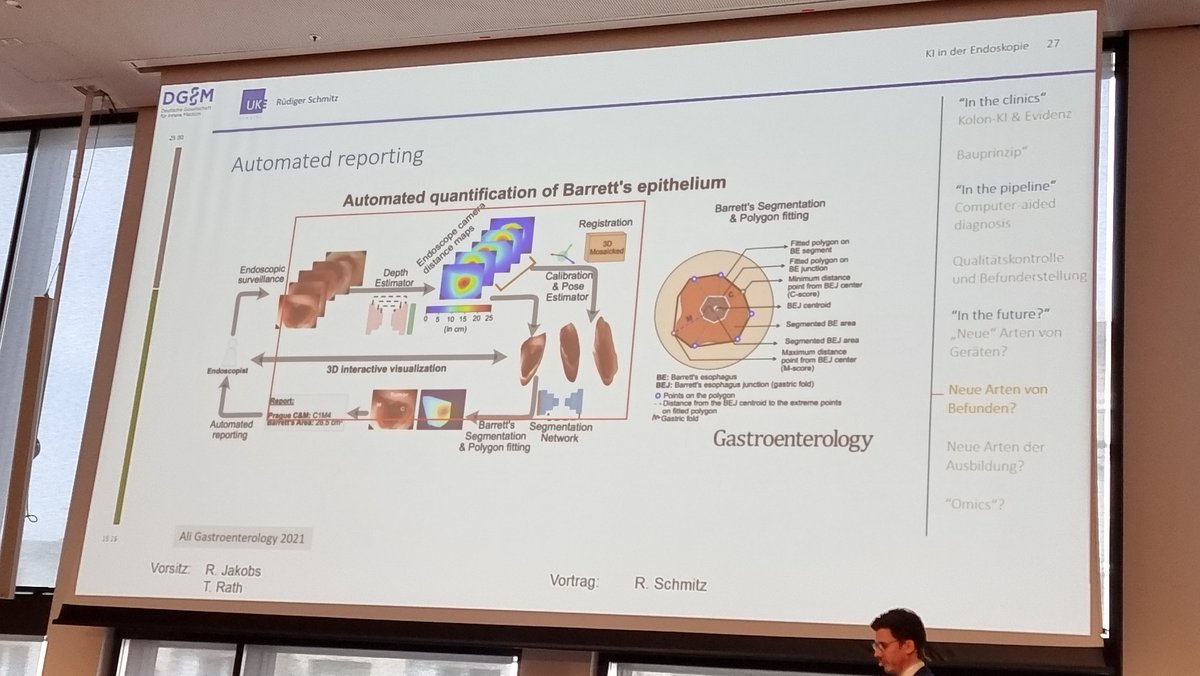
@schmitzruediger at @dgimev presenting the work of @vision_sharib and showing a possible application scenario where the patient gets his Barrett's as a 3D dataset included in the report.
https://t.co/kaZhWz0XeM
Heute vor 80 Jahren trafen sich fünfzehn deutsche Spitzenbeamte, um die Ermordung des europäischen Judentums zu koordinieren. Zu den historischen Hintergründen der #Wannseekonferenz und der Bedeutung für die Gegenwart hier mein Artikel auf @FNFreiheit: https://t.co/sUT8uGbKhR
@accessnow@algorithmwatch So perhaps, “#AIact” is just the wrong term for what is intended. It’s more an “automated decision support systems act”, and that’s perfectly fine — We should focus on regulating applications and application scenarios, not so much the underlying technique. 3/@LinaRusch
@accessnow@algorithmwatch whilst the intention to regulate automate decision support systems in high-risk scenarios also if they use “simpler and rule-based” techniques etc and avoid cutting-edge #ML is more than understandable, this does not make such approaches “#AI”. 2/