Optimus can now sort objects autonomously 🤖
Its neural network is trained fully end-to-end: video in, controls out.
Come join to help develop Optimus (& improve its yoga routine 🧘)
→ https://t.co/dBhQqg1qya
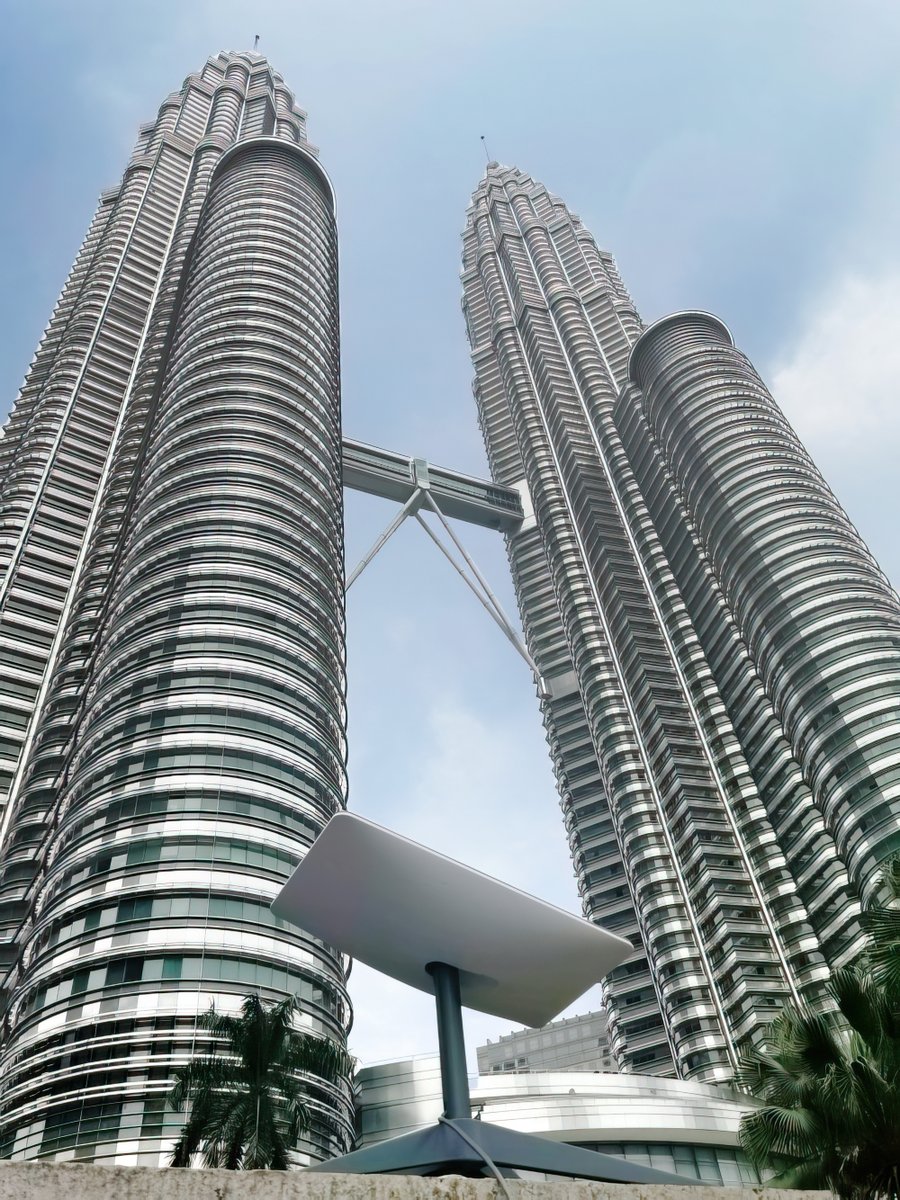
Starlink is now available in Malaysia, marking the 60th country around the world where Starlink can provide high-speed internet connectivity → https://t.co/G1myzWJQ6j 🛰️🇲🇾
Starlink is now available in Malaysia, marking the 60th country around the world where Starlink can provide high-speed internet connectivity → https://t.co/G1myzWJQ6j 🛰️🇲🇾
On Investor Day a few months ago, Zach Kirkhorn, Tesla's CFO, mentioned that Tesla plans on spending $150 to $175 billion by 2030 to build factories so they can make 20 million vehicles and 1,000 gigawatt hours of battery storage per year. Currently, Tesla has built the capacity to make about 2 million vehicles and roughly 40 gigawatt hours of battery storage per year. That’s 10x growth in vehicles and 25x growth in battery storage.
Is this level of capital investment achievable?
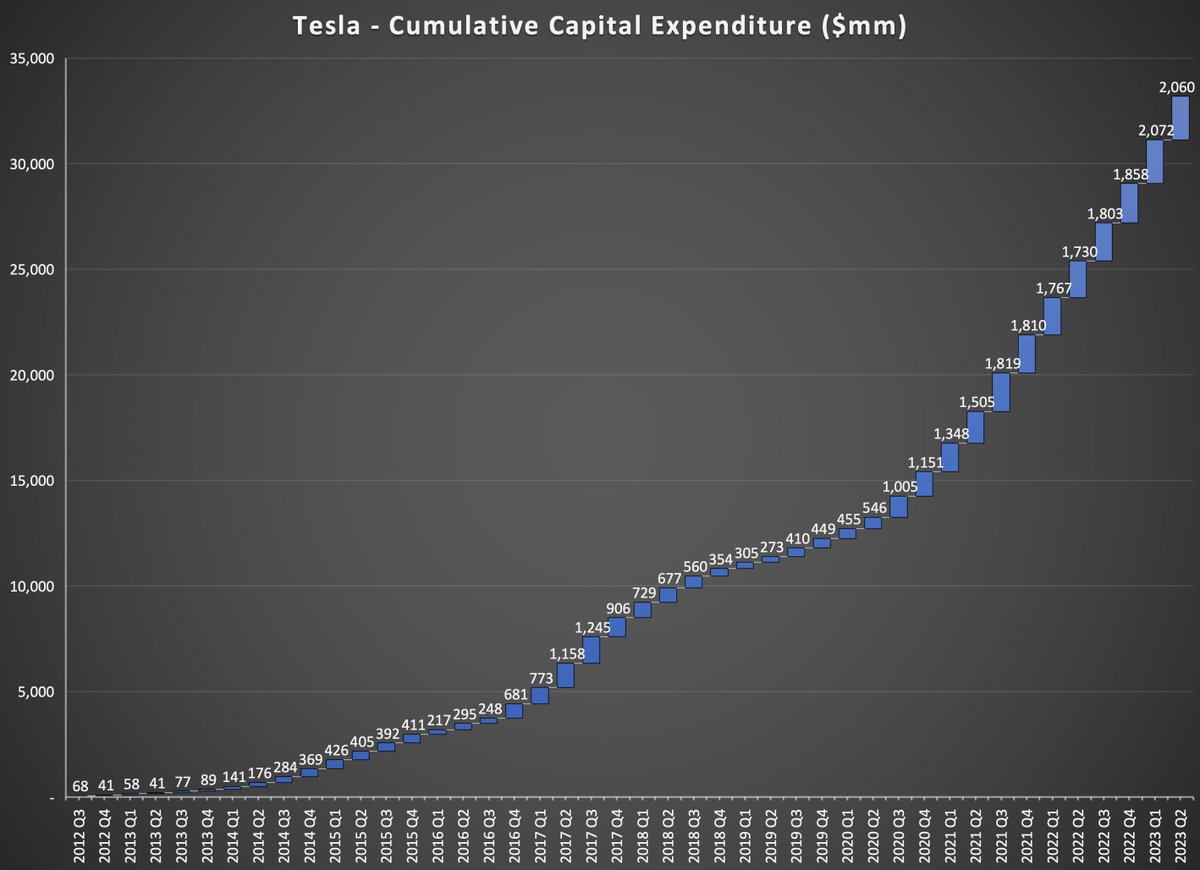
From 2012 Q3 thru 2023 Q2 Tesla has invested nearly $33 billion in capital spending.
So that's "only" $130 billion remaining to reach the midpoint of the capital spending target.
How much will Tesla have to invest per quarter to reach their target by the end of 2030?
They need to average about $5 billion per quarter - less in the early quarters and ramping above in the later quarters as they approach 2030.
Last quarter Tesla invested more than $2 billion in capital expenditures.
The second chart shows how the capital spending ramp might look in order to reach the goal over the next 26 quarters.
At Investor Day Zach stated "... the point about CapEx guidance, the intent of that slide was not to provide specific guidance, but to just be transparent about internally, what our rough estimates are and to provide context that we think getting to 20 million vehicles per year and 1 terawatt hour of energy storage is very feasible relative to our expected cash generation for the business. That's a number that will move as we learn. We may choose to vertically integrate more into things. We may find efficiencies elsewhere. To the whole conversation we were having earlier about, do we do mining, do we not do mining? But the entire point is to say that this is something that's entirely possible based upon our forecast."
At the very least, this gives investors a gauge to measure on-going capital spending against - how does the actual CapEx track against the plan? - it may give some clues as to how well Tesla is tracking towards the 20 million vehicles and 1,000 gigawatt hours battery storage target.
$tsla
On Investor Day a few months ago, Zach Kirkhorn, Tesla's CFO, mentioned that Tesla plans on spending $150 to $175 billion by 2030 to build factories so they can make 20 million vehicles and 1,000 gigawatt hours of battery storage per year. Currently, Tesla has built the capacity to make about 2 million vehicles and roughly 40 gigawatt hours of battery storage per year. That’s 10x growth in vehicles and 25x growth in battery storage.
Is this level of capital investment achievable?
From 2012 Q3 thru 2023 Q2 Tesla has invested nearly $33 billion in capital spending.
So that's "only" $130 billion remaining to reach the midpoint of the capital spending target.
How much will Tesla have to invest per quarter to reach their target by the end of 2030?
They need to average about $5 billion per quarter - less in the early quarters and ramping above in the later quarters as they approach 2030.
Last quarter Tesla invested more than $2 billion in capital expenditures.
The second chart shows how the capital spending ramp might look in order to reach the goal over the next 26 quarters.
At Investor Day Zach stated "... the point about CapEx guidance, the intent of that slide was not to provide specific guidance, but to just be transparent about internally, what our rough estimates are and to provide context that we think getting to 20 million vehicles per year and 1 terawatt hour of energy storage is very feasible relative to our expected cash generation for the business. That's a number that will move as we learn. We may choose to vertically integrate more into things. We may find efficiencies elsewhere. To the whole conversation we were having earlier about, do we do mining, do we not do mining? But the entire point is to say that this is something that's entirely possible based upon our forecast."
At the very least, this gives investors a gauge to measure on-going capital spending against - how does the actual CapEx track against the plan? - it may give some clues as to how well Tesla is tracking towards the 20 million vehicles and 1,000 gigawatt hours battery storage target.
$tsla
@chickengenius From no brainer DCA to master of market timer…Well done…
By the way, enjoy your old video…but I suggest you to delete your old videos…they are just reducing your credibility…
https://t.co/PgXZo95W5K
@chickengenius You’ve changed to a trader who time the market…very contradicting with what you have told everyone last time to keep buying and DCA and hold long term…
@FSD_Arthur FSD needs get into the most populous cities in Asia with the most complex and disorder traffics and reckless road users. That will be a huge learning curve for FSD. @elonmusk