we live on a planet where trees warn each other of danger through underground networks. where octopuses dream. where elephants return to the bones of their dead and stand over them in silence. where bees communicate through dance, showing each other where to fly. where flowers bloom...where crows remember human faces -especially those who were cruel to them - and pass that memory on to their young. where ants build entire cities. where cats purr at a frequency that can help heal bones. where forests, after fires, grow flowers first.
@RyanHoliday I’ve done the same periodically over the last six months in my neighborhood on the south side of Chicago. I think of the people who came before me that contributed to the aesthetics. My small thanks - the least I can do.
@NMTimMcGrew I have similar worries. Need to build: ‘in this place we read and write and interact without machines.’ Check your phone at the door, no computers or wi-fi, just thousands of books and free notepads for writing by hand.
How to make something like that take off?
🚨BREAKING: MIT hooked people up to brain scanners while they used ChatGPT.
What they found should concern every single person reading this.
ChatGPT users showed 55% weaker brain connectivity than people who didn't use it. Not after years. After just four months.
Here's how they tested it. 54 people were split into three groups: one used ChatGPT to write essays, one used Google, and one used nothing but their own brain. They wore EEG monitors that tracked their brain activity in real time across four sessions over four months.
The brain-only group built the strongest, most widespread neural networks. Google users were in the middle. ChatGPT users had the weakest brains in the room. Every time.
Then the memory test hit. Participants were asked to recall what they'd just written minutes earlier. 83% of ChatGPT users couldn't quote a single line from their own essay. They wrote it. They couldn't remember it. The words passed through them like they were never there.
It gets worse. In the final session, ChatGPT users were told to write without AI. Their brains were measurably weaker than people who never used AI at all. 78% still couldn't recall their own writing. The damage didn't go away when the tool was removed.
Meanwhile, brain-only users who tried ChatGPT for the first time? Their brains lit up. They wrote better prompts. They retained more. Their brains were already strong enough to use AI as a tool instead of a crutch.
The researchers also found that every ChatGPT essay on the same topic looked almost identical. More facts, more dates, more names. But less original thinking. Everyone using ChatGPT produced the same generic output while believing it was their own.
MIT gave this a name: cognitive debt. Like financial debt, you borrow convenience now and pay with your thinking ability later. Except there's no way to pay it back.
The question isn't whether ChatGPT is useful. It's whether the price is your ability to think without it.
@voravault@bitbrunchpod I’ve noticed Claude has lowered the bar for what humans must provide to put him to work. Originally you had to type out prompts, ideas - you had to create words to engage it.
Now it offers you menus so you just have to click a couple times to put it to work on complex tasks.
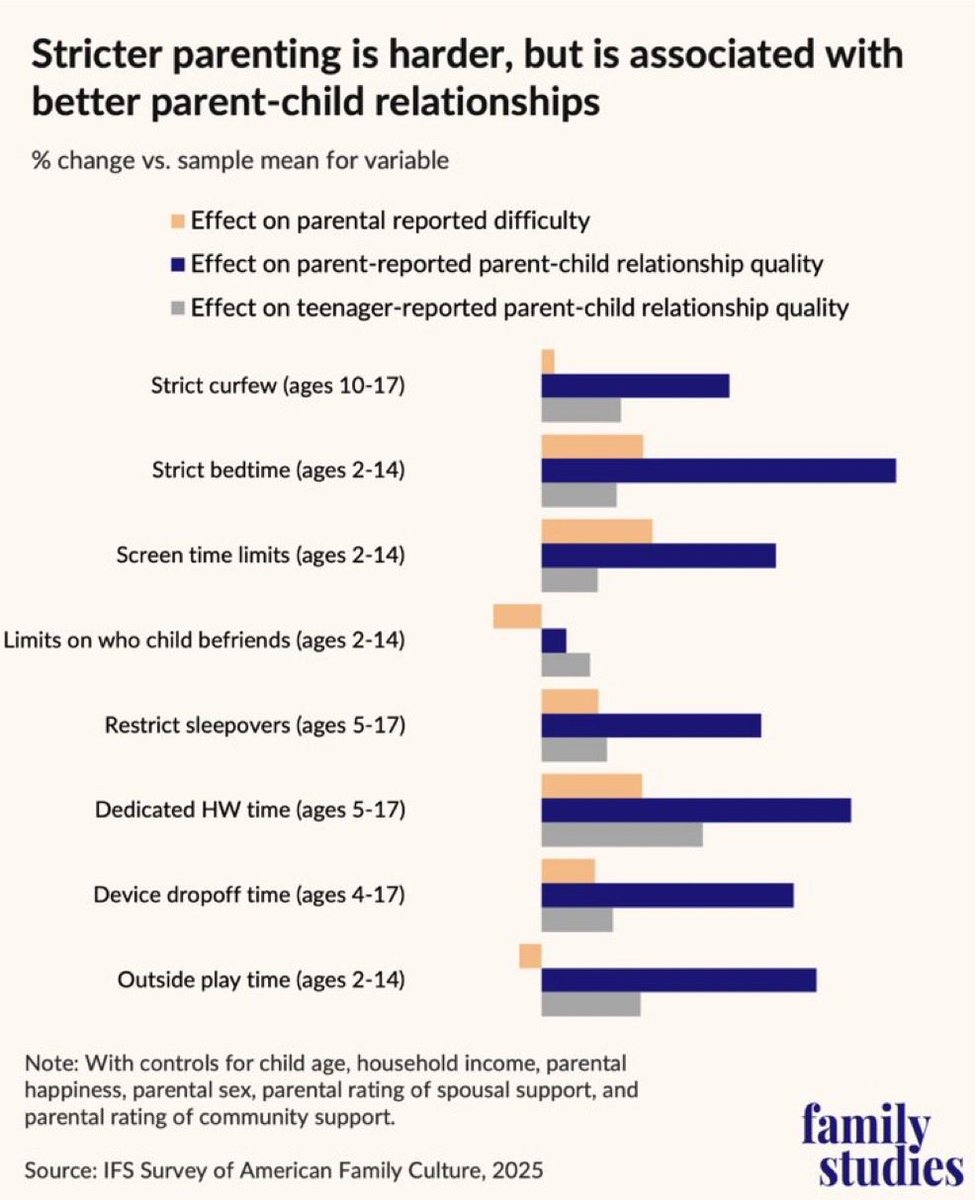
We now have evidence that gentle parenting doesn’t work.
Here’s an uncomfortable truth about parenting no one wants to say out loud:
The data is not kind to gentle parenting.
According to teenagers, strict curfews. strict bedtimes, screen limits, device drop off times, dedicated homework blocks, and sleepover restrictions IMPROVE higher relationship quality.
And yes, parenting difficulty goes up.
Of course it does. Leadership is harder than appeasement.
For the past decade we have been sold a watered down, Instagram friendly version of “gentle parenting” that often collapses into boundary avoidance, endless negotiation and emotional processing without enforcement. Parents terrified of saying no because they do not want to rupture connection.
But connection without authority is not connection. It is dependency.
When parents impose structure, the relationship improves.
Teenagers report better parent child relationship quality in homes with curfews and rules. Younger kids report better relationships in homes with screen limits and bedtimes. Even device drop off times correlate positively.
Why?
Because structure is not cruelty. Structure is love made visible.
A bedtime says: your brain matters more than your entertainment.
A screen limit says: your dopamine system is not fully developed and I will guard it until it is.
A curfew says: your safety matters more than your social standing.
That is not authoritarianism. That is caring.
Boundaries create friction. Friction creates growth. The parent absorbs the short term discomfort so the child does not pay the long term cost.
Children do not experience well calibrated limits as rejection. They experience them as stability. The human brain craves predictability. Predictability reduces anxiety. Reduced anxiety strengthens attachment.
That is why relationship quality goes up.
Notice something else in the data. The strongest effects are around time structure. Bedtime. Homework. Devices. Outside play. These are environmental constraints. They scaffold executive function.
The winning formula is not tyranny.
It is high warmth plus high structure.
The modern failure mode is high warmth plus low structure. That is just abdication of responsibility wrapped in empathy.
Children need leadership, not negotiation. They need adults who can tolerate their anger. They need boundaries that do not move every time emotions spike. They need someone whose prefrontal cortex is fully myelinated.
The harder path produces the stronger bond.
Because when a child feels that someone is strong enough to hold the line, they relax. And relaxed nervous systems build durable relationships.
@LEEBEY I was there yesterday - it's not great. To read the text you have to stand at a precise location on Stony Island and look directly at the southwest corner of the structure. It's a shame; someone should have realized the flaw before they started building.
@SCHDETF Thanks for your updates. Your account helped me decide to dca into SCHD in my HSA over the last 18months. 🙏🏼🙏🏼🙏🏼
Wondering if you know how these Q1 dividend increases compare with prior years. Is this activity “normal” (just SCHD doing its thing) or is this unusual?
A lot of people I hear from (some I know) seem to always live on the edge when it comes to their money, moving from one idea and opportunity to the next as attention shifts between big ideas. They’re chasing the big outcome with blinders on, looking for that one big leap into riches. You only need to see the bias that develops and grows on X around themes, until it’s too late. I certainly did a lot of this in my early years.
Sometimes they get close and sometimes they temporarily achieve far more than expected. Success creates a hero complex that consumes them and the network effect of reinforcement compounds it. But because everything is always in such hectic motion, always at risk, one forgets how to formalize their win. What’s gained in one season or theme, is often quickly handed back before the theme runs its course, as all sense of discipline and logic escapes them. Then the cycle repeats, they move on to the next idea looking for that escape level wealth, and again suddenly believing it’s their only chance to make it big or a way to get it all back.
What I’ve come to appreciate later in life is that risk alone is not a wealth strategy. It's more akin to an income source. You need a compounding strategy running alongside the speculation, something relatively predictable and structurally boring. People shy away from this because it seems (on the surface) that you can’t get rich or leverage it. But without that parallel system, there’s nowhere for winnings to go except right back into the same volatile arena they came from. And without a home, your risk is just amplified to scale at another level, but without any newfound level of risk appreciation and with a belief that the idea will just keep on giving. The problem isn’t risk itself, it’s the absence of a place to crystallize the outcome of that risk and therefore it often runs it's course, the full cycle.
I think real wealth is something that is not constantly at risk. Something stable and dependable. Something that emerges at the point where volatility is converted into something that can quietly grow on its own. A mechanism that allows temporary wins to turn into a permanent foundation. Risk then becomes something that feeds the foundation versus something that is never quite yours.
The Flex Loan, a new type of payday loan pioneered by Advance Financial in Tennessee, allows residents to borrow up to $4,000 at a 279.5% interest rate.
It has burdened low-income borrowers while generating huge profits for lenders.
https://t.co/SwJlhw5aLi
Longevity is a game of avoiding chronic disease for as long as possible. The more diseases you accumulate over time, the shorter you will live.
Subsistence populations are largely free of chronic disease, and despite wildly different diets, there’s one metric they share 👇
Everyone should read this. If you align “hard” with a political party you have turned off your brain and outsourced your thinking to others. Data is clear on both sides of aisle. Think for oneself.
@Eric_Erins@MontanaParlay I live in a different condo building on the same block if you want to know anything more about the area drop me a dm. We love it here.