The thing I learned this year is that when engineers say they like working on “hard problems”, they actually don't. What they like is puzzle solving, and having a repertoire of patterns that they can pattern match onto traditionally hard problems, usually involving databases or something with scale, etc. And they know that the industry used to pay you a lot for how deep and broad this repertoire was. Unfortunately, in 2026, well, you have a cheat code machine that has infinite breadth and depth for pattern matching. So the question is, do you actually like hard problems? Because there are now hard problems that are a complection of engineering, product, society, culture, politics, and they are fairly intractable, probably unsolvable! Because if you do want to work on those actually hard problems, there is so much money that people will pay you for it. But you’ll have to face that truth about yourself first.
@fernavid@toiletkingcap “ People realize” that is one of many potential outcomes that you have cherry picked. Slowing down isn’t a quantitative term. If you slow down more than the acceleration rate, then no you don’t see the same rate of progress.
There it is. TACO supreme.
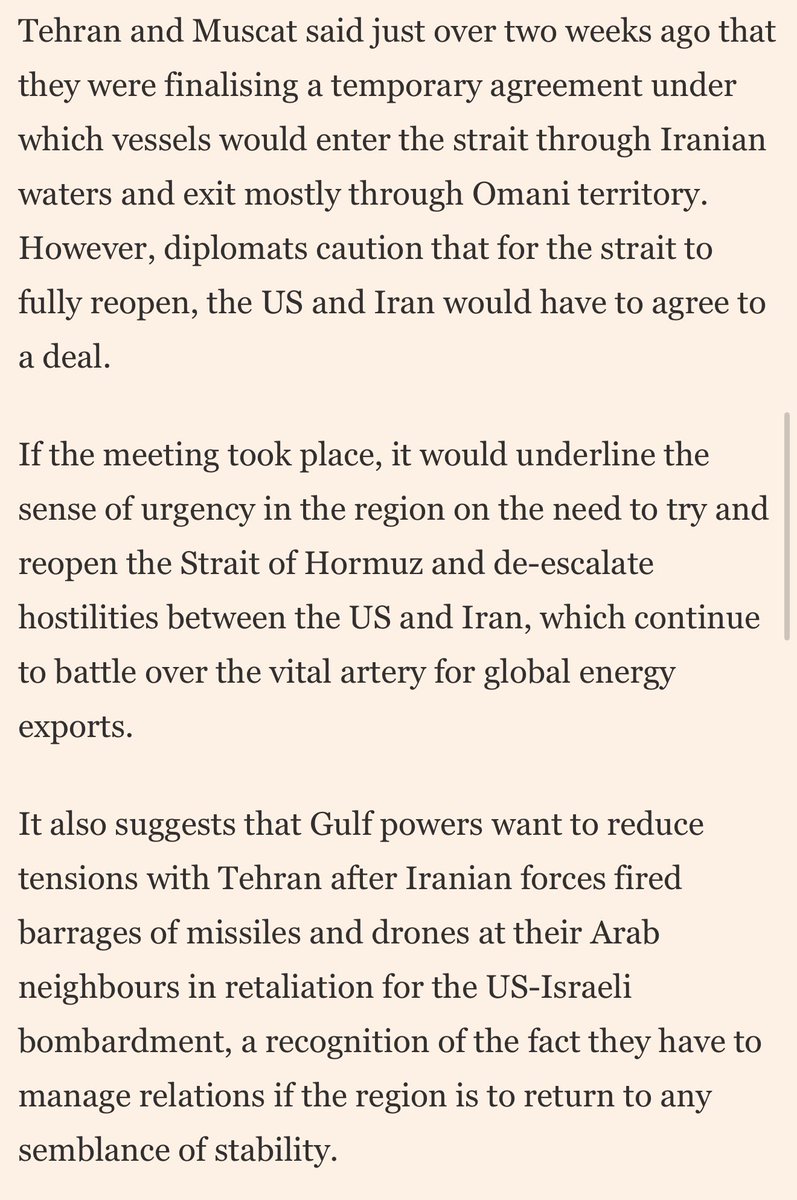
FT:
Gulf foreign ministers plan to meet their Iranian counterpart in a push by Oman and Iran to secure buy-in for a deal temporarily managing shipping through the Strait of Hormuz, as regional states seek a pathway to ease hostilities over the waterway.
The gathering, an Omani initiative, would be the first meeting between the top diplomats from the six-member Gulf Cooperation Council and a senior Iranian official since the US and Israel launched the war against the Islamic republic in February.
It is scheduled to be held on Monday in the Omani coastal city of Salalah, according to two people briefed on the matter. One of the people said the details were not finalised, but that a number of states had confirmed and it was expected to go ahead.