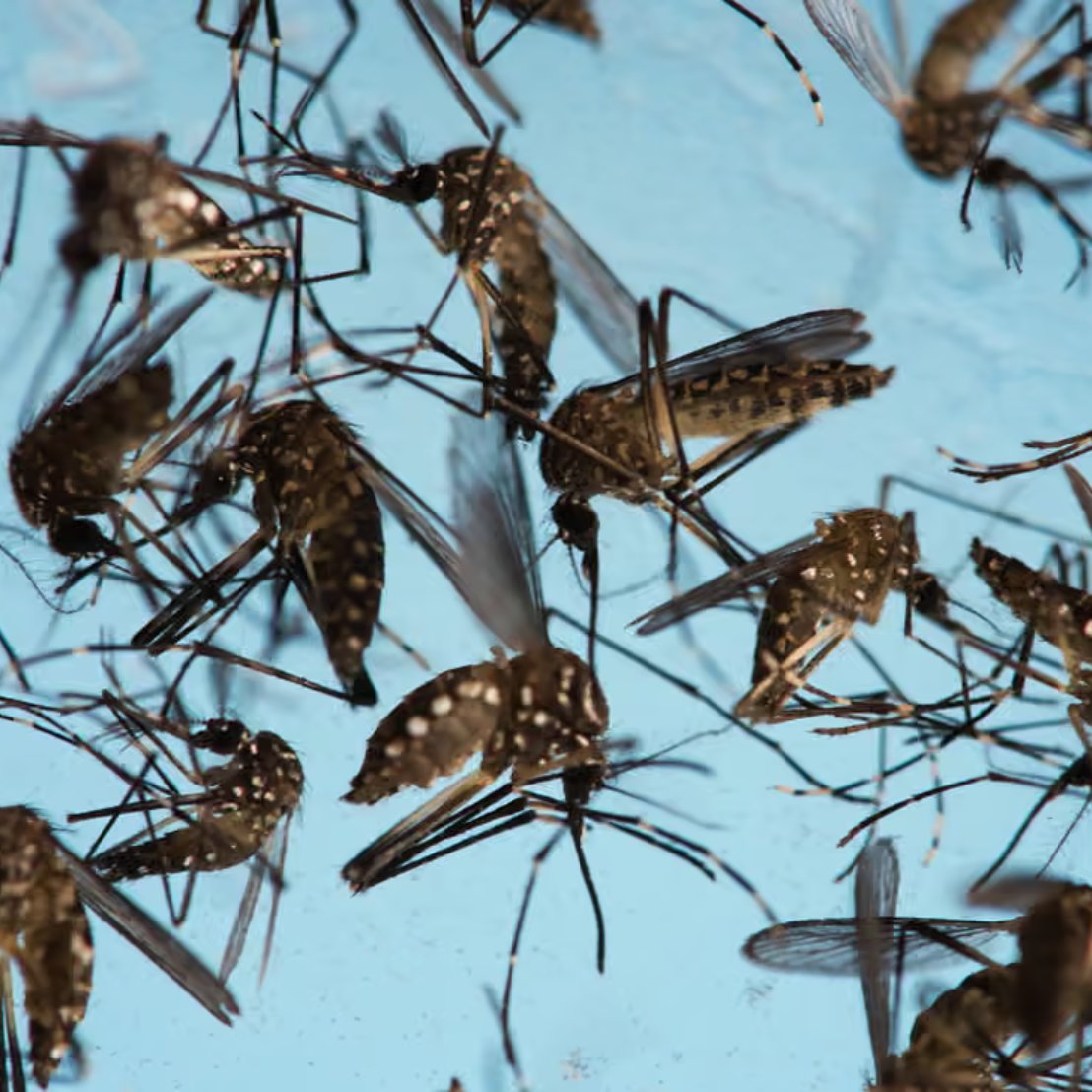
BREAKING: Google is planning to release 32 million mosquitoes across Florida and California.
The company has asked the EPA for permission to proceed, with the public given until June 5 to respond.
The mosquitoes are infected with Wolbachia bacteria, which stops them from reproducing and slowly collapses the wild population from within.
Google's previous Debug Project trial in California's Central Valley nearly eliminated mosquitoes from three test sites entirely. A separate trial in Singapore cut dengue cases by 70% within 12 months.
Google has now released over 1 billion mosquitoes across four continents. This new proposal is the largest deployment in US history.
That water clarity is an engineering decision, and the math behind it is wilder than the video.
Roman aqueducts ran on gravity alone. No pumps, no pressure systems. Engineers carved channels with a gradient so shallow it borders on absurd. The Pont du Gard in southern France drops 2.5 centimeters over 275 meters. That's roughly the thickness of a coin over the length of three football fields. They surveyed that accuracy with plumb lines and wooden leveling instruments.
The clarity you're seeing is a direct product of flow velocity. Too steep and the water erodes the channel walls, picks up sediment, turns brown. Too flat and it stagnates. Roman engineers targeted a slope of about 20 centimeters per kilometer, which kept the water moving fast enough to stay fresh but slow enough to stay clear. Before the water reached the city, it passed through multi-chamber settling tanks where velocity dropped near zero. Suspended particles sank. Clean water flowed out the top into the next chamber. Repeat three or four times.
Pliny specified the minimum slope in writing. Vitruvius published the exact mortar ratio for hydraulic cement: one part lime to two parts volcanic ash for underwater work. The pozzolana from Pozzuoli reacted with water to form a calcium-aluminum-silicate compound that actually gets stronger the longer it sits submerged. Modern concrete degrades in water. Roman concrete bonds with it.
Scale the whole system and it gets harder to process. Eleven aqueducts fed Rome at its peak. Combined output: roughly 1 million cubic meters of water per day. That works out to about 250 gallons per person for a city of one million. Modern New York delivers about 125 gallons per person per day. Ancient Rome had access to double the per capita water supply of the largest city in the United States, running entirely on slope and stone.
The Trevi Fountain in Rome is still fed by one of them. Two thousand years, same source, same gravity, same water.
SITUATION DETECTED: Google DeepMind’s AI agent autonomously solved 9 of 353 open Erdos problems in mathematics, at a cost of a few hundred dollars per problem.
According to ESPN Analytics, the Knicks win probability was as low as 0.1% 🤯
Teams trailing by 22 points in the fourth quarter of a playoff game since 1997-98 were 1-594 entering Tuesday.
Harvard ha votado limitar las notas A en los grados: como máximo, el 20% de los estudiantes de cada clase podrá recibir una A, con una pequeña excepción de cuatro A adicionales para clases pequeñas.
El objetivo es frenar una inflación de notas muy intensa: en 2012-13, alrededor de un tercio de las calificaciones eran A; en 2024-25, ya eran dos tercios.
La inflación de notas tiene consecuencias reales: si casi todos obtienen A o A-, las calificaciones dejan de distinguir el rendimiento verdaderamente excepcional.
https://t.co/5vNuU7LjEg https://t.co/WfE2bHo0l2
https://t.co/gjtUY7iJ4V NYT’s Maureen Dowd just dropped ‘What A.I. Kant Do’ — and it’s spot on. Tech bros spent years calling humanities ‘useless.’ Now? AI codes for them, but can’t touch Kant’s Analytic of the Sublime, existential grit, or raw human imagination.
AI comprehends. Humans apprehend. Big difference. Enter tools like ML11 (MorphLine11’s AI orchestration): It turns messy convos into execution workflows. Useful AF for founders grinding solo. But it’s a tool, not a thinker. Kant would say: Use it to free your mind for the real work — ethics, creativity, judgment — not outsource your humanity.” “Lesson for 2026: Stack ML11 (or whatever your AI stack) for ops. Study Kant, Shakespeare, Nietzsche for the edge AI can’t replicate.
Humanity’s comeback tour starts in the liberal arts dept. Who’s building the next gen of thinkers + doers?
#KantAI #ML11 #WhatAIKantDo #HumanEdge”
Liberal arts majors - and I mean those committed to the broad intellectual canon and to critical thinking, textual analysis, etc. - are best positioned for the AI age. You learn how to evaluate AI output. Pre-professional degrees, esp in high tech fields, are most vulnerable.
Why is biological insight so useful for the legal system? I wrote this article in the Atlantic over a decade ago; this is the first reading in my neurolaw course at Stanford.
https://t.co/Ao2eHApVvf




![Rainmaker1973's tweet photo. The complexity of the human brain and its functions in a neat infographic map
[zoomable version: https://t.co/ADEhDeTkmx] https://t.co/DI0gQaywHu](https://pbs.twimg.com/media/HIl494OXgAAZoPj.jpg)