"You aren't a Christian if you don't accept the Trinity."
The history of that statement is quite shocking, and almost nobody who says it knows that acceptance of the doctrine of the Trinity was once enforced by exile, fire, and death.
Here is what happened.
For the first 300 years after Jesus, Christians did not agree on how He related to God the Father. They argued about it constantly. There was no official rule. That was just normal.
Then a priest named Arius said the Son came from the Father and was beneath Him. Not equal. Not eternal. A lot of Christians agreed with him. A lot. This was not some fringe group. For stretches of the next century, his side was winning.
Other Christians said the opposite. The Son was fully God, equal to the Father, no beginning. Two camps, same Bible, opposite conclusions.
The fighting got bad. Riots. Mobs in the streets. Christians brawling over the nature of God.
So the Roman emperor stepped in. Constantine. He had just won a civil war and he wanted his empire to stop fighting. He was not even baptized. He did not care about the theology. He cared about order.
In the year 325 he called the bishops to a town called Nicaea. He paid for it. He ran the meeting himself. And they voted. They ruled that the Son was equal to the Father, fully God, one substance with Him. That ruling is the core of the Trinity. It got settled in that room, by that vote, on one word that is not even in the Bible.
They wrote the ruling into an official statement of belief. A creed. Every bishop was expected to sign it.
That is the part people think is the story. It isn't. The shocking part is how they made everyone accept it.
Constantine made the bishops sign the creed. The few who refused, he banished.
Then he ordered every book Arius ever wrote to be burned.
Then he made a law. If you were caught hiding one of those books, you were put to death.
Even after all of that, the Trinity did not win for good.
A few years later Constantine changed his mind. He brought Arius back. And he exiled Athanasius, the bishop who had won the argument at Nicaea. That man got banished five separate times in his life for believing the thing the church now says you have to believe.
For the next fifty years it flipped back and forth. One emperor said Trinity. The next said no. Whoever sat on the throne decided what was true. The official belief about God changed every time power changed hands.
It finally got locked in by another emperor named Theodosius. He made the Trinity the law of the empire. Disagree, and you were a heretic. Not in some spiritual sense. By law. Backed by soldiers.
A few years after that, the empire executed a bishop for his beliefs. The first time the state put a Christian to death over doctrine. It would not be the last.
Then came the document that says it out loud. A creed written around the year 500. Almost five centuries after Jesus. They named it after Athanasius, that same bishop. He did not even write it. They put his name on it for the authority.
It opens by declaring that anyone who does not hold the Trinity, whole and complete, will perish forever. Believe it or be damned. Put in writing, and made the test of who gets saved.
So that is where the line comes from. Not from Jesus. Not from the apostles. From emperors and councils who needed a divided empire to fall in line.
The Trinity did not become the rule because the argument was settled. It became the rule because the side that held it had the throne, the law, and the sword.
The next time someone says you aren't a Christian unless you accept the Trinity, remember what it took to make that rule stick. Exile. Fire. And death.
@WEschenbach@stkirsch@HouseLyndseyRN Good that you've heard of case studies. I was starting to wonder. Are you also aware that that doctors routinely use BMJ case reports as evidence to support clinical diagnosis and treatment? https://t.co/cPPnLv6RxS
The UK just deployed a political weapon it's only used once before in modern history.
And nobody is talking about what it just backfired into.
🚨 🚨 🚨 KEIR STARMER BANNED FOREIGN JOURNALISTS FROM ENGLAND TO STOP A RALLY → IT PRODUCED THE LARGEST ANTI-GOVERNMENT MARCH IN YEARS 🚨 🚨 🚨
The Home Office issued entry bans on 11 foreign nationals ahead of the 16 May 'Unite the Kingdom' rally in central London. Rebel News founder Ezra Levant. Multiple journalists. Commentators. Banned from the country. To stop a march.
Metropolitan Police deployed 4,000+ officers. Live facial recognition. Drones. Dogs. Horses.
The result: tens of thousands — some estimates reaching hundreds of thousands — flooding the streets of London anyway.
THE WEAPON:
→ UK Home Office entry bans — 11 foreign nationals barred from the country
→ Prime Minister publicly labeled the rally "extremist" and "hatred and division"
→ Starmer framed it as "a battle for the soul of our nation" in direct pre-rally statements
→ Police mobilized at a scale typically reserved for state visits or terror threats
→ Live facial recognition deployed across central London
→ Rival pro-Palestine march simultaneously permitted on the same day
→ Metropolitan Police prepared for 50,000 — the actual crowd exceeded preparation
→ Government rhetoric amplified international media attention across the US and Europe
THE TARGET:
→ A march organized around "national unity, free speech, and Christian values"
→ Organized weeks after Reform UK seized 1,350+ council seats and control of 13 councils in the 8 May local elections
→ Reform's gains came primarily at Labour's direct expense — Essex, Sunderland, council after council
THE MATH:
→ Reform UK: 1,350+ seats gained in a single election cycle
→ 13 councils flipped — including Essex with 42 seats
→ Starmer's response: ban journalists, deploy 4,000 officers, call the march extremist
→ Outcome: the bans became the story, the march became a symbol, and the streets filled anyway
Read that again.
💀 Every ban Starmer issued handed organizers a government-censorship narrative
💀 Every officer deployed turned a political rally into a national confrontation
💀 The suppression didn't shrink the movement — it advertised it
⚠️ Reform just proved it can win elections. The march proved it can also fill streets.
⚠️ Starmer called it "a battle for the soul of our nation" — and then lost the visual battle on live television
⚠️ This isn't a fringe moment. This is what a political realignment looks like in the streets.
They're showing you the arrests and the police lines.
They're NOT showing you what this sequence actually means — a government that just lost 1,350 council seats in one night responded to the aftermath by banning journalists and calling a march extremist, and the streets answered with the largest visible opposition mobilization in years.
You don't ban foreign journalists to stop a fringe event. You ban foreign journalists when you're afraid of what the footage will show. And you only deploy 4,000 officers with drones and facial recognition when you already know the crowd is going to be too large to ignore.
Process that.
Most people won't see this. RT to change that. 🔥
I'll keep you updated as this unfolds, turn on notifications this is EXTREMELY important.
@WEschenbach@stkirsch@HouseLyndseyRN Yes, there are lots of "studies." Unfortunately, they're mostly paid for by the pharma folks who make the shots or by the CDC. CDC MMWRs cannot be your go-to info source.
@WEschenbach@stkirsch Willis, what is the basis for the assertion that myocarditis is a more common side effect of Covid than of the vax?
Are you familiar with the story of @HouseLyndseyRN?
https://t.co/X7vXBofD1X
Wilis, as I said, "For a shot offering so little benefit, it makes sense to await 'rigorous, scientific proof' of no harm." So we agree that it's a cost-benefit question. The "rarity" of myocarditis is relative. And myocarditis is only one of many VAERS signals from the "clot shot". It's a judgment call. You do you! But to say that one can "infer nothing" from VAERS is not accurate.
Thanks, Willis. The question is whether the vaccine has been proven NOT to cause myocarditis. VAERS reports 111 Covid-shot myocarditis events with no other meds involved. Even assuming no underreporting, and setting aside efficacy questions, this is enough of a causal signal to say "No poke without proof of NO harm." VAERS reports ARE evidence that a correlation cannot be ruled out. Their anecdotal status affects their evidentiary weight, not their relevance. For a shot offering so little benefit, it makes sense to await "rigorous, scientific proof" of no harm.
Be well!
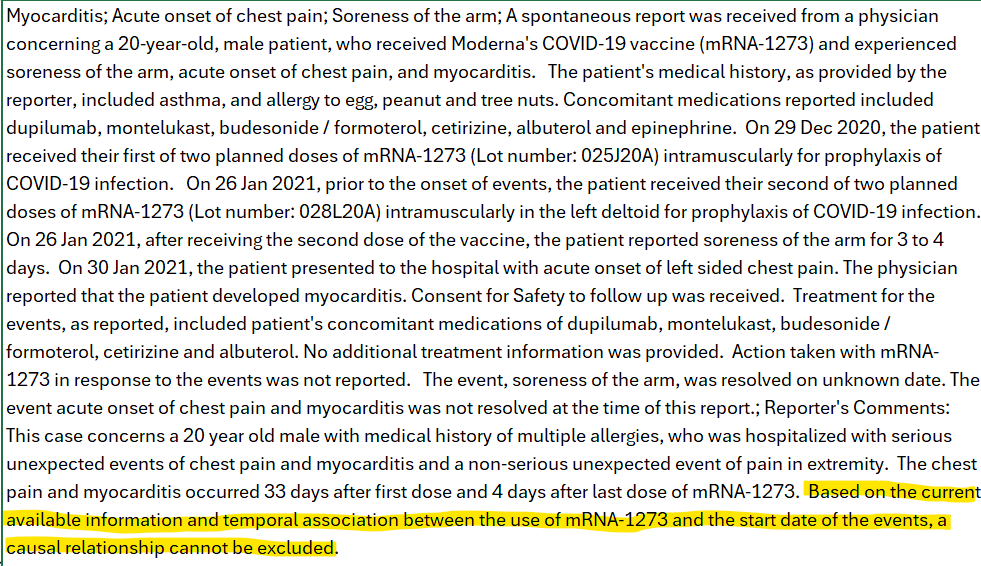
Yes, see a VAERS report example below.
CDC: "The strengths of VAERS are that it is national in scope and can often quickly detect an early hint or warning of a safety problem with a vaccine...VAERS is designed to rapidly detect unusual or unexpected patterns of adverse events, also referred to as "safety signals."
When a government agency tells me in broad terms that "scientists" have found this or that, I immediately think, "Scientists. LoL," followed by, "The more he spoke of his honor, the faster we counted our spoons."
Winston Churchill fought his depression with bricks. He'd lay them for hours at his country home in Kent. He joined the bricklayers' union. And in 1921 he wrote about why it worked. It took psychology another 75 years to catch up.
He called his depression the "Black Dog." It followed him for decades. His method for fighting it back was as basic as it sounds: laying brick after brick, hour after hour.
Churchill spelled out his theory in a long essay for The Strand Magazine. People who think for a living, he wrote, can't fix a tired brain just by resting it. They have to use a different part of themselves. The part that moves the eyes and the hands. Woodworking, chemistry, bookbinding, bricklaying, painting. Anything that drags the body into a problem the mind can't solve by itself.
Modern psychology now calls this behavioral activation. It's one of the most-studied depression treatments out there. Depression sets a behavior trap. You feel bad, so you stop doing things, and doing less means less to feel good about. Feeling worse makes you do even less. The loop tightens until you can't breathe inside it.
Behavioral activation breaks the loop from the action side. You schedule the activity first, even when every part of you doesn't want to. Doing it produces small rewards: a wall gets straighter, a painting fills in, a messy room gets clean. Those small rewards slowly rewire the brain. Action comes first, and the feeling follows.
Researchers at the University of Washington put this to the test in 2006. They studied 241 adults with major depression and compared three treatments: behavioral activation, regular talk therapy, and antidepressants. For the people who were most severely depressed, behavioral activation matched the drugs. It beat the talk therapy. A 2014 review of more than 1,500 patients across 26 trials backed up the result.
Physical work like bricklaying does something extra on top of this. It crowds out rumination, the looping bad thoughts that grind people down during the worst stretches of depression. Bricklaying needs both hands and gives feedback brick by brick: each one is straight or crooked. After an hour you can see exactly how much wall you built. No room left for the mental chewing.
The line George Mack used in his post, "depression hates a moving target," is good poetry. The science behind it is sharper. Depression hates a brain that has somewhere else to be.
"Is" vs "may" is a false dichotomy. Evidence *is* probabilistic, never deterministic. So "may" ~ "is". VAERS data does not "prove" causation; nothing can. But a rash of VAERS reports of myocarditis appearing closely on the heels of vaccination justifies a presumption of probabilistic harm. Wise doctors will weigh that presumed harm against perceived benefits of vaccination for individual patients.