I've been reading a lot about "plant biosensors" or "plant sentinels" lately, which are crops that have been engineered to sense molecules in the environment (like pesticides or toxins) and then change color in response.
I think they could be incredibly useful for farmers and help stop infections before they spread. Here's how they work...
About two decades ago, Sean Cutler (who I met last weekend at Lake Arrowhead) did seminal work to discover protein receptors that bind to a plant hormone called abscisic acid, or ABA. This plant hormone regulates how plants respond to stress during, say, droughts.
Now, plants sense ABA in a slightly complicated way: First, ABA binds to a protein called PYR1. This forces PYR1 to shift into a different shape, revealing a "binding pocket" that latches onto another protein called HAB1. Over time, this causes HAB1 levels to drop in the cell, which plants use as a signal to activate their stress response.
Okay, so those are the basics. Now how are these proteins actually engineered to sense *new* molecules?
That's the cool bit. Cutler's group at UC Riverside is basically really good at engineering the ligand-binding pocket in the PYR1 protein. They've solved its crystal structure, and they know exactly which amino acids are responsible for grabbing onto the ABA molecules. So in one of their papers (see here: https://t.co/0mABsRfEyl) they randomly mutated these amino acids and then searched for PYR1 mutants that were able to grab onto NEW molecules, rather than just ABA.
And it actually worked.
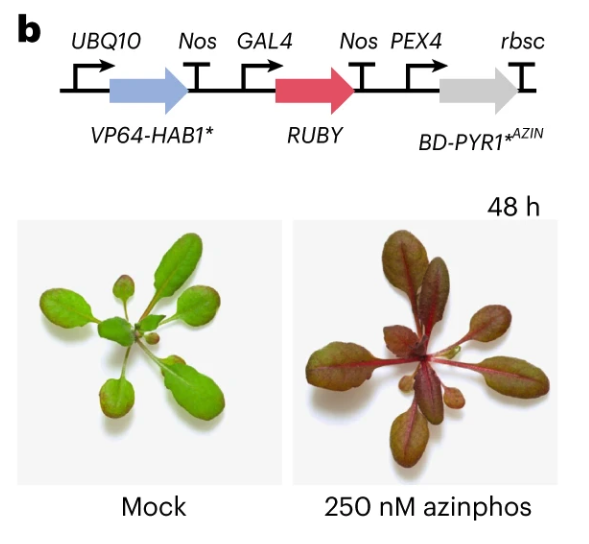
They found mutated PYR1 proteins that can grab onto lots of different things. Cutler's team has made PYR1 variants, for example, that can grab onto banned organophosphate pesticides, like azinphos-ethyl and diazinon, with nanomolar sensitivity and without grabbing onto ABA (in other words, the *new* proteins are orthogonal to the old ones.
But what about the RESPONSE? When a mutated version of PYR1 grabs onto a pesticide, how does that trigger the plant to physically change color?
That's where the "synthetic biology" comes in. When the engineered PYR1 binds to the target molecule, it then grabs onto a MODIFIED VERSION of HAB1 (called HAB1*, and which is also orthogonal to the normal HAB1), which in turn activates genes of the scientists' choosing. For example, Cutler's team can encode the betalain biosynthesis pathway into these plants --- the same genes that give beets their dark red color --- and have the plants make those pigments after sensing a desired molecule. They've basically built orthogonal, programmable biosensors inside of plants.
So here's the breakdown:
- Engineer PYR1 to detect new molecules. The sky is the limit; this could be toxins, molecules associated with soil nutrient levels, pathogen proteins, and much more.
- Rewire the genetic output so that PYR1, when activated, triggers the production of red pigments or something else (and not drought response.)
- The plants change color when they sense the target molecules.
Hopefully there will be field trials for these plant biosensors soon. Regulations will obviously slow this work down, but the good news here is that farmers could plant JUST A FEW of these "plant biosensors" among the tens of thousands of plants in their fields. And these biosensors would not be sold as food! They could just act as sensors, and be discarded at the end of every growing season.
Thanks for reading!
I'm travelling through S. Korea, China and Singapore to visit biotechnology programs.
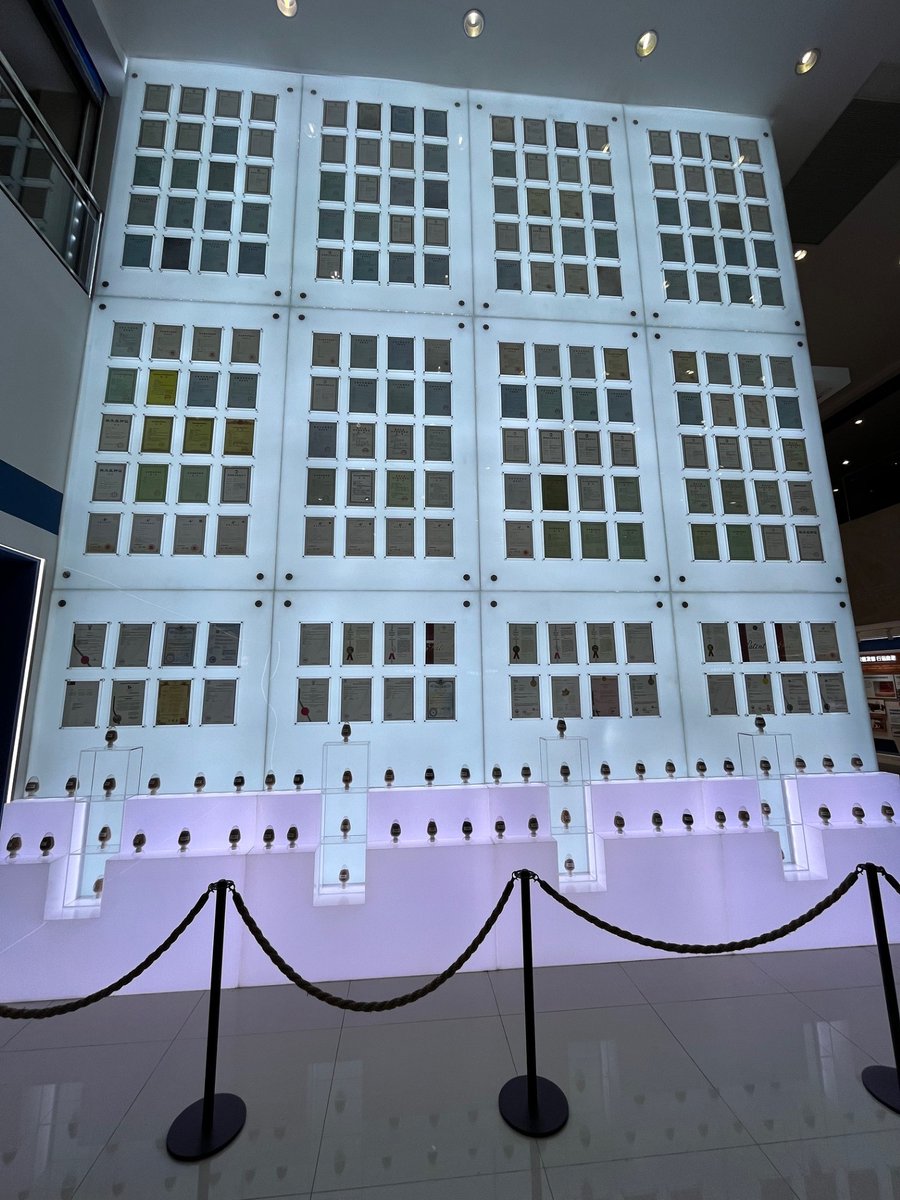
This is a wall of patents at a Chinese Academy of Science research building; one of the best plant engineering centers on the planet.
The jars hold engineered seeds that they developed here.
If you’re interested in working at the cutting edge of AI and bio reach out. We have many opportunities in both biotech startups and in academia working on some cool projects. Please RT and feel free to DM or email #bio/acc
The team wiki has been a key deliverable since iGEM first became an international competition in 2005 and is archived so it can be accessed by future teams and iGEM community members. Today we're celebrating the best team wikis from the last #20yearsofiGEM https://t.co/uEQCEkQCa6
Announcing Asimov Press, an editorially-independent venture that will publish books and essays that make sense of biology, AI, and our collective future.
Learn more: https://t.co/qoT7JCXYZG
🧬8 Free Courses to Learn Synthetic Biology
Yesterday, I gave my ten book picks. Today, it's all about online videos and lectures.
Here are my recommendations, in order of increasing difficulty:
Saltwater powered light. If one is able to build this product in large scale who would use it and why? Any insights would be great!
https://t.co/AGmArkn30T via @YouTube
The final item up for grabs in our Twistiversary Giftopolooza is one of the best #TwistSwag items ever created. Snag this one by liking and retweeting.
We’re turning ✨10✨ and celebrating our Twistiversary with giveaways all day! Snag this wine key to help you celebrate your milestones. 🥂 Like and retweet to enter to win!
@TwistBioscience Weirdly I find making sample plates most relaxing. The smooth streak plate motions, the hum of the LAF, and then the satisfaction of seeing 50 plates stacked in the incubator.
DNA synthesis hasn't changed in 30 years - but this company is about to disrupt the entire industry with its desktop DNA synthesizer that empowers scientists to print their own DNA on demand using clean, enzymatic DNA synthesis #EDS technology.
1/
Biology is one of our best tools to avoid climate catastrophe (see @Solugen producing carbon-negative chemicals at scale!). We're compiling an open list of the labs doing the most interesting research in climate meets synbio. Who should be added?
List 👇
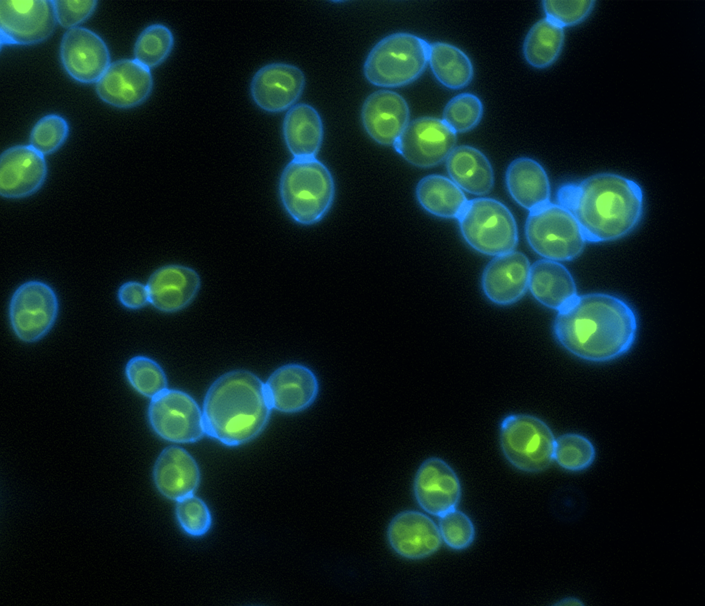
Hey folks, we have a new preprint out. How hard is it to give a eukaryote a supplemental biological solar panel (aka, become facultatively phototrophic)? We stuck a rhodopsin, which pumps protons when hit by green light, into yeast to find out. 1/24
https://t.co/mzg6PhXlRt
We’ve had > 600 synbio students apply for SynBioBeta in May! We are giving away 100 conference passes. @ericschmidt & @SchmidtFutures are sponsoring 100 travel grants but we have a delta of 500! Want to support the next generation of bioeconomy entrepreneurs? Please let me know!
20 years ago, a typical biological experiment generated 3-5 Mb of data. Today, #synbio workflows produce between 1,000-40,000 Tb. That is a BILLION times more data! But @LatchBio is helping scientists tackle the data deluge with code-free biocomputing:
1/
https://t.co/UH8S9ckBM5
Young biologists should work on plants. 🌱
1. SynBio tools are ~10 yrs behind bacteria
2. Basic science has lagged. Often, we don't know what to edit to improve traits
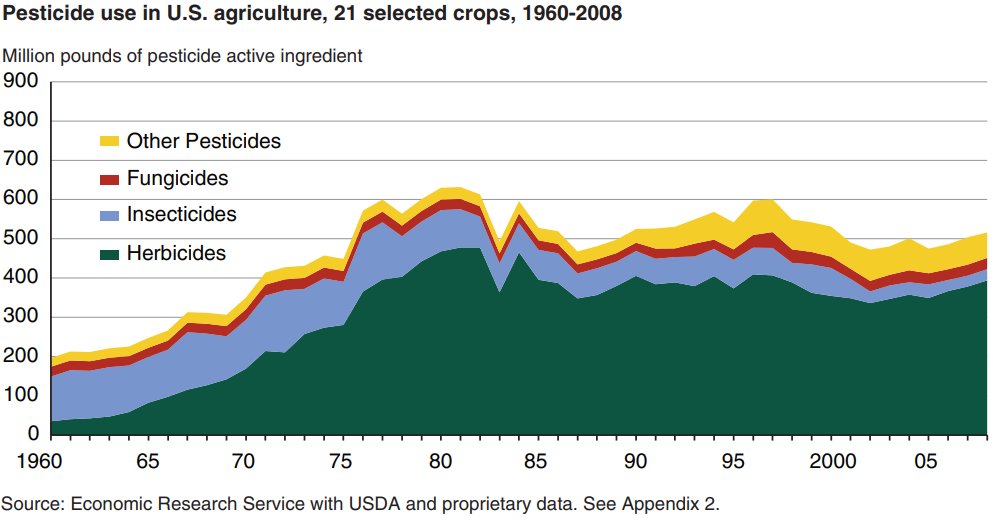
3. Pesticide use is flat & 40% of crops lost to pests
5. Design flowers.
Lots of room to make a big impact!