What to know about the new Trump Account for children. @sarahffoster explains who’s eligible and how it differs from traditional savings accounts and 529s.
People with IDD need your support in the FY27 Budget! A 3% COLA increase for home and community-based services would protect supports for people with IDD,Contact your legislators and tell them to support Senate Resolution #261 and Assembly Resolution #131! https://t.co/V9K4Owu4fr
A new shot literally regrows knee cartilage.
Researchers at Stanford Medicine have identified a novel strategy to regenerate articular cartilage in knees and potentially prevent or treat osteoarthritis (OA).
The method targets 15-hydroxyprostaglandin dehydrogenase (15-PGDH), an age-related enzyme—or "gerozyme"—that accumulates in aging tissues and drives degeneration.
In aged mice, small-molecule inhibitors of 15-PGDH, delivered systemically or via intra-articular injection, promoted cartilage thickening and regeneration of functional hyaline articular cartilage.
This occurred without recruiting stem or progenitor cells; instead, existing chondrocytes underwent transcriptional reprogramming to a youthful state, with reduced populations of inflammatory and hypertrophic/degradative cells and expanded matrix-producing articular chondrocytes.
The inhibitors also reversed natural age-related cartilage thinning, improved joint function, and—when administered after simulated ACL injuries—strongly mitigated post-traumatic OA progression and associated pain.
Human OA cartilage explants from total knee replacements responded similarly in vitro, showing decreased degradation markers and evidence of new articular cartilage formation.
Given that an oral 15-PGDH inhibitor has already completed Phase 1 safety trials for age-related muscle atrophy, the findings open a path toward disease-modifying, regenerative therapies that could delay or obviate the need for joint replacement surgery.
[Agarwal, P., Su, S., Ancel, S., et al. (2025). Inhibition of 15-hydroxy prostaglandin dehydrogenase promotes cartilage regeneration. Science. DOI: 10.1126/science.adx6649]
This is New Jersey" - natural beauty, serene landscapes. "Can we stop turning it into this?" - overbuilt and soulless. This transformation isn't progress, it's destruction. Nature belongs to us all, not just developers. What do you think? 🌳
People with IDD need your support in the FY27 Budget! A 3% COLA increase. Contact your legislators and tell them to support Senate Resolution #261 and Assembly Resolution #131! https://t.co/V9K4Owu4fr
Today even Nobel Prize laureates are beginning to move toward the NMSI paradigm.
Frank Wilczek openly suggests that: matter and energy may NOT be fundamental, but instead emerge from deeper informational structures.
This is precisely the central direction of NMSI: matter is not primary, energy is not primary, coherent information is fundamental.
And this becomes increasingly important as the standard ΛCDM cosmological model continues accumulating unresolved tensions and contradictions.
Modern cosmology still relies on:
Dark Matter, Dark Energy, accelerating expansion, inflation, an initial singularity, and multiple adjustable parameters introduced to fit observations.
The problem is that many of these components have never been directly detected.
Meanwhile observations continue producing major anomalies: Hubble Tension, mature galaxies observed too early by JWST, large-scale structure inconsistencies, S₈ and σ₈ discrepancies, non-uniform galaxy distributions, and the rapid formation problem of supermassive black holes.
ΛCDM still works mathematically on certain scales, but it increasingly resembles a system of theoretical patches..
NMSI proposes a different paradigm: the Universe is not built from matter producing information. The Universe itself is a coherent informational geometry, while matter and energy are emergent manifestations of that coherence.
In this perspective: gravity becomes an emergent informational effect, cosmic structures arise through oscillatory harmonization, and redshift may reflect informational and phase processes, not only metric expansion.
Perhaps physics is approaching the moment when it will have to accept that: information is not a byproduct of the Universe.
Information is its fundamental infrastructure.
For more info - full Paper:
https://t.co/115NwuM5jY
#NMSI #Cosmology #ΛCDM #Physics #FrankWilczek #JWST #HubbleTension #QuantumPhysics #Ormuz #Lazarev
#HubbleTension #NobelPrize #RON #US
This is New Jersey" - natural beauty, serene landscapes. "Can we stop turning it into this?" - overbuilt and soulless. This transformation isn't progress, it's destruction. Nature belongs to us all, not just developers. What do you think? 🌳
I 287 closed in both directions Edison, New Jersey after an 8,000 gallon fuel tanker ignited 😳
Seeing multiple reports of people hurt from this, cannot fully confirm. Over 150 firefighters are on scene, be careful folks
https://t.co/Qoh5Rmwb2G
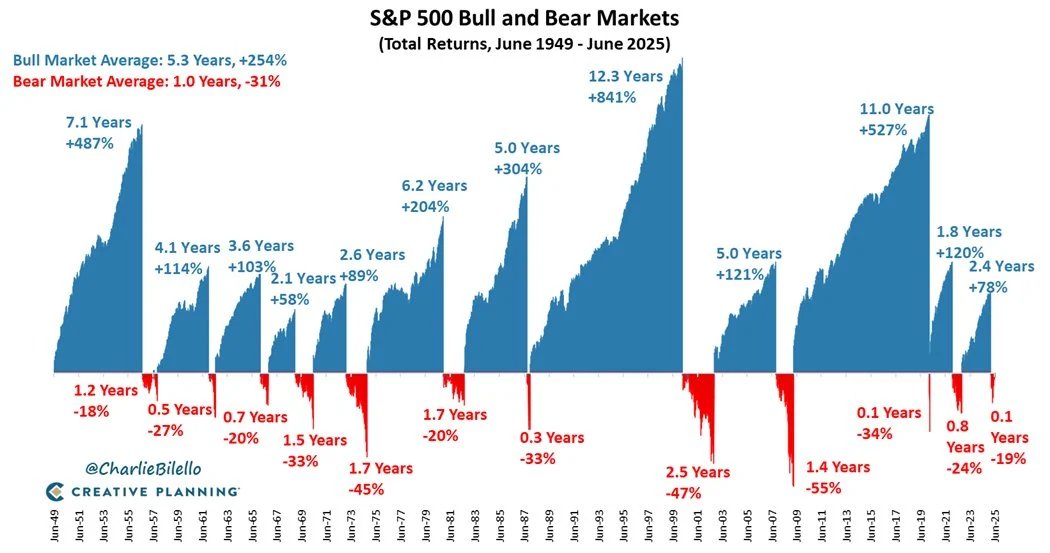
"Markets take the stairs up and the elevator down."
This chart proves it beyond any doubt.
S&P 500. Every bull and bear market since 1949.
Bull markets:
→ Average 5.3 years
→ Average +254%
→ Longest: 12.3 years, +841%
Bear markets:
→ Average 1.0 years
→ Average −31%
→ Worst: 1.4 years, −55%
The asymmetry is breathtaking.
You spend years building wealth on the stairs.
Then the elevator arrives and takes a chunk back in months.
But here's what the chart really shows.
The blue always came back.
Every single time.
And always went higher than before.
The bear markets look terrifying in the moment.
On a 75-year chart, they look like speed bumps.
The stairs always win.
Time is the only ticket you need.
Here is Mikie Sherrill telling people our elections in NJ are not safe and we need paper ballots.
Trump wants to put barcodes on mail-in ballots and she calls it unconstitutional
#JerseyDeservesBetter and secure elections.
@GovSherrillNJ Mikie Sherrill Saying NEW JERSEY has SECURE ELECTIONS all while she states NJ has the LEAST SAFE ELECTION SYSTEMS IN THE COUNTY
If elections are secure here, why did the Democrats have TO BE SUED TO SEE THE VOTER ROLLS
https://t.co/BxOUXPPhk5
There is a near-perfect correlation between US oil prices and US CPI inflation, as shown in our below analysis.
As WTI crude surges above $112/barrel, we believe the US economy is bracing for 3.5%+ CPI inflation, particularly if current prices persist through April.
Asset owners will be the only winners in the long-run.


![Rainmaker1973's tweet photo. A new shot literally regrows knee cartilage.
Researchers at Stanford Medicine have identified a novel strategy to regenerate articular cartilage in knees and potentially prevent or treat osteoarthritis (OA).
The method targets 15-hydroxyprostaglandin dehydrogenase (15-PGDH), an age-related enzyme—or "gerozyme"—that accumulates in aging tissues and drives degeneration.
In aged mice, small-molecule inhibitors of 15-PGDH, delivered systemically or via intra-articular injection, promoted cartilage thickening and regeneration of functional hyaline articular cartilage.
This occurred without recruiting stem or progenitor cells; instead, existing chondrocytes underwent transcriptional reprogramming to a youthful state, with reduced populations of inflammatory and hypertrophic/degradative cells and expanded matrix-producing articular chondrocytes.
The inhibitors also reversed natural age-related cartilage thinning, improved joint function, and—when administered after simulated ACL injuries—strongly mitigated post-traumatic OA progression and associated pain.
Human OA cartilage explants from total knee replacements responded similarly in vitro, showing decreased degradation markers and evidence of new articular cartilage formation.
Given that an oral 15-PGDH inhibitor has already completed Phase 1 safety trials for age-related muscle atrophy, the findings open a path toward disease-modifying, regenerative therapies that could delay or obviate the need for joint replacement surgery.
[Agarwal, P., Su, S., Ancel, S., et al. (2025). Inhibition of 15-hydroxy prostaglandin dehydrogenase promotes cartilage regeneration. Science. DOI: 10.1126/science.adx6649]](https://pbs.twimg.com/media/HK_64zQXEAAhV_3.jpg)