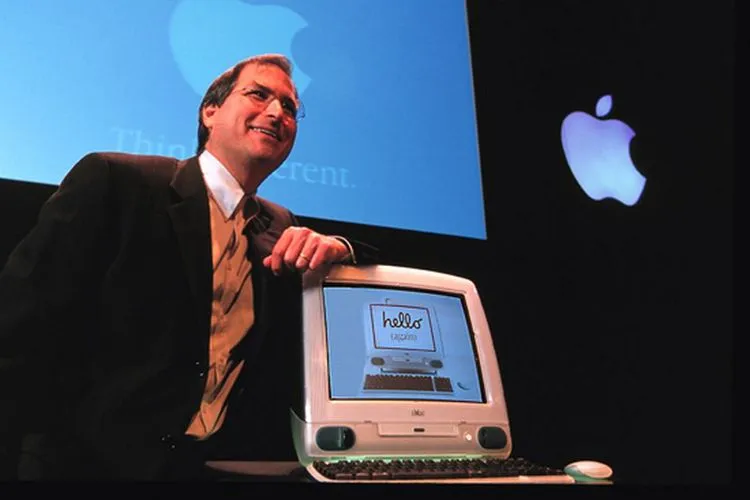
When Jony Ive designed the first iMac, he put a handle on it.
Not so people could carry it, it was a desktop computer. Nobody was going to carry it anywhere.
Steve Jobs insisted on it anyway.
Manufacturing a recessed handle cost a fortune. Every engineer at the old Apple would have killed it.
Ive explained why it mattered: "Back then, people weren't comfortable with technology. If you're scared of something, you won't touch it. If there's a handle on it, it makes a relationship possible. It gives you permission to touch."
A handle changed how people felt about approaching a computer.
Elon thinks the same way.
Early Tesla engineers would describe him stopping meetings over a panel gap, a surface ratio, a curve that didn't feel right... Things that had nothing to do with range or performance.
He'd just say it's not beautiful enough and refuse to move on.
Most people assume Jobs and Musk are opposites, one sold dreams, the other sells engineering.
The overlap is that both understood something most builders never figure out: "The way a product makes you feel when you look at it is part of how it works."
.@EricJorgenson on why Steve Jobs and @elonmusk are more similar than people realize:
"I think Elon is underrated in his design sense. There's a lot of times when you hear Elon quotes that sound exactly like Steve Jobs would've said.
He thinks about it like an algorithm. There's certain things, ratios that have to exist between the product, or it needs to feel bigger on the inside than it looks on the outside — that he just absolutely insists on.
There's stories, especially from early Tesla, of him being unreasonable about design decisions that he just puts a finger on, and is like, 'It has to be this way or it's not good enough, it's not beautiful enough, it's not aesthetic enough.'
In the same way that Steve Jobs was very much like, 'No, put a handle on that computer, because it changes the relationship that somebody has with this kind of new, foreign machine.'"
Travis Kalanick: "I was running a $70 billion company the way somebody who thought he was going to starve next week would run it."
In June 2017, Uber's investors pushed him to resign as CEO of the company he co-founded.
"Every decision I made at Uber, I defend to this day. Never had chalk on my shoe."
"The problem was I ran too close to the line in too many situations. When you're big and important, the scrutiny and expectation is that you don't run that close to the line, even if it's correct. That is a thing I definitely did not understand."
The fear of starving came from his first two companies.
His first startup, Scour, was sued by the entertainment industry for $250 billion and went bankrupt. His second, Red Swoosh, nearly ran out of money several times. Along the way he moved back in with his parents. Akamai bought Red Swoosh in 2007 for about $19 million.
"First four years, no salary, ran out of money several times, super grind, lose all friends. The non-luckiest entrepreneur journey of all time."
"It was so hard that I had to be epically precise and hardcore just to pay the bills and go to the grocery store next week. And that precision and intensity made Uber what it was."
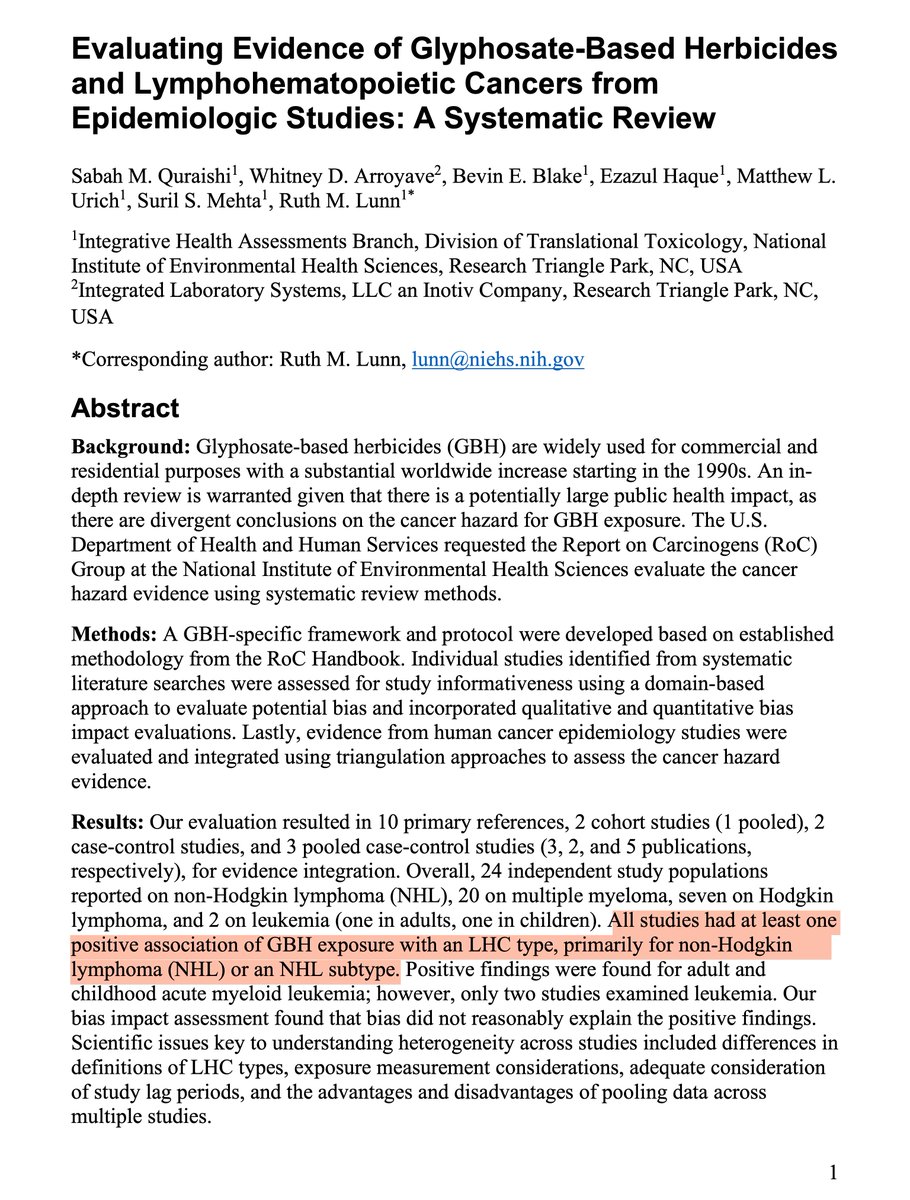
JUST IN: NIH scientists released their systematic review of glyphosate and blood cancers.
All studies had at least one positive association of glyphosate exposure with a blood cancer, primarily non-Hodgkin lymphoma. (1/12)
Jensen got his job back this morning, and Wall Street added 30% to Nvidia.
Meanwhile, you can run one of his B300s for an afternoon. Free, no credit card required.
Apple pushed Steve Jobs out in 1985 and left the company to a Pepsi executive.
12 years later Apple was weeks from bankruptcy, selling a dozen versions of the same Mac that nobody could tell apart.
Jobs came back, walked up to a whiteboard, drew four boxes and killed every product that didn't fit in one.
One reason founder CEOs are so hard to replace is that they’re effectively also the chief product officer. They know how the product was built, can hold the entire product in their head, and have the vision and authority to reinvent it.
When they leave, the CEO role gets filled, but the product role they played rarely does.
Jensen Huang resigned as Nvidia's CEO on November 12, after reports of affairs.
Palmer Luckey on why he wants Jensen to stay at Nvidia:
"China wants Jensen out. So I want him in."
Even though he doesn't even agree with Jensen on China: "I don't think that we should be exporting chips to China. He thinks that there is an argument. I think there are reasonable arguments... I just happen to not be quite on their side."
His point is that Beijing and Chinese companies want different things:
"China doesn't want Nvidia to sell GPUs to Chinese companies. There are Chinese companies that want to buy Nvidia GPUs."
"There's 600,000 H200 GPUs sitting in a port right now because China will not give them an import permit because they want to build an internal domestic processor industry."
"They're thrilled to have Jensen out. They know that it makes America weaker to knock him out."
On the interim CEO, Colette Kress, Nvidia's CFO since 2013:
"I'm sure this CFO lady they put in as interim CEO is a perfectly wonderful woman, but she is not Jensen. His personal relationships are the reasons that everyone is willing to do business, because paper means nothing. Paper gives you the right to sue somebody after you think they screwed you. That doesn't actually solve problems."
In 2014, Palmer Luckey sold Oculus to Facebook for about $2 billion.
In 2017, Facebook fired him because he donated $9,000 to a pro-Trump group.
In 2025, his company Anduril partnered with Meta to build headsets for the US military.
“Mark Zuckerberg is not the one who fired me. He runs this massive organization. I was like an update on his daily brief.”
“There’s people who, they’re like, oh, but shouldn’t he have stood up for you? No, man, he’s running a multi hundred billion dollar company. His job is not to countermand the signal he gets from his deputies one, two, three levels down.”
The people he blames are the ones he built Oculus with.
“These are people who I’d worked with since the very beginning, and they decided that I was a millstone around their neck, and they cut it loose.”
“The guy who’s worth tens or hundreds of millions of dollars because I bet on him, I put him in a position, I protected him as the Facebook politics tried to replace his job. Those are the people that I loathe.”
“I’m not a forgiving guy.”
He made the deal anyway.
“If I can make a deal with Mark that says that all the tech I sold him can be used to help the US Army... I am gonna make that deal. I am not that mean of a guy that I could say, well, this could save a lot of soldiers, but Mark Zuckerberg, he really should’ve stood up for me.”
Luca Ferrari (CEO @bendingspoons) on acquiring Evernote for $200 million:
When Bending Spoons acquired Evernote in early 2023, it was doing roughly $90 million in revenue and was approximately breakeven. The company had 350 employees.
What Ferrari saw: a quarter of a billion people had used Evernote over its history, creating a powerful brand. Several million active users and customers. A highly tenured customer base... paying customers had been on the platform five to ten years on average. Most revenue came from predictable subscriptions.
Most importantly: "Substantial opportunity for improvement across the board."
Bending Spoons paid about $200 million. Ferrari believes they bid 50% higher than the next highest offer.
The transformation was dramatic. "A year and a half after the acquisition closed, we were more around 50 to 60 team members." Today, Evernote runs with about 20 people.
Bending Spoons' overall adjusted operating income margin is around 54-55%, and individual businesses owned for more than a couple years tend to be more profitable than that.
How did 20 people replace 350?
First, access to talent. "We got 800,000 job applications. Last year, we hired fewer than 300 people. If you're running Evernote, even if you're Steve Jobs, 800,000 people are not applying to Evernote."
Second, ability to take risks. "If you're running Evernote, and that's all you do, and you make the change I just described in terms of headcount, if something goes wrong, you're out of a job. It's not that we want something to go wrong, but we can make bets that are the expected outcome is highly appealing, but maybe they are a little bit more risky."
Third, the proprietary technology platform. "It just enables us to do so much more with fewer people. But if you're running Evernote standalone, you're not going to have resources to develop those technologies."
Fourth, freedom from perverse incentives. "Making a change that would result in a smaller number of non-selective users or subscribers will get you so much hail. Even though it's maybe the right thing to do for the business, we could make some of those unpopular decisions more easily."
Product innovation accelerated: "If you look at the timeline of product improvements, features, before we acquired it in the two, three years before and after, it's night and day. I feel very comfortable saying it's at least three times as fast under almost any frame of measurement, despite the team being much smaller."
Brian Armstrong on why the point of life is not happiness:
Most founders struggle to pause and absorb their wins. Brian admits that even after major successes, he rarely takes time to appreciate what just happened.
"Even when something goes super well, I often don't really take a moment to like celebrate very well," he explains. "I'm just like, cool, that was great. What's next? What's next?"
It's a pattern he recognizes might not align with conventional wisdom about being present. "Somebody could say, well, that's not being, you know, in the Buddhist sense, it's not being present in the moment and appreciate." But he pushes back on the idea that this mindset is a flaw.
He distinguishes between momentary happiness and something deeper. "I also think it's fulfilling over time to try to go do things that make, you know, you want to go do. And like I do feel a deep sense of fulfillment over time." Any single day might feel like a grind or a small victory, but the cumulative effect matters more.
"At any given moment, it can feel like, man, I got my ass kicked today or like that was pretty good. Like a bunch of cool stuff happened. But over the arc, I think it's like the goal to me is fulfillment. It's not like happiness or something."
He concludes with a simple logic: "You're not going to be getting fulfillment out of doing something that's easy, right? If I was just chilling all day, I don't think I'd feel very fulfilled by that."
Fulfillment comes from the arc, not the moment.
A new conversation with @brian_armstrong about the way AI is changing the way he works.
“Someone was asking me today, ‘What percent of transactions in global GDP do you think will be agent-to-agent in 10 years?’ And I was like, ‘5 nines.’ 99.999%.”
0:00 Writing down that he'd start a billion-dollar company
2:23 "I love conflict"
4:50 Pinging 30 or 40 people a day about the Coinbase app
7:51 Why he skips the celebration and asks what's next
9:25 The point of the game of life is not happiness
13:49 The Civilization tech tree hanging in his office
17:20 Giving agents a job instead of a prompt
19:52 An infinite team of L5-type employees
25:05 Seven or eight lead agents and a chief of staff
31:18 99.999% of transactions will be agent-to-agent in 10 years
36:53 So excited he has to tell himself to go to sleep
38:46 Why evolution favored people who fear change
42:39 How the precautionary principle stopped new nuclear plants
46:14 Seven of the world's largest banks building on Coinbase
49:33 Why all of fintech is still only 4% of the market
53:43 A private banker in everyone's pocket
56:55 Waiting for robots that can make an espresso
58:35 An agent called Retail App Quality
Includes paid partnerships.
Jensen Huang says the first AI supercomputer he ever built had exactly one customer on earth:
Elon Musk.
Back in 2016, he had just created a machine called the DGX1.
It cost $300,000 dollars.
He announced it on stage, and the room went completely silent since nobody understood it, so nobody wanted to buy it.
Since Elon knew him because Nvidia had built the first self-driving computer for the Tesla Model S, Elon bought & tried it.
Elon said he had a small company that could use it.
Jensen boxed one up himself and drove it to San Francisco. He carried it up to a room full of researchers. That tiny company turned out to be OpenAI.
The machine nobody wanted went on to launch the AI revolution.
Robert Pattinson: vampire, Batman, now Bond.
Patrick J. Adams: fake lawyer, now the face of a bank AI launch.
Never let anyone tell you your CV doesn’t make sense.
Every bank has people capable of extraordinary work.
Yet most of them are stuck navigating painful old systems.
Those same systems are what hold AI back. On a modern stack, AI can do real work, and @StitchHQ now has it built in:
- A copilot that does the work, not just the talking.
- A banking-grade harness to natively embed your own agents.
- Ready-made agents that drop into your existing workflows.
All within the limits your bank sets. So your team gets to do the work it's capable of, with the tools they deserve.
PS: I heard central banks now ask Jeff to audit them.
Marc Andreessen explained why the people who invented AI are the worst people to ask about its future, using a mistake Thomas Edison made in 1877...
Geoffrey Hinton won a Nobel Prize in 2024 for the work behind modern AI.
When people ask Hinton where AI is going, he believes "rampant unemployment" and UBI for everybody.
"People think, because he's one of the inventors of AI, that he must be the guy who knows."
Andreessen's answer is Thomas Edison.
Edison invented the phonograph in 1877. To him, Andreessen says, the use was obvious. Every family would buy a record player and a library of discs with sermons from the great preachers of the time. Then the machine went on sale.
"Immediately, of course, it's music. It's ragtime, and swing, then it's jazz. And Edison's just completely horrified."
"If Edison didn't know what the phonograph was going to get used for, the idea that Joe AI entrepreneur is going to be able to forecast the economic implications... No. That's not going to happen."
Inventors, he says, are "too buried in the specifics of the here and now."
He includes himself.
"I don't know if there's anybody that can predict big cultural, or economic or social trends, but it's certainly not somebody who's been in the lab for 20 years, including myself."
When Heartbleed hit in 2014, OpenSSL was running on about two-thirds of the web’s servers.
It was maintained by one full-time developer. The foundation took in roughly $2,000 a year in donations. Banks, hospitals, every major tech company, all sitting on code that nobody was paying anyone to check.
Twelve years later that hasn’t really changed, except now attackers point AI agents at that code around the clock.
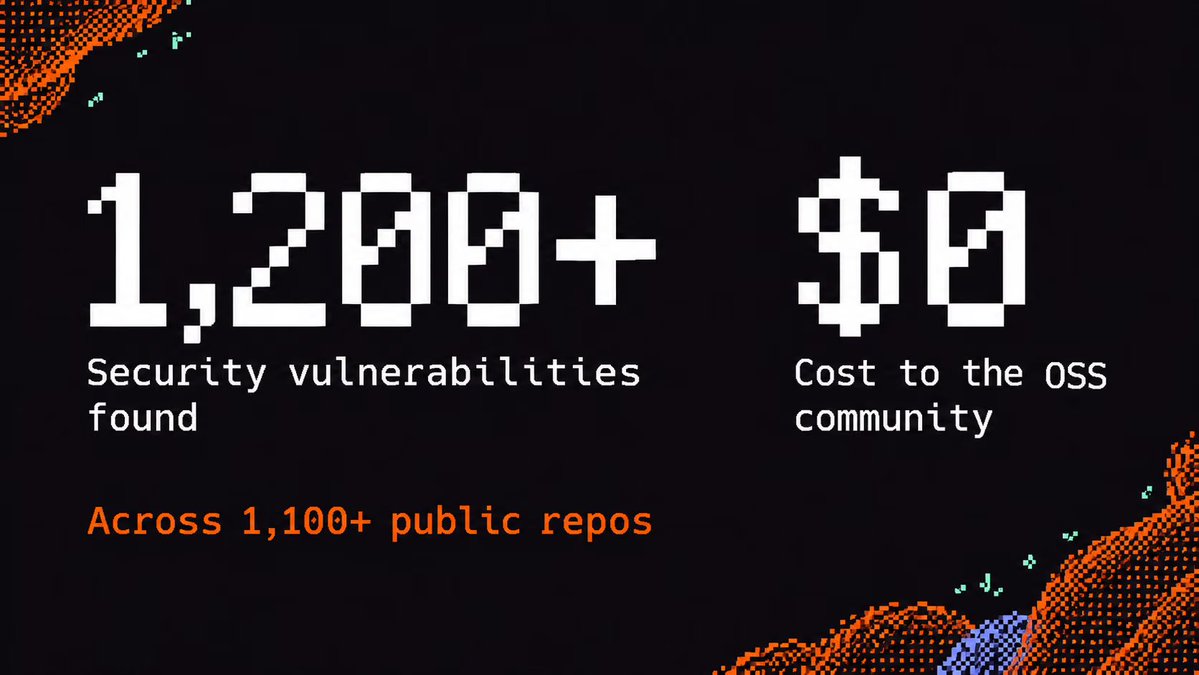
@coderabbitai put $1M toward free deep scans for OSS maintainers. In 10 days: 1,200+ critical or high vulnerabilities across 1,100 open source orgs, at no cost to the community.
If your OSS project hasn’t tried CodeRabbit Secure, your first deep scan is free: https://t.co/XE8jQ0Y92T
Attackers have AI agents probing open-source code 24/7 & we think maintainers should too!
CodeRabbit ran Deep Scans on 1,125 public repos with 1,215 high or critical findings, 75 of which are already fixed.
Your first Deep Scan is on us, up to $1K for orgs with 2+ people.
Kevin O'Leary worked with Steve Jobs in the early 90s making educational software for Apple.
Jobs taught him the concept that explains his extraordinary success: Signal To Noise Ratio
Kevin explains:
"His vision of signal was the top three to five things you have to get done in the next 18 hours. Not your vision for the business next week or next month or next year. Just the next 18 hours you're awake."
"You're going to get those three things or five things done that you have deemed critical for your mission. They must get done today. Anything that stops you from doing that is the noise."
For Steve Jobs, this ratio was 80-20. Eighty percent signal, twenty percent noise.
Kevin knew this firsthand because Jobs would email him at 2:30 in the morning expecting immediate responses.
The only person Kevin has seen with a better ratio is Elon Musk. "He has no noise. He does not deal with noise. He has 100% signal, 24 seconds of every cycle."
This is the secret weapon of the world's most productive people. They ruthlessly protect their signal.
The ability to distinguish signal from noise — and keep the noise away from what must get done — defines great entrepreneurs, great managers, and great leaders.
In 2014, I sold my first company Loom to Dropbox.
Today, I’m proud to announce Roma 2.0 (YC F26): the first to-do list for AI agents.
Everyone uses a different agent: Claude, Grok Bot, Muse…
Until now, none of them could work together.
Roma automatically creates tasks and hands them to the right agent.
Allowing you and your agents to work together, with shared context.
Try it here: https://t.co/w9Ag9OrTUO