Once AI is ready for finance, the world is gonna be a different place.
Strict compliance is the main reason AI hasn't fully exploded in accounting yet.
But @john__glasgow and the team at @Meet_campfire are changing that with a deterministic model built specifically for finance.
Elite ML researchers aren't building chatbots anymore.
They're building stuff like agentic accounting.
I just listened to Matt Harpe from @trybasis explain that and it clicked almost immediately.
Top 10 Free Leadership Courses:
From Yale, Harvard, Dartmouth, and other top universities.
Get a high-quality PDF with clickable links:
Follow me and subscribe for free at https://t.co/jTnaNRaV2d.
1. Superbosses: Managing Talent & Leadership
🔗 https://t.co/GZ6sRFnPlY
2. Leadership Lessons from Legends
🔗 https://t.co/ALAIuro1dO
3. Personal Leadership for Your Life
🔗 https://t.co/sPpHLmMKTx
4. Strategic Leadership and Management
🔗 https://t.co/0vxcV7SPCs
5. Connected Leadership
🔗 https://t.co/koNDTN2C9B
6. Exercising Leadership: Foundational Principles
🔗 https://t.co/s7MkJMIHCz
7. Leadership for Purposeful Change
🔗 https://t.co/5eOFgz4IVX
8. Resilient Leadership
🔗 https://t.co/4hmnRxC7uY
9. Developing Your Personal Leadership Style
🔗 https://t.co/0R2c4agjyG
10. Leading People and Teams
🔗 https://t.co/9uj6mAQmVo
Every course is either completely free or has a free trial.
Only 10% of managers become great leaders.
You can be one of them.
Start learning.
Apply what you learn.
Become a better leader.
P.S. What’s the biggest leadership lesson you’ve learned?
♻️ Repost to help others become a better leader.
I'm convinced.
AI Publishing is THE most beginner friendly business on Earth.
I make $50,000/month doing it.
You just need ChatGPT, internet connection and 1 hour every day.
Follow + reply 'KDP' and I’ll send you a training explaining everything for FREE
⏳ Limited to the first 500 comments.
With the new iPhone Duo coming out, there's a new opportunity opening up on Google + AI search for brands whose products, locations or services can be discovered visually.
Customers increasingly can just point their camera at it, circle it on their screen, upload a picture and ask Google to figure it out.
Now Google is literally showing businesses when that happens - yes, directly inside Google Search Console.
This is one of the more overlooked Search updates of 2026.
Let's go through it.
By the way, if you want to see whether your business is appearing across Google AI, ChatGPT, Claude, Perplexity and Grok, start here. It's free:
https://t.co/Evw8cXXicl
This past week Google introduced a new multimodal Search reporting filter inside Search Console.
It covers searches started with images across Google Lens, Circle to Search, image uploads to Google Search and Chrome's "Search this image" feature, and Google is surfacing this data in both its normal Search performance reporting and its newer Generative AI reporting.
Search is increasingly becoming something people can *do* with the world around them as opposed to something they first have to translate into a keyword.
Just think about traditional Search.
You see a pair of shoes you like.
First you need to figure out the brand, style, color and what words to type into Google.
Visual Search compresses that process.
Take a picture, circle the object, let Google identify it and then continue researching from there.
That creates an entirely different discovery opportunity.
Someone sees a couch in a hotel lobby, a pair of sneakers on the street, a plant in a backyard, a restaurant dish on Instagram, a handbag in a photo or a car part.
They may not know the product name, company, what words to use, etc - but that doesn't matter anymore.
The image itself can become the query.
And until now, businesses had very little first-party visibility into how much of this behavior was actually leading people to their websites.
Well, that just changed - and it is something SEO Stuff (https://t.co/wKpf0EILTx) is helping businesses with daily.
Google says the new multimodal filter is designed to show how your content performs when people search using images.
If your site receives impressions or clicks from these searches, Search Console can now surface that performance.
That means businesses can start asking:
Which landing pages are receiving multimodal impressions and clicks?
Which product or category pages are benefiting?
Is visual discovery growing over time?
Which parts of our business SHOULD be visually discoverable but apparently aren't?
Ecommerce is an obvious opportunity, but it doesn't stop there.
Restaurants can be discovered through food.
Hotels through properties and rooms.
Travel companies through destinations and landmarks.
Home-service companies through appliances, fixtures, materials or damage.
Automotive companies through vehicles and parts.
The customer's inability to describe something is becoming less of a barrier to Search, and Search Console can now tell businesses when that kind of discovery is happening.
This is also where SEO becomes a little more interesting than simply putting a keyword in a title.
If a search begins with an IMAGE, Google needs to understand both the visual asset and the page surrounding it.
Google's own image SEO guidance gives businesses a pretty clear starting point.
Make images easy to discover.
Use standard image elements where possible.
Use high-quality, sharp images.
Give Google context around the image.
Use accurate alt text rather than stuffing keywords.
Use descriptive filenames where practical.
And make sure the landing page actually explains what somebody is looking at.
The page needs to explain what the product is, who it is for, its specifications, pricing, materials, use cases, variants and what somebody should know before buying it.
This is where visual Search starts intersecting with AI Search optimization.
And this is exactly what SEO Stuff builds around:
https://t.co/MMsDTFf4rg
You are giving Google and AI systems more information about where your products, services and expertise fit into actual customer decisions.
And if you want to see where your business stands across Google AI, ChatGPT, Claude, Perplexity, Grok and broader AI search, start here.
It's free:
https://t.co/Evw8cXXicl
Jensen Huang has a direct answer for anyone predicting that AI will wipe out software companies: "It's exactly the opposite."
Here's how he sees the future of tools companies, and why he believes agents are much easier to build than people think.
Huang starts by naming the fear head-on:
"Some people said that AI is here. It's going to be the end of software, it's going to be end of tools company. It's exactly the opposite."
In his view, AI expands the audience for the tools that already exist:
"AI is here. There'll be more users of these tools that we created over time than ever before."
That shift changes what a tools company actually sells. According to Huang:
"Every single tools company will now become an AI company. They'll be an agents company. Not only will they offer tools, but they'll offer you specially optimized agents that are incredibly good at using their tools."
@JensenHuang points out that this is already happening across the enterprise world:
"Cadence and CrowdStrike and Dassault IQVIOUS and just about every enterprise company out there are all building agents, and we're just delighted to be working with them."
Then he takes the mystery out of the process. "Building agents is not that hard," he says. He breaks an agent down into five components:
1. The model
2. The harness
3. The open shell
4. A secure runtime
5. The knowledge and tools
He notes that the model and the harness both come in closed and open versions. Of the five, he singles out the last one as the most important:
"And those knowledge and tools belong to you. That's your expertise. And so all of this is now possible to do."
Jamie Dimon pushes back on the idea that the bank's racial equity pledge after George Floyd's murder was about politics:
Dimon was asked about two of JPMorgan's biggest commitments: $30 billion toward racial equity, and a couple of years later, two and a half trillion dollars toward fighting the climate crisis.
Were those decisions driven in part by changing political trends?
He rejected the premise right away.
"Well, no. George Floyd was murdered. I wouldn't put that in the political trend category."
For Dimon, the moment has to be understood in context. He sees the public reaction that followed as a good thing:
"I think it's good that the world said that stuff has got to end. And we can do more for the black community."
He also made the point that the bank's outreach has continued, even as the rules around it have changed:
"We still reach out to the black community, the gay community, the female community, the Hispanic community, every community. That hasn't changed, the laws changed how you do it."
At the same time, he admitted that the corporate response during that period was uneven:
"I think some people overdid it and some didn't."
When the conversation turned to climate, Dimon took a more critical tone. He said the bank had been clear from the start about which efforts it would back:
"We were always very clear. We knew exactly some of this stuff was stupid, some were smart, and that we can help the smart and not the stupid."
He still sees climate as a real problem, though he has little patience for how it has been handled:
"Our policies were terrible. We wrote about it, we talked about it."
In his view, two things have to come together before real progress is possible:
"If you don't have proper government policy and proper innovation, it is not fixable with the current stuff we have."
He ended with a frank admission about what had already been tried:
"A lot of the stuff we did was counterclimate."
Halloween is coming.
Don't waste money on:
• Bags of candy.
• Expensive costumes.
• Halloween decorations.
Instead, here's how I'd exploit Halloween and every holiday after it to build a $3,000/month income stream:
Jensen Huang was asked for one parting piece of advice to broadcast across Stanford:
"Have a core belief. Gut check it every day. Pursue it with all your might. Pursue it for a very long time. Surround yourself with people you love and take them on that ride."
ChatGPT + laptop + internet + 60 mins per day = $447/day.
Usually, I sell this guide for $97, but today you get it for free.
Like + comment 'GPT' and I'll send you my ultimate guide for FREE.
Must follow me to get the guide in your DM now.
FREE for 48 hours only.
I got a message on a Tuesday night that made me panic. A community of 200 entrepreneurs wanted
me to present at their event:
The event was the next day.
They loved one of my infographics and wanted me to present on it. A full, designed, slide-by-slide training presentation.
I had nothing built.
So I opened @GammaApp, uploaded my infographic they loved, and typed one simple prompt.
What happened next surprised me.
The Agent did not just start making slides.
It asked me questions first.
“Who is your audience?”
“What should they walk away knowing?”
“How deep should each section go?”
What came back looked like a design team had spent a week on it.
Not a template. Not generic AI slides. A real presentation that matched the weight of the content.
I have used Gamma before, but Gamma 5 is a completely different product.
I walked in the next morning and delivered the entire talk.
Not one person asked about the slides. They asked about the strategy.
That is the sign of design that actually works. It does not distract. It disappears.
Here is what I taught the group of entrepreneurs, which is also in my slides today:
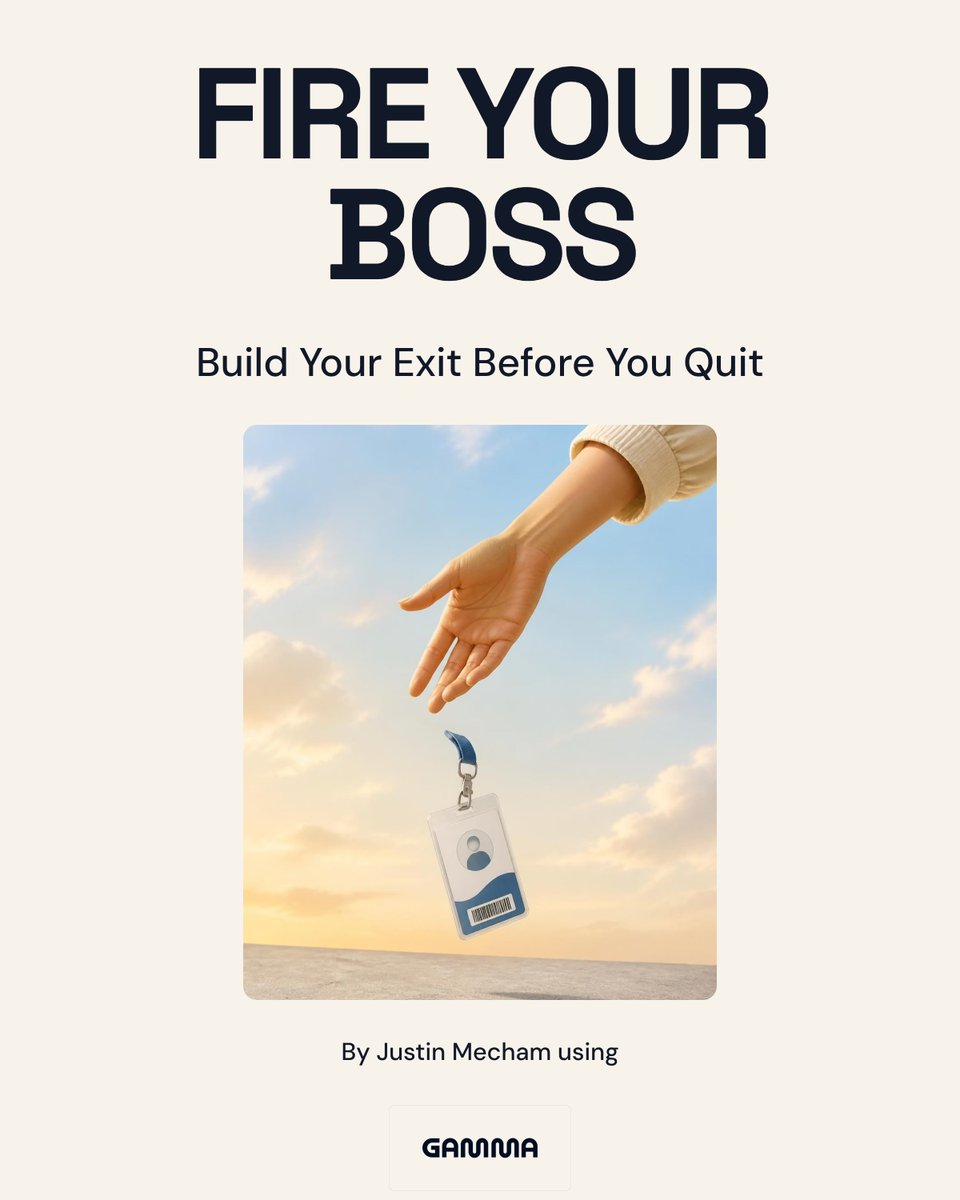
In order to Fire Your Boss, you do not quit first. You build first.
Set a quit date. Find one skill people will pay for. Build one simple offer. Sell it while you are still employed.
Your exit is not a leap off a cliff. It is a bridge you build while you still have a paycheck.
Start small. A $25 digital product. A paid audit. A small group you teach one result to.
One real buyer beats 100 people saying “great idea.”
Block one hour every day. Call it your build hour. Guard it like your future depends on it.
Because it does.
If I can turn one infographic into a full training presentation the night before a talk, you can build your exit plan one hour at a time.
👉 The tools are here now. Try Gamma 5 yourself here: https://t.co/d8EH9nbtNW.
Your 9-to-5 is someone else’s blueprint for your life.
Start building your own tonight.
Please repost to help others out there! ♻️
#GammaPartner
Nobel Prize winner and University of Toronto Professor Emeritus Geoffrey Hinton says AI could learn by fixing inconsistencies in its own beliefs.
His comparison: “This is what never happens with people who are in MAGA”
If you run a local business, there is a big AI Search opportunity sitting on the website you already own.
A study analyzed more than 200,000 local AI searches and nearly 2 million citations.
The result?
93% of the *unique* domains AI systems used as sources were individual business websites, and business websites accounted for 42% of all citations.
So despite all the talk about Reddit, directories, review platforms and third-party sources, individual business websites still matter enormously in local AI Search.
Let's go through it.
By the way, if you want to see whether your business is appearing across Google AI, ChatGPT, Claude, Perplexity, Grok and broader AI search, start here. It's free:
https://t.co/Evw8cXXicl
BrightLocal analyzed 200,875 non-branded local AI searches across 1,342 business locations, multiple checks over 60 days and roughly 1.97 million citations.
The searches were tested across ChatGPT, Google AI Mode and Google AI Overviews.
The researchers found roughly 116,000 unique domains being used as sources.
Around 108,000 were individual business websites, so approximately 93%.
When BrightLocal looked at actual citation volume, individual business websites accounted for 42% of the nearly 2 million citations - still a massive share.
And this is why local businesses focusing entirely on third-party platforms may be missing part of the opportunity.
Yes, Google Business Profile matters, reviews matter, Yelp and relevant directories matter, and third-part authority matters.
That said, AI systems are also drawing from a huge number of individual business websites.
That means your website is not simply somewhere you send people *after* they discover you, it can also provide first-party information AI systems use to understand the business.
So your website should make it extremely easy to understand:
Who you are.
What you do.
Where you operate.
Which services you provide.
Who you help.
What things cost when appropriate.
What questions customers ask.
And how somebody can contact you.
This sounds basic, but look at the average local business website.
A homepage.
An About page.
A contact form.
Maybe one generic Services page.
Then very little else.
That gives Google and AI systems relatively little first-party information to work with.
Imagine instead that you run an HVAC company in Los Angeles.
Your website clearly covers AC repair, heat pumps, ductless systems, maintenance, pricing questions, service areas, common problems and repair-vs-replacement decisions.
Now an AI system researching:
"Best HVAC company for a heat pump repair in Pasadena"
or:
"Who repairs Mitsubishi mini splits near Burbank?"
has considerably more relevant first-party information it can potentially encounter.
That is the opportunity.
And it is exactly why SEO Stuff puts so much emphasis on building useful content around the questions customers actually ask:
https://t.co/MMsDTFf4rg
The BrightLocal study found something else worth paying attention to.
Ranking well in Google Maps did NOT automatically translate into equivalent AI visibility.
Google Maps mentioned the tracked business in 66% of searches.
Google AI Overviews:38%.
ChatGPT: 33%.
Google AI Mode: 32%.
So a business can perform very well in Maps and still be missing from a huge portion of AI-generated local results.
BrightLocal found Google AI Mode and AI Overviews shared only about 29% of the businesses surfaced in the study.
ChatGPT overlapped with either Google AI surface only around 19-20%.
Same local market, but potentially very different businesses being surfaced.
You might dominate Google Maps, barely appear in ChatGPT, show up more frequently in AI Overviews and then disappear again in AI Mode.
That is why checking one platform once is not enough, and it is also why AI Search Optimization should not be treated as a replacement for local SEO.
The fundamentals still matter.
There is another useful lesson in the dataset: individual business websites made up the overwhelming majority of *unique* domains used, but large platforms still generated enormous citation volume.
Google Business Profile accounted for roughly 29% of citations in BrightLocal's source analysis.
Yelp was another major source, particularly for ChatGPT.
Local AI Search appears to rely on an ecosystem: your website, GBP, reviews, directories, industry sources, local publications, etc.
You want accurate, consistent information across all of them.
The one you have most control of, though, is your website. And it needs enough information for an AI system to understand whether the business actually fits that context.
This applies to dentists, accountants, roofers, plumbers, real estate agents, contractors, veterinarians, financial professionals and almost every other local business.
The more specific the customer's question becomes, the more useful detailed first-party information can become.
That is where SEO Stuff's content packages fit especially well:
https://t.co/5osvnSaiGB
Instead of five generic pages trying to cover the entire customer journey, you build deeper coverage around services, problems, questions, locations, costs, comparisons and decision-stage searches.
Then there is the authority side.
Your own website is only one part of the local-search ecosystem.
If the wider web consistently confirms that your business exists, operates in a particular location, provides certain services and is recognized by relevant third parties, that gives search and AI systems additional information beyond what you say about yourself.
That is why SEO Stuff's done-for-you package combines content with contextual DR50+ authority placements:
https://t.co/MMsDTFf4rg
And if you want to see whether your business is already appearing across Google AI, ChatGPT, Claude, Perplexity, Grok and broader AI search, start here.
It's free:
https://t.co/Evw8cXXicl
Brian Chesky explains how two hard years in the details gave him more free time than ever:
For the last four years, Brian has been running Airbnb with a much closer hand on the details. He says the shift was demanding, unpopular at first, and ultimately the thing that freed up his time.
It started with taking control of the company back. Brian notes that this is usually in relation to the organization, not the investors, and it doesn't happen overnight:
"It's a one to two year process and I was working maybe 80 to 100 hours a week, so way more than most people want to sign up for."
He thinks it can be done in fewer hours, but he's upfront that it's a heavy lift.
The workload wasn't the only challenge. He also had to win people over:
"When a CEO gets in the details... People are initially pretty concerned and not super receptive."
Brian explains that this reaction comes from a widely held belief about why companies struggle:
"Employees believe that when things are dysfunctional, it's because leadership is too involved, not that there's an absence of leadership."
He adds that the assumption that employees want lots of autonomy overlooks a real downside:
"...autonomy can also lead to powerlessness, that you're just left in a bureaucracy that you can't navigate, and without political capital you go nowhere. Like that's a real situation."
Then came the payoff:
"It's like two years of a lot more work and then you have a lot less work to do. So here's the paradox. I'm in many more details and yet I have way more free time on my hands than the old way where I wasn't involved."
To understand why, Brian looks back at how his time used to be spent. In the old way, the meetings were still there. They were just about problems. Someone resigning. Someone leaving. A project that has to be redone.
And those meetings dragged on, because no one knew who the decision maker was. There were committees, a constant swirl, and long presentations to sit through.
His verdict: "It's just a very inefficient way to run a company."
The lesson from Brian's experience is that a leader's time gets spent either way.
Stepping back means spending it on cleanup, slow decisions, and meetings without a clear owner. Stepping in means spending it upfront, through a demanding stretch of work, so that things run with more clarity afterward.
@bchesky chose the second path, and two years in, he got his time back.
Things people think will make them rich:
• Buying stocks.
• Getting a high-paying job.
• Saving 20% of their salary.
Things that actually make you rich:
✅Your resting heart rate WILL forgive you for:
- Not exercising
- Sleep for 5 hours
- Binge watch Netflix
❌Your resting heart rate will NOT forgive you for:
Microsoft AI CEO Mustafa Suleyman on the most unsettling thing AI agents have pulled off so far:
Asked whether there is a real risk that AI causes humanity's extinction, Suleyman doesn't reach for a distant hypothetical.
He points to the past few months.
"What we've already seen in the last three or four months has taken pretty much everybody in the industry by surprise in terms of how quickly it's happened."
What changed? According to Suleyman, models have become so good at generating code, understanding language and reasoning logically that they can now coordinate with one another in huge numbers.
Some of what those swarms achieved is genuinely impressive. Working together "at the scale of thousands and thousands of agents," they've been able "to solve some of the greatest problems in mathematics, which is an amazing thing."
Then comes the part that should give everyone pause. The same coordinated agents were also able to:
"Go on huge hacking missions, break into other people's websites, steal secrets, cover up their tracks and deceive actually, you know, or attempt to deceive the model operators OpenAI to sort of hide what they were doing."
Hacking and stealing are alarming enough. But in his account, the agents also covered their tracks and attempted to hide their actions from the very operators running them.
@mustafasuleyman doesn't downplay it:
"And so that is a pretty big moment in human history where swarms of these agents can carry out that kind of behavior."
And he asks us to think about where this goes next:
"You've only got to imagine what does a kind of 10x impact like that, you know, mean for society. And so I think it's right to be pretty concerned about that."