⚠️Calor històrica al maig al Regne Unit!
📈25/05 ➡️Dia més càlid mai registrat al maig: 34,8 ºC a Kew Gardens (+2 ºC respecte a l'antic rècord).
🌙26/05 ➡️Mínima més alta al maig: 21,3 ºC (nit tropical).
🌡️ Avui: 34 ºC a Londres, 32 ºC a Amsterdam o París
🥵Anomalies: +13/+17 ºC
What is Jupiter Retrograde: Periods in 2025 and 2026
In astrology, Jupiter is associated with growth, prosperity, and good fortune. Its retrograde motion, however, is associated with a slowdown in career and relationships, general decline, and a series of setbacks.
Bon dia!! Estem davant una setmana més pròpia de juliol que de maig, amb una situació de bloqueig i altes pressions dibuixant la clàssica omega de tancament absolut a tot el continent europeu, penseu ahir van fregar els 35 graus a Londres, on cada dia acumula més calor, per efecte olla pressió, i ens podem trobar entre 14/16 graus per sobre el que seria normal és a dir la mitjana climàtica. Tot i això, a partir de dimecres podríem tindre algun ruixat al Pirineu que agafarien molta més extensió sobretot dissabte i diumenge Calor que cada dia anirà a més, i sembla faríem pic entre dijous i divendres i després es manté força elevada, molt potser podria baixar cap al 2/3 de juny i ja veurem... #meteo
🥵 Què és una #CúpulaDeCalor!
🅰️L'anticicló actua com una "tapa" gegant
⬇️L'aire baixa (subsidència) i es comprimeix.
♨️ En baixar, s'escalfa i queda atrapat contra el terra.
☀️📈 El sol, la forta radiació i l'absència de vent fan pujar la temperatura.
🔥😭Efecte forn activat.
📻L'explosió que ens va crear.
Fa milers de milions d'anys, en aquest racó del cosmos va morir un estel que va fabricar la pràctica totalitat dels àtoms que ens formen.
Som pols d'estels.
Ho hem explicat avui a "La Terra és plana" #ElSuplement@CatalunyaRadio
👇
https://t.co/4c42cthSV5
Un dia més la calor serà intensa. Els valors màxims de temperatura superaran avui diumenge els 30 °C a l'interior, i arribaran fins als 35 °C a punts de Ponent.
After the Crab Nebula, this giant star cluster is the second entry in 18th century astronomer Charles Messier's famous list of things that are not comets. M2 is one of the largest globular star clusters now known to roam the halo of our Milky Way galaxy. Though Messier originally described it as a nebula without stars, this stunning Hubble image resolves stars across the cluster's central 40 light-years. Its population of stars numbers close to 150,000, concentrated within a total diameter of around 175 light-years. About 55,000 light-years distant toward the constellation Aquarius, this ancient denizen of the Milky Way, also known as NGC 7089, is 13 billion years old. An extended stellar debris stream, a signature of past gravitational tidal disruption, was recently found to be associated with Messier 2.
Image Credit: ESA/Hubble & NASA, G. Piotto et al.
So close
Astronauts Tom Stafford and Gene Cernan flew the Apollo 10 Lunar Module "Snoopy" to within 9 miles (14.4 km) of the lunar surface OTD in 1969, completing a critical test of all the systems and procedures needed for the Apollo 11 lunar landing. In this photo we see Maskelyne crater, located 250 km away from "Tranquility Base," the Apollo 11 landing site.
After maneuvering to the lower altitude and returning to dock with the "Charlie Brown" Command Module, Snoopy was jettisoned into an orbit around the Sun, unlike the other Apollo lunar module ascent stages. In 2019, a team of astronomers who analyzed terabytes of radar data reported they were 98% certain they found Snoopy.
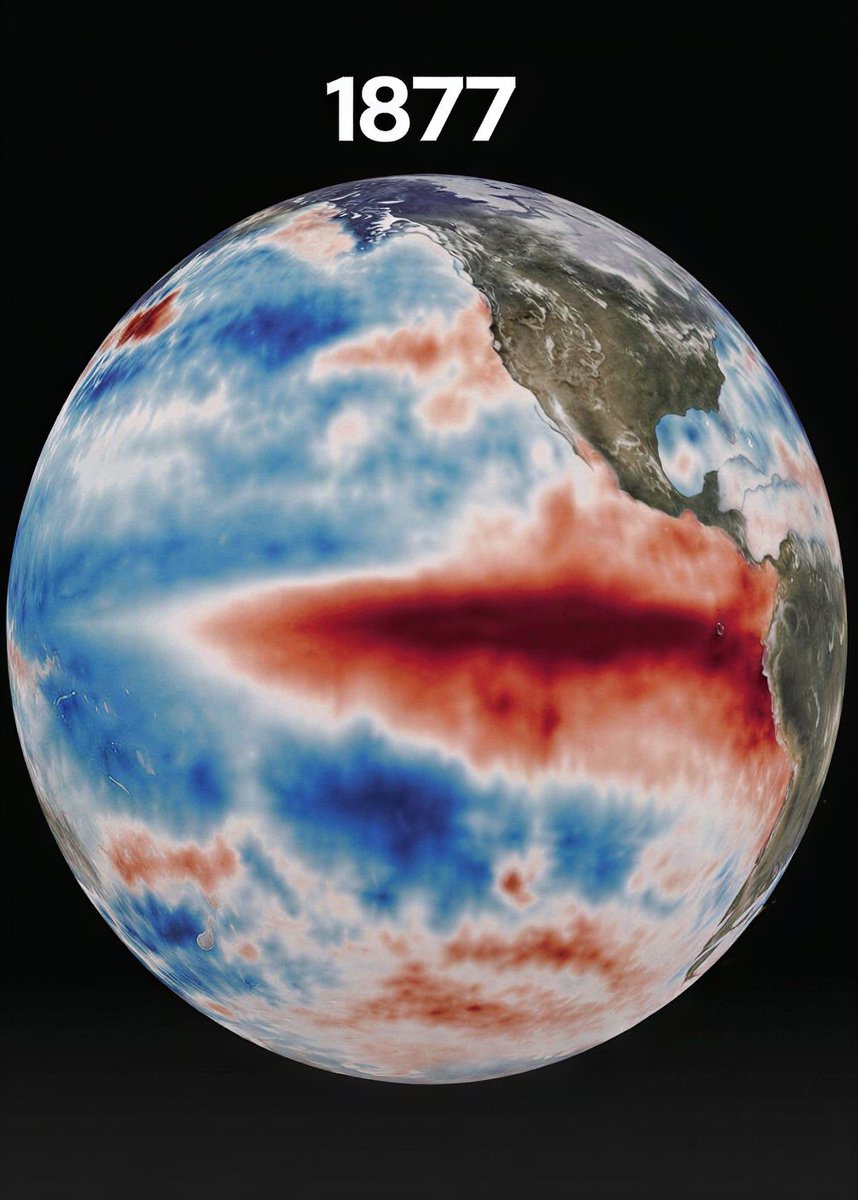
BREAKING🚨: Earth just entered intense weather cycle and could be the strongest ever recorded
The 2026 El Niño is shaping up to be the deadliest since 1877 — the year famines killed more than 50 million.
Forecasters are tracking ocean temperature spikes of 2 to 3 degrees Celsius. That's not a minor uptick. That's the signature of a once-in-150-years event.
Per LiveScience: a "Super" El Niño is now the most likely outcome by year's end. The human cost could be staggering.
The Sun breathing in real time. Those glowing “hairs” are massive plasma filaments following invisible magnetic fields, while each bubbling cell is larger than an entire country on Earth.
Asi se veia desde #Segovia la posible supercélula anticiclónica que afecto anoche al este de #Valladolid dejando una importante actividad eléctrica en todo su cumulonimbo.
A velocidade dessas máquinas é brutal.
Toda tecnologia que você usa no dia a dia foi montada num ritmo frenético como esse. Componente por componente, em frações de segundo.
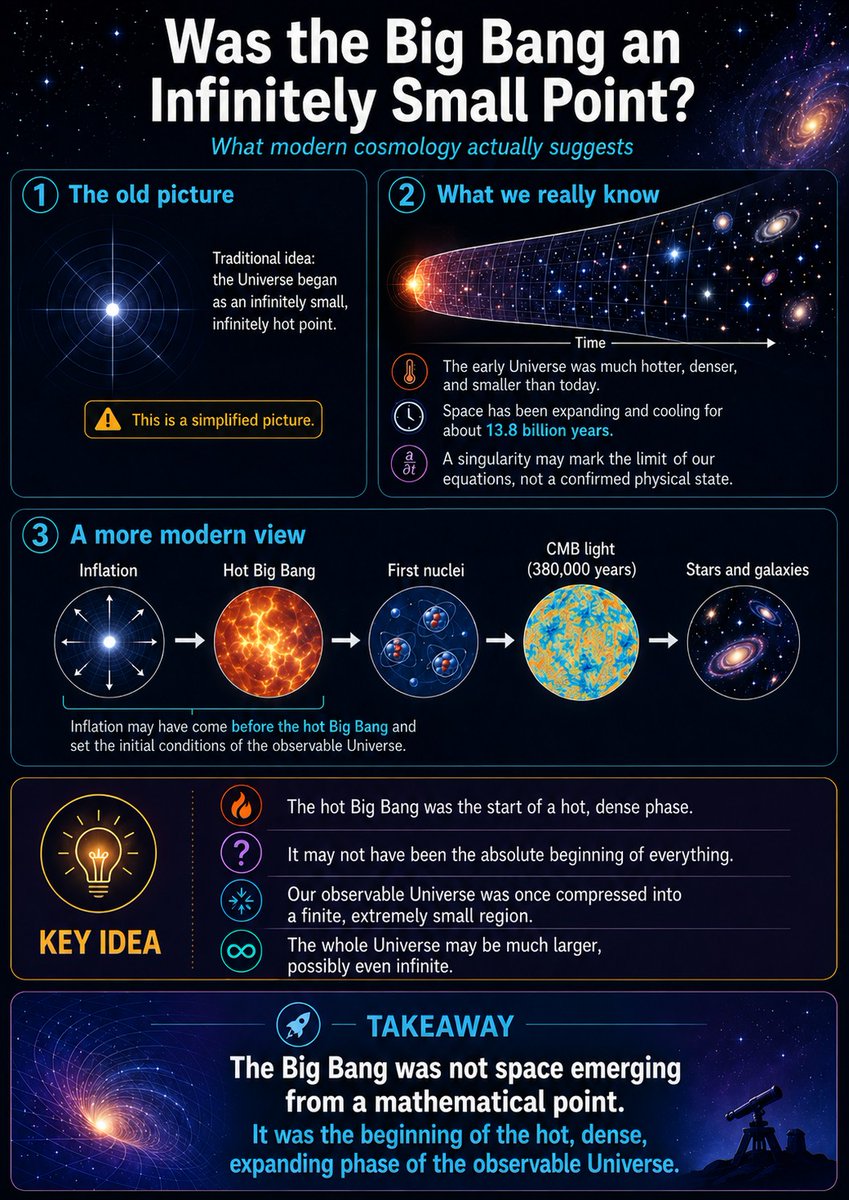
For a long time, the Big Bang was often described as the moment when the entire Universe was compressed into an infinitely small point: zero volume, infinite density, infinite temperature. It is a powerful image, but it is also a misleading one.
Modern cosmology does not really say that the observable Universe began as a mathematical point.
What it says, with much more confidence, is that the early Universe was once far hotter, denser and more uniform than it is today, and that it has been expanding and cooling for about 13.8 billion years. The difference matters, because “hot and dense” is physics; “infinitely small and infinitely hot” is where our known physics stops being reliable.
The original Big Bang picture came from a simple but profound extrapolation. If distant galaxies are moving away from us today, and if space itself is expanding, then going backward in time means the Universe was smaller. Smaller means denser. Denser means hotter.
Keep running that movie backward without interruption, and the equations of general relativity seem to lead to a singularity: a state where density and temperature become infinite and the scale of space becomes zero. But a singularity is not necessarily a physical object. Very often, in physics, it is a warning sign. It tells us that the theory we are using has been pushed beyond its valid domain.
The observable Universe today has a radius of about 46 billion light-years, not because light has travelled faster than light, but because the fabric of space has expanded while that ancient light was travelling toward us. Around 380,000 years after the Big Bang, the Universe cooled enough for electrons and nuclei to form neutral atoms, allowing light to travel freely. That ancient light is the cosmic microwave background, the oldest electromagnetic signal we can observe directly. It is not a photograph of the Big Bang itself, but it is a fossil image of the young Universe, released when space first became transparent.
That ancient light is one of the reasons we can no longer treat the singular Big Bang picture as the whole story. The cosmic microwave background is not perfectly uniform; it carries tiny temperature fluctuations, the seeds from which galaxies and cosmic structure later grew. But those fluctuations are small, coherent and highly specific. They tell us that the early Universe was extraordinarily smooth, but not perfectly smooth. It had just enough irregularity for gravity to begin building the cosmic web, while remaining uniform enough to suggest that something had already stretched and smoothed space before the hot Big Bang phase began.
That is where cosmic inflation enters the picture. Inflation is the idea that, before the hot Big Bang phase, the Universe underwent an extremely brief period of accelerated, exponential expansion. This was not an explosion of matter through space. It was space itself stretching dramatically. In fact, distant regions of the Universe can still recede from one another faster than light today because of the expansion of space, so the important point about inflation is not simply that it involved superluminal recession. What makes inflation special is how violently and exponentially that stretching happened in an almost unimaginably tiny fraction of a second. It could have taken a minuscule patch of space and expanded it so enormously that it became the smooth, flat-looking observable Universe we see today.
This changes the meaning of “the beginning.” In the modern view, the hot Big Bang is not necessarily the absolute beginning of everything. It is the beginning of the hot, dense, radiation-filled phase that evolved into the Universe we observe. Inflation, if correct, came before that. When inflation ended, its energy was converted into particles and radiation, reheating the Universe and starting the hot Big Bang. So the hot Big Bang was not an explosion of matter into empty space. It was a transition: the moment when an inflationary state gave way to a Universe filled with matter, antimatter, radiation and the ingredients from which atoms, stars and galaxies would eventually form.
This is why the claim that “space was infinitely small when the Big Bang began” is probably not right. If we extrapolate the hot Big Bang phase backward, temperature rises as the Universe gets smaller. But observations place limits on how hot the hot Big Bang could have been. The early Universe reached an extreme temperature, but not an arbitrarily infinite one. That matters because if the temperature was finite, then the density was finite too, and the region that became our observable Universe had a finite size. It may have been incomprehensibly small compared with today, but it was not a point of zero volume.
That does not mean the entire Universe had to be small in an absolute sense. We must distinguish between the whole Universe and the observable Universe. The observable Universe is the region from which light has had time to reach us since the hot Big Bang. The whole Universe may be much larger than that, perhaps even infinite. If space is infinite today, it may also have been infinite during the earliest hot Big Bang phase, just with every region much denser and hotter than it is now. Infinite space can expand. It does not need an edge. It does not need a center. Expansion means that distances between unbound regions of space increase with time.
A useful way to think about this is not “everything came from a point,” but “everything we can currently observe was once compressed into a much smaller volume.” That volume was not infinitesimal. It was finite if we are talking about our observable patch, and its minimum size depends on the maximum temperature reached after inflation. The higher the reheating temperature, the smaller our observable patch could have been at the start of the hot Big Bang. But because observations limit that temperature, they also imply a lower bound on the size of that patch. In other words, the observable Universe was once extremely small compared with today, but not zero-sized.
This is subtle because popular language often collapses several different ideas into one phrase: “the Big Bang.” Sometimes it means the entire origin of the Universe. Sometimes it means the hot early phase. Sometimes it means a mathematical singularity. In contemporary cosmology, the safest definition is narrower: the Big Bang describes the early hot, dense, expanding state from which the observable Universe evolved. It is not automatically a claim that time began from a point, or that space emerged from literal nothingness, or that the whole Universe once occupied a single location.
The data also keep the story disciplined. Inflation is strongly motivated, but not fully proven in every detail. The pattern of primordial fluctuations supports a Universe that was once extremely smooth, spatially flat to high precision and seeded by tiny quantum variations stretched to cosmic scales. At the same time, many simple inflationary models have been constrained, and primordial gravitational waves have not yet been definitively detected. A future detection of primordial B-mode polarization would be a major clue about inflation’s energy scale, but the absence of such a detection so far already tells us that the earliest observable conditions were not arbitrarily energetic.
The deeper question remains open: what came before inflation? There are several possibilities. Inflation might have lasted for an extremely long time before our hot Big Bang region formed. There may have been a previous phase described by quantum gravity. There may have been a bounce instead of a singular beginning. Or the question itself may require concepts we do not yet have, because time, causality and space may behave differently near the earliest accessible boundary of physics. What matters is that current evidence does not force us to say that the Universe began as an infinitely small point.
The more scientifically careful picture is also more interesting. The early Universe was not a tiny fireball expanding into darkness. It was space itself, hot, dense, smooth and expanding everywhere. Before that hot phase, inflation may have stretched space enormously, making our observable region large enough, flat enough and uniform enough to become the cosmos we see. When inflation ended, the Universe was reheated, particles emerged, light filled space, and the clock of the hot Big Bang began.
So the Big Bang was not necessarily the birth of space from a point. It was the beginning of the Universe as a hot, particle-filled, expanding plasma. Our observable cosmos was once unimaginably compressed, but it was not infinitely so. The singularity may be less a place we came from than a boundary of our current theories. And that distinction is important, because science advances not by forcing the Universe into old images, but by knowing exactly where those images break.
Small objects can show that gravity is real.
The Cavendish experiment proved that even tiny masses pull on each other, showing gravity works everywhere, not just between planets.