Peru has one of LATAM's most dynamic scientific systems. At SCImago, we contributed to the new bibliometric indicators report. The challenge: raise quality, decentralize & engage businesses to transform the ecosystem. Full report (Spanish): https://t.co/1zbe1hCfD9
@ConcytecPeru
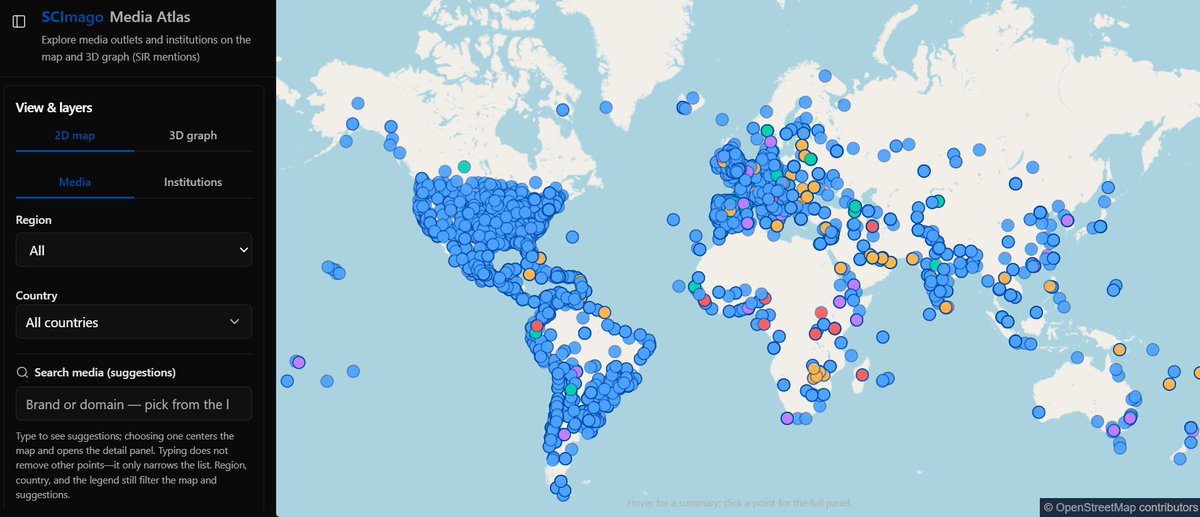
#SCImagoUpdates From observation to tactical action. Discover the new #SCImagoMediaAtlas: an interactive console integrating SIR and SMR data. Audit your institution's media positioning and launch a strategy for global impact. https://t.co/ty9qoyTL10
#SCImagoUpdates ¡A new edition of the SCImago Media Ranking is here! The first global map to assess journalistic leadership based on web reputation. A vital observatory for understanding the transformation of the digital ecosystem. Explore now https://t.co/8M5Gwk4ocO
@felixdemoya
The latest edition of the SCImago Media Ranking includes the SCImago Media Atlas (https://t.co/BDvYsOOOxU). It is a geospatial and network visualization tool whose main purpose is to allow users to explore the geographic distribution of 6,120 media outlets and 8,199 research institutions, and to visualize their relationships based on media mentions of SIR institutions.
Accessibility is not the same as reliability. For responsible research assessment, the path forward is a hybrid approach—moving from mere data accessibility to active validation. Read more https://t.co/VC9cfg7V8V
Is "more" always better in science? We have analyzed open infrastructures (The Lens, OpenAlex, OpenAIRE) against Scopus, and the results invite a deep reflection on data quality. https://t.co/VC9cfg7V8V
Thread below #OpenScience#Bibliometric@felixdemoya
Outside the curated core, DOI coverage falls to 46-53% and ISSN presence drops below 32%, leaving millions of documents disconnected from any clear publishing framework.
More volume = higher quality in scientific evaluation? SCImago's latest analysis of open platforms (Lens, OpenAlex, OpenAIRE) vs Scopus shows scale ≠ better data. Finding: nearly 74% of their "extended literature" records lack institutional links. Read: https://t.co/9WfgJ5W1vH
#SCImagoAtlas enables an iterative quarterly reassessment. It’s data science applied to institutional communication strategy.
Discover more at: https://t.co/8M5Gwk4ocO
Why do universities with exceptional science remain invisible on the global radar? At #CRECS2026, @felixdemoya introduced SCImago Atlas: the tactical answer to this question. #SCImagoAtlas
How does SCImago Atlas empower a research institution? 📍 Maps 2D/3D coordinates of the institution within the media landscape. Identifies "topological neighbors" (who is excelling and how to emulate them). 🎯Defines target media to bridge visibility gaps.
Una de cada cuatro universidades peruanas incluidas en el ranking @scimago presenta riesgo significativo de malas prácticas científicas
https://t.co/9SEpRtLtKi
Why strive for high performance if it isn’t responsible?Institutional impact is inseparable from credibility. IRIS delivers data driven signals to anticipate scrutiny and respond with evidence—not defensive narratives. Turn trust into institutional capital https://t.co/CJjRxv9br6