Told my yt colleague I’m coming. He screamed “but you’re going Kingsley”.
My other colleague to him: “oh Jordan, you’ll learn with time”
I’m ruining these folks lmao.
First, our mothers back then DIDN'T REFUSE to take their husband's name. The husband or society didn't ask them to take it at all because it wasn't part of our culture.
On tracing one's lineage or generation, Yorùbá has one of the most robust systems in the world, known as oríkì (panegyric). The oríkì includes history, struggles, previous places of settlement, heroes and heroines related to your family and place of origin and so on. That's why we have oríkì ẹni (self panegyric), oríkì ìdílé (family panegyric), oríkì agboolé (compound panegyric) and oríkì ìlú (town/village panegyric).
Every time a child cries as a newborn, every time they get angry as a toddler, every time they do something worthy of praise and so on, these oríkìs are blended together and recited or chanted for the child to serve several purposes such as praising the child for a job well done, calming the child down and so on. With time, every child knows who they are.
I normally use myself as an example. I have only known Ado Odo since I was little. My grandfather was a very popular man there and that's our place of origin. It was when I grew up and analyzed my oríkì that I discovered that we're originally from Ìṣàgá Orílé. I had to dig further to learn the history of how my grandfather ended up in Ado Odo and I found my answers.
Therefore, we didn't need surnames in Yorùbá Land to know the sons or daughters of whom we were. The system was perfect and amazing.
Thank you
Non-Nigerians can never understand some of the things we say , our slangs >>>>>>>>>>>>>>>>>
Imagine explaining to someone that “let me hear word please” means “ I don’t want to hear any words” lmao
For those that couldn't hear what they were saying.....
They said
"Òbí ni bí ikú,
Òbí ni bí àrùn,
Ọ̀tún rèé,
Òsì rèé,
Òbí yàn,
Ire,
Yoo gbàá.
TRANSLATION
Òbí the averter of death
Òbí the averter of illnesses
Here is my right
Here is my left
Òbí becomes acceptable,
For goodness
Accept it.....
After dropping the obi:
They said "Eèpà Ifa" which means I salute you IFA.
Then the second throw of that obi was to ask if Ifa shares the Obi with them. It came as yes and that's why they took a bite.
Now let's analyse what they were doing.
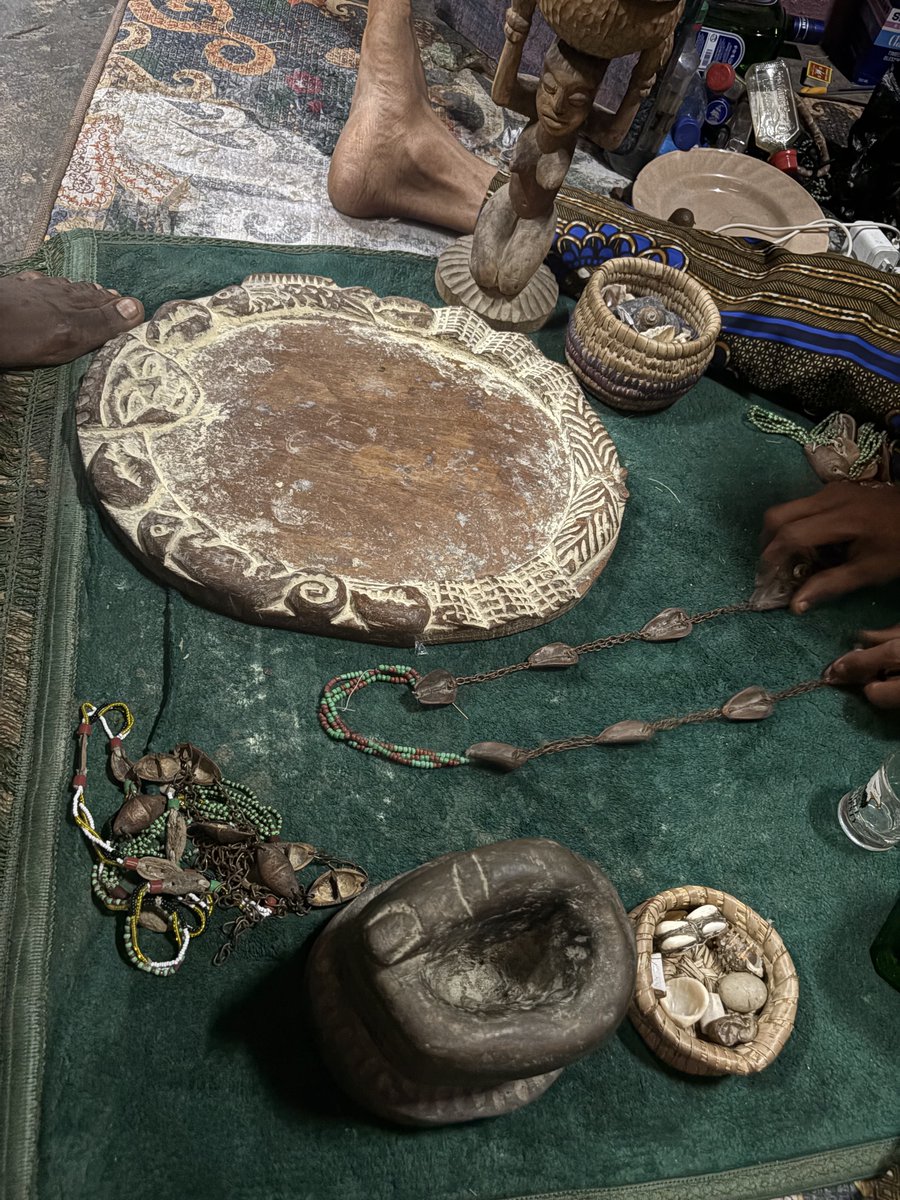
This procedure is called Ìbọ (offering) usually Ìbọ can be done for Ifá, orí and Òrìṣàs hence we have Ìbọ-orí, Ìbọ̀rìsà and what's done in this video is Ìbọ-Ifa.
Usually after Ìsẹ́fá or Ìtẹfá, the devotee is given is ikin-Ifá which is a vessel to connect with his Ifá. Things he is expected to do with this Ifá includes Ìkẹ́, Ìbọ and periodic divination.
Processes of Ìbọfá (has three stages)
Ìpè (call)
During this process, you take òbí to sprinkle water on the ikin-Ifá and call on Ifá and then you call Ilẹ̀
2. Mokó-morò (explanation)
Here, you explain the purpose of the call, you give thanks and you make Iwure (requests). You also go into details of chanting the standard odu Ifa (the first sixteen. NB. The whole 16 are only chanted completely during ceremonies. So chanting 2,4,6,or 8 is acceptable).
You chant your Odù ifá and/or odu of your lineage.
You then chant Ọ̀sẹ́-Òtùá ( the concluding Odu).
3. Ibo (offering):
its at this stage you offer what you've brought for offering. This includes but not limited to water, oti, obi, eku, ẹja, ẹyẹlé, abo adie, Ewure, àgùntàn, Ẹlẹ́dẹ̀ and so on. You follow the order of their sizes in ascending order.
4. Ìbéèrè:
This is the last stage. Here, you chant Òtúrúpọ̀n Ofùn before the òbí divination.
It is through this obi divination that you will know if the offering is accepted and if there is any necessary information to know. In the divination, this is the part where he dropped the obi in that ceramic plate. Once the obi is accepted, you do "Ìforíbalẹ̀" and say "Eèpà Ifa". You can ask Ifa you can eat out of the obi or not. That marks the end of the Ìbọ-ifa.
Aboru aboye.