I’ve always enjoyed learning about different business best practices, strategy documents, and ways of thinking through a company game plan. One example I’ve seen more frequently over the last year is the concept of “right to win.”
Right to win is the idea of understanding your competitive positioning and what makes your product distinct from competitors. It is often broken down into a table with three columns. The first column is the capability or functionality provided. The second column is why it matters, which articulates why this particular capability or functionality is needed by the market and your specific customer base. The third column is why your competitors struggle with it. Here, the goal is to describe why other competing products in the market have a hard time doing the same thing.
Put more simply, the framework is: the capability, why it matters, and why competitors struggle with it.
My general approach to competition is to be competitor aware and customer obsessed. Even when obsessing over customers, there are often competitive new deals where, in order to win the business, you have to articulate how your product is different from others in the market. Merely being competitor aware doesn’t solve the entire issue. You really have to understand what makes your product unique and how that connects with the prospect and their goals.
The right to win strategy should be used to align team members, investors, partners, and advisors. Many entrepreneurs even include a right to win slide in their investor updates or board decks. It’s a great way to communicate the product strategy internally in the context of competition.
For entrepreneurs, my recommendation is to think through this right to win idea and use it to consistently deliver a winning strategy against the competition. Competition is what makes free markets such an incredible way to produce the best products. Regularly revisiting your right to win strategy and updating it in the context of the market is something every entrepreneur should do.
Thanks to @ScottDorsey for kicking things off at Indiana’s CS+AI PDWeek. Over 450 educators from Indiana have convened for a week full of learning to improve their craft as CS Teachers #CSforIN#CSforALL
Congrats @AnthropicAI on an amazing round! Am in awe of the growth and execution to a $47B runrate. Up from $0 when we invested in 2023 and $9B at the beginning of the year. Valuation has gone from ~$5B to $960B over that period. Trying to think about which is more impressive...
Congrats @AnthropicAI on an amazing round! Am in awe of the growth and execution to a $47B runrate. Up from $0 when we invested in 2023 and $9B at the beginning of the year. Valuation has gone from ~$5B to $960B over that period. Trying to think about which is more impressive...
Applied AI is about jobs to be done, not tokens to be consumed. Token usage may be a reasonable short-term proxy for adoption. But long term, success comes from outcomemaxxing, not tokenmaxxing.
It's why we took an early bet on outcomes-based pricing: pay for the value delivered. A mortgage completed, an order returned, a customer saved, a claim settled, a basket size increased.
The future of applied AI won’t be measured by consumption, but by outcomes achieved.
🍹Saasparillas flowing, saaspocalypse in full swing 😂
We’re getting sassy with unstoppable momentum.
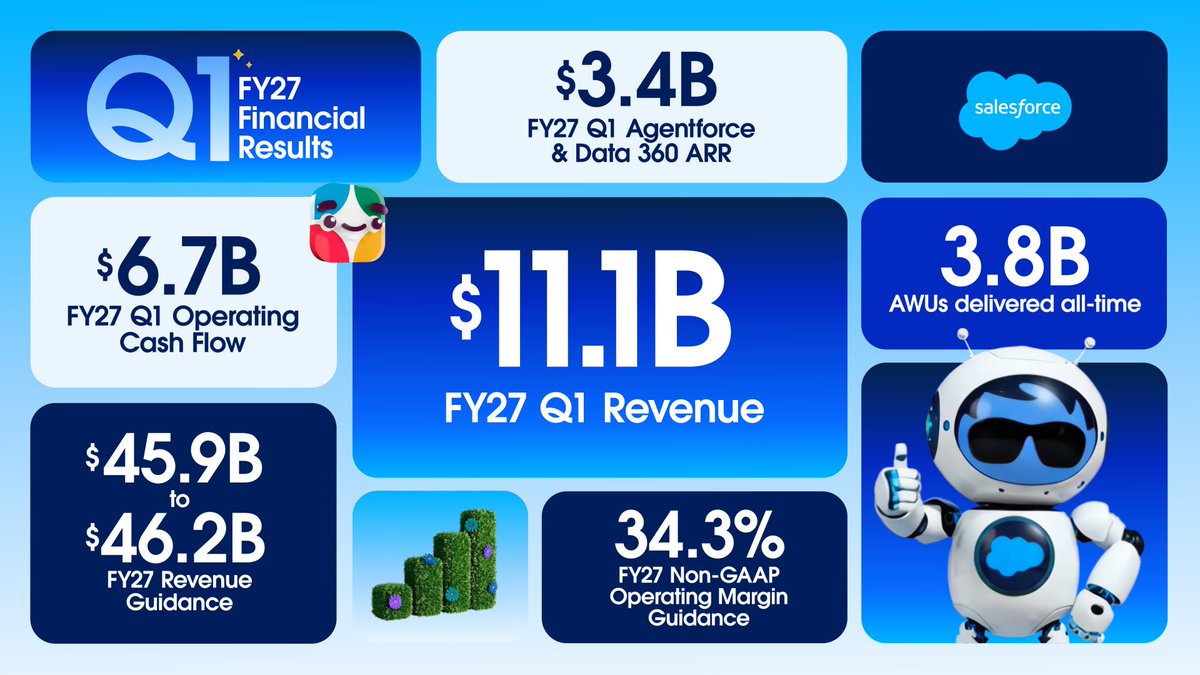
Salesforce just dropped an absolute monster Q1:
📈 Record revenue: $11.13B (+13% YoY)
💰 Operating cash flow: $6.7B
🤖 Agentforce ARR just crossed $1B
Combined with Data 360 and Informatica, we’re now at $3.4B in AI + Data ARR.
We’re not just talking about the agentic future — we’re delivering it. The #1 Agentic CRM, powering the shift to agentic enterprises at scale.
The momentum is real. The future is unstoppable. 🔥
#Agentforce #Salesforce #AI #EnterpriseSoftware
1 in every 1,000 people in the United States will be in Indianapolis at the track today for the Indianapolis 500, as they have been for over 100 years.
There is nothing else like it in the world.
Rippling crossing a billion in ARR and growing 78% year on year is the best argument against the SaaS is dead meme I've seen. When people say they hate the model what they really mean is they hate the lack of growth.
Rippling is growing because payroll is a market where the entire vibe coding discussion is complete rubbish. You have legal and statutory obligations that carry criminal penalties if you get it wrong. You're not interested in vibe coding your payroll. You want to outsource this to someone wildly competent, have them take the responsibility, and you do not want non-deterministic processes anywhere near it.
AI might change how the software gets built, but the core reason people pay for it doesn't change. It just has to be done right.