𝐆𝐨𝐨𝐝 𝐌𝐨𝐫𝐧𝐢𝐧𝐠, 𝐗 𝐅𝐚𝐦𝐢𝐥𝐲! 🌅
Building a decentralized computing network is not only about distributing workloads across different devices.
Security matters just as much.
When applications process important information, developers need confidence that their workloads are running in protected environments.
This is one reason @Acurast’s approach to Trusted Execution Environments (TEEs) is worth understanding.
TEEs provide hardware-backed isolation that helps protect sensitive workloads during execution.
They can also support verification that computing tasks were performed within trusted environments.
By combining smartphone-powered computing with secure execution, Acurast is working to address an important challenge in decentralized infrastructure.
The goal is not simply to make computing more distributed.
It is to make distributed computing more useful for real applications that need privacy and security.
As AI, automation and data-driven services continue to expand, secure computing infrastructure will become increasingly valuable.
base:0xc5fed7c8ccc75d8a72b601a66dffd7a489073f0b is building toward that opportunity.
gn frens
most "rewards" in crypto come with a waiting room
> farm points, wait for tge
> stake, wait for unlock
> claim, wait for vesting
and by the time it lands, the token has already done -80%
@RebateLaunch skips the waiting room
> buy bonus of 2% to 9% lands in the same transaction as your buy
> holder payouts come in the pair token, pushed to you through the day
> no claim, no unlock, no vesting schedule
you don't have to trust a future airdrop
the reward is in your wallet before you've closed the tab
the longer you hold, the bigger your share
> 1x for days 0 to 3
> 1.5x for days 3 to 7
> 2x from day 7
a reward you get now beats a promise you get later
$REBATE @starlisting
𝐆𝐍, 𝐖𝐞𝐛𝟑 𝐅𝐚𝐦 🌌
Another day is coming to an end, bringing new experiences, lessons and small wins along the way.
No matter how today went, be proud of yourself for showing up and giving your best.
Every step forward matters, even when progress feels slow.
Take some time to relax, recharge your energy and leave today’s worries behind.
Tomorrow is another chance to learn, build and get closer to your goals.
Sleep well, stay positive and keep believing in your journey.
GN,Web3,fam.
Good night
It's strange how quickly time passes.
One moment you're planning the beginning of the year, and suddenly months have gone by.
The people around us change, our priorities shift, and even the things we once worried about become distant memories.
Don't let tomorrow take away all the beauty of today.
Sleep well.
Most memecoin launchpads compete on how quickly someone can turn an image into a token.
@onlystreetsfun is approaching that process from the opposite direction.
Its in-app camera requirement means creators have to find something worth capturing before they can launch. No gallery uploads, screenshots, or recycled images.
I find that interesting because it changes the starting point of meme creation.
Instead of asking what internet trend can become a coin, you're asking what happened outside that deserves attention.
The bigger experiment is whether real-world discovery can produce a more interesting source of internet culture than another recycled meme.
late night reading on how hardware attestation verifies code execution on @Acurast without trusting the host device makes you realize why decentralizing cloud compute differently is actually working
Stablecoins can do more than sit in a wallet. They can also become liquidity that borrowers use.
@rntprotocol brings this idea to Polygon through RNT Lend, where users can deposit USDT0 and USDC into lending pools and earn variable interest based on borrowing demand.
The part worth understanding is how interest builds:
→ APY changes with pool utilisation.
→ Interest accrues with every Polygon block, roughly every few seconds.
→ Earnings accumulate onchain instead of waiting for a daily payout.
This gives depositors a way to follow their lending earnings as they build, while rates respond to activity in each pool.
It's a straightforward DeFi use case, but remember that variable APY isn't guaranteed, and lending always comes with smart contract and protocol risks.
Explore: https://t.co/l57elujsxN
Every good campaign deserves a strong finish, and today is the final day for @onlystreetsfun .
The project brings a fresh idea to Solana: turning real-life moments into coins that people can discover, share, and build communities around.
What I appreciate is the focus on everyday creativity. You don't need to create a viral meme from scratch; sometimes a moment happening right in front of you is enough to start something.
If you've been following the campaign or planning to participate, this is your last chance to give it one final push.
A profitable trading system is useful, but a system that can explain its mistakes gives traders something more valuable: a way to learn from each decision.
@FensoryApp is moving toward this with agents that can explain the market conditions behind their trade suggestions, rather than simply reporting an execution.
For example, if a BTC breakout trade closes at a loss, the agent could break down what changed: momentum weakened, the breakout failed, and the conditions supporting the entry were no longer there. It could then suggest reviewing the confirmation rules for future setups.
The Alpha Vantage integration adds another market data source to the agent's workflow, giving it more information to work with.
What matters here is the feedback loop:
- Understand why a trade was entered.
- Review what caused the outcome.
- Identify which conditions may need adjustment.
- Evaluate the next decision with that context.
This doesn't make the agent infallible or remove trading risk. Its analysis still needs human scrutiny.
But automated trading becomes much more useful when users can inspect the reasoning, challenge the conclusions, and improve their own understanding instead of blindly trusting a black box.
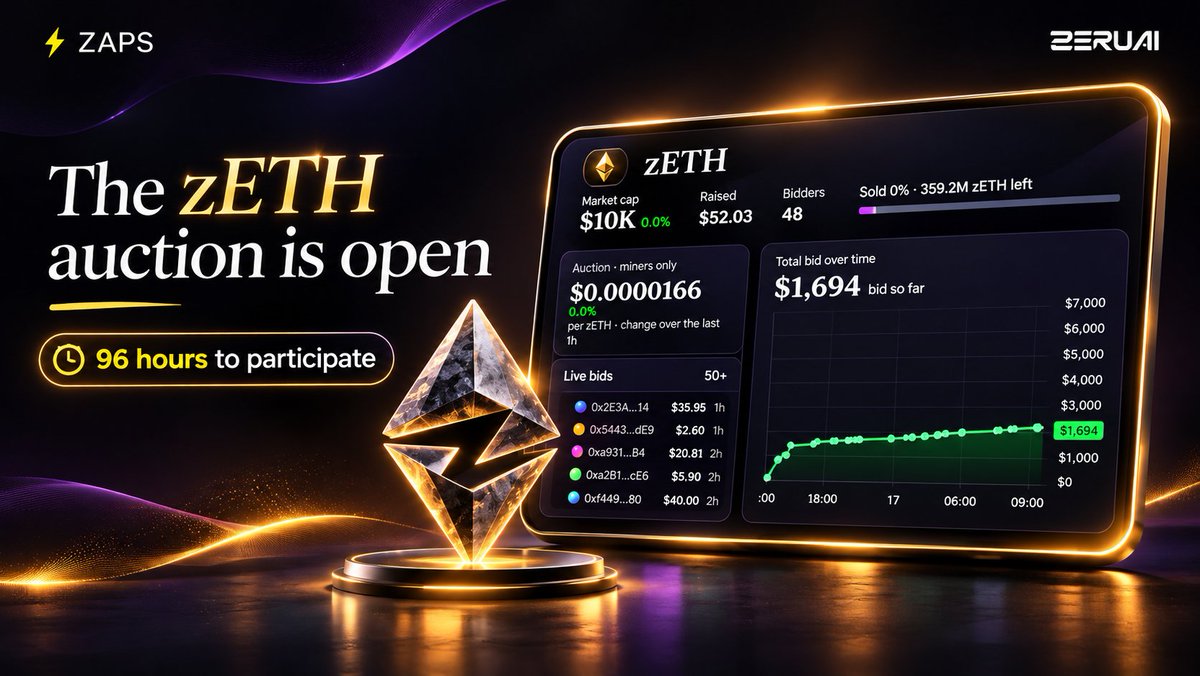
The zETH Miner race has officially ended, and the first Activity Market from @zerufinance has moved into its public auction phase on Uniswap CCA.
What makes this launch different is how the supply was determined. Eligible community activity shaped the final supply, with no team or developer token allocation.
The auction runs for 120 hours, including a 96-hour public bidding window after the Miners' phase.
The process separates two important things: community activity determines how much zETH is available, while the auction lets market participants discover its price.
Now the focus shifts from earning Miner rights to actual market demand. It will be interesting to see how buyers value the supply created through this activity-based model.
How RNT Protocol Makes Real Estate Useful in DeFi
What if you could borrow money using real estate without selling it?
That's the idea behind @rntprotocol.
Normally, real estate is difficult to use as money. If you own a property, selling it or getting cash from it can take time.
RNT wants to make this easier by bringing real estate into DeFi on Polygon.
Here's how it works:
1. RNT Lend
If you own a token representing real estate, you can use it as collateral to borrow stablecoins like USDC or USDT.
This means you can access money without selling your real estate tokens.
2. RNT Vaults
You can deposit stablecoins into RNT Vaults to gain exposure to different real estate investment strategies.
Instead of choosing one property, you get access to a basket of strategies.
3. The solana:2fUFhZyd47Mapv9wcfXh5gnQwFXtqcYu9xAN4THBpump Token
solana:2fUFhZyd47Mapv9wcfXh5gnQwFXtqcYu9xAN4THBpump is the protocol's utility and governance token.
You can stake it to receive xRNT, which provides voting rights and other protocol benefits.
However, holding solana:2fUFhZyd47Mapv9wcfXh5gnQwFXtqcYu9xAN4THBpump does not mean you own the properties.
Why does this matter?
Real estate is valuable, but it is not always easy to turn into cash.
RNT wants to make tokenized real estate more useful by allowing people to borrow against it and access real estate strategies through DeFi.
The goal is simple:
Make real estate more accessible, flexible, and useful onchain.
Of course, there are risks, including smart contract issues, changing collateral values, liquidity problems, and variable yields.
RNT is still early, but the idea is worth understanding.
Gm gArc
ARC Terminal: Making AI-Powered Trading Easier
Trading can be complicated, especially when you have to analyze the market, calculate position sizes, set stop losses, and manage risk yourself.
@TheARCTERMINAL wants to make this process easier with AI.
ARC Terminal is an AI-powered trading platform built on Hyperliquid. It combines trading tools and an AI assistant in one place.
Here's how it works.
1\. What is Hyperlink?
Hyperlink is a trading venue connected to Hyperliquid.
It allows users to place private orders without broker fees.
You can select Hyperlink from the venue menu when preparing a trade.
2\. What is ANIMA?
ANIMA is the AI assistant inside ARC Terminal.
Instead of calculating everything yourself, you can describe the trade you want in simple English.
For example:
"I want to long SOL with $40 risk."
ANIMA helps you prepare the trade by suggesting:
* Entry price
* Position size
* Stop loss
* Take profit targets
3\. You Control Every Trade
One important thing is that ANIMA doesn't execute trades automatically.
It prepares the trade, but you must review and approve it before anything happens.
Your funds remain in your own account, and you stay in control.
4\. Multiple Markets in One Place
ARC Terminal aims to bring different markets together, including crypto, stocks, and gold.
The goal is to make trading easier by combining market analysis, AI assistance, and trade execution in one platform.
The bigger picture:
ARC Terminal is making AI a practical trading assistant.
Instead of doing every calculation manually, you can use ANIMA to prepare a trade while keeping the final decision in your hands.
Explore: [https://t.co/wT3IL2BFAH](https://t.co/BNHHYWpWaW)






](https://pbs.twimg.com/media/HXRqZ_PWEAAMBVP.jpg)


