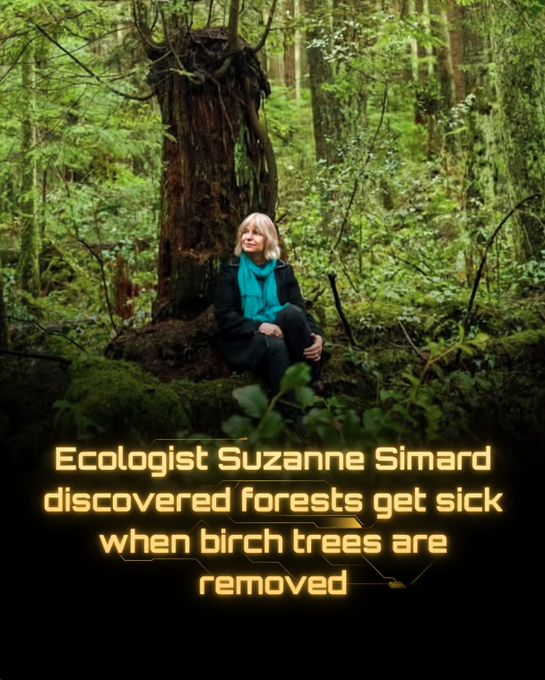
In the 1990s, Canadian ecologist Suzanne Simard made a groundbreaking discovery that challenged everything we thought we knew about how forests work. While studying managed forests in British Columbia, she noticed something puzzling: when birch trees were removed to promote the growth of valuable Douglas firs, the firs did not flourish as expected, they actually struggled and grew more slowly.
Determined to understand why, Simard traced the movement of nutrients using radioactive carbon isotopes. What she found was astonishing. Trees were actively sharing resources through vast underground fungal networks known as mycorrhizae. These delicate, thread-like fungi connect the roots of different trees across the forest floor, forming a complex web that allows the exchange of carbon, water, nutrients, and even chemical signals, sometimes between entirely different species.
She discovered that older, larger trees often serve as central "hubs" or "mother trees," supporting younger saplings by redistributing vital resources and helping the entire ecosystem remain resilient. When these key trees are removed, the underground network weakens, and the health of the remaining forest declines.
Simard’s research overturned the traditional Darwinian view of forests as battlegrounds of ruthless competition. Instead, she revealed a far more sophisticated reality: forests operate as highly cooperative systems where trees communicate, support one another, and even warn neighboring trees about threats like drought, disease, or insect attacks.
What appears to the human eye as a silent, still forest is, in truth, a vibrant, interconnected living network, built not on isolation and rivalry, but on deep connection and mutual aid.
THIS MOLLUSK HYPNOTIZES ITS PREY WITH FLASHING NEON LIGHTS...
The Broadclub Cuttlefish is a master of camouflage, but it uses its skin for much more than just hiding.
When hunting crabs, it rapidly flashes bands of shifting colors across its body, creating a mesmerizing strobe-light effect.
This pulsating light show completely stuns the prey, locking them in a trance just long enough for the cuttlefish to strike with its hidden tentacles.
A biological screen playing a deadly illusion.
In 2016, a dog was stranded in a dam in Almaty, Kazakhstan, unable to escape the slippery banks.
Complete strangers linked arms to pull it to safety. Ten years later, their compassion lives on through a statue honoring that unforgettable rescue.
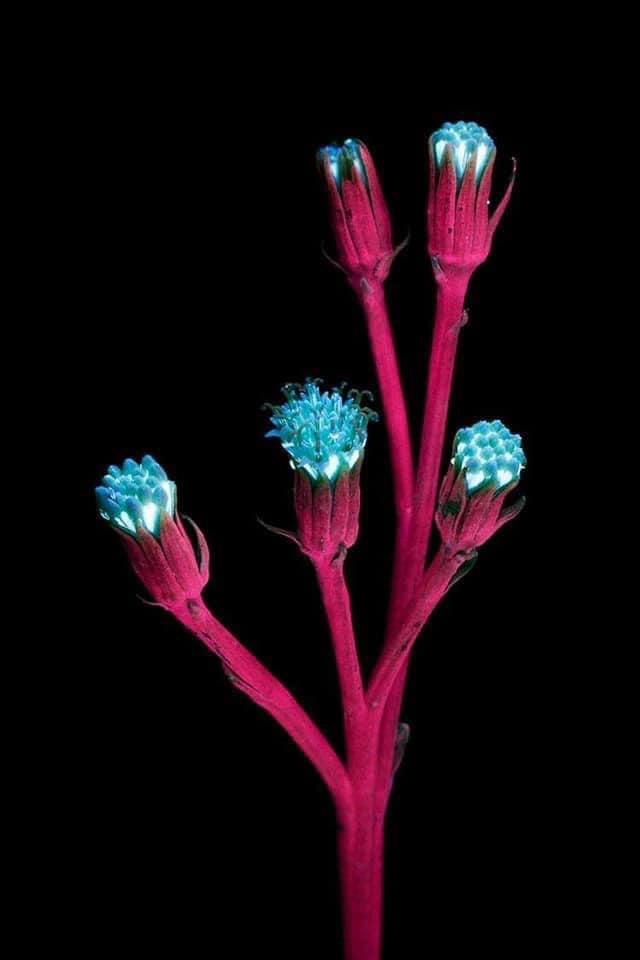
This is how flowers may appear to many insects
Photographer Craig Burrows used ultraviolet photography to reveal flower patterns that humans can't see but many insects including bees and butterflies use to find nectar and pollen
This 2-brush system for goats by Schurr Gerätebau is designed for unproblematic use of horned animals with no risk of injuries for the animals. It's automatically activated by the animals' presence
Costa Rica has outlawed recreational hunting, solidifying its role as a worldwide leader in animal protection and a safe haven for the remarkable 5% of global biodiversity it hosts.
Home to an astonishing proportion of Earth's plant and animal species, Costa Rica stands as one of the planet's most vital biodiversity hotspots. Yet this extraordinary natural heritage faces ongoing threats from human activities—including unsustainable wildlife tourism, illegal wildlife trade, domestic animal neglect, and organized animal fighting.
As encounters between people and wildlife grow more frequent, the country's fragile ecosystems require proactive safeguards to protect their most vulnerable residents.
Costa Rica has responded with groundbreaking animal welfare laws that reflect a deep national commitment to conservation. Building on its landmark 2012 nationwide ban on sport and trophy hunting, the country introduced stringent anti-trafficking measures in 2017 to combat poaching and biodiversity loss. By imposing mandatory prison sentences for animal cruelty and creating a national registry of offenders, Costa Rica demonstrates that effective conservation demands strong legal enforcement alongside widespread societal resolve to safeguard all living beings within its borders.
This is real footage from 126 years ago.
What you are watching is the trottoir roulant, the moving sidewalk, built for the great World's Fair in Paris in 1900.
More than a century ago, three years before the Wright brothers would make the first airplane flight, the city built an electric street that carried you across itself while you simply stood there...
It ran in a loop of around three and a half kilometres, raised on a viaduct above the fairgrounds, with nine stations where you could step on and off.
And it had a clever design: two moving platforms side by side, one going at walking pace and one faster, so you could step onto the slow one first, then onto the quick one, and ride the whole circuit in about twenty-six minutes without taking a single step.
Nearly fifty million people came to that fair, and for most of them it was the first time they had ever moved through a place without taking a step.
The very first moving walkway had appeared seven years earlier, at the World's Fair in Chicago in 1893, built by the same designers. But the Paris version was longer, faster, and far more sophisticated, and it was here that the world truly fell in love with the idea.
It astonished people. The thought that the ground itself could carry you felt like magic, like something out of a dream of the future. They even called it the Rue de l'Avenir: the Street of the Future.
Thomas Edison sent a crew to film it, which is why we can still watch it today...
Every year from April to August and from November to January, Baja California is the home to the largest and most spectacular mass migration of Mobula Rays. This clip captures the magic of this underwater flight
[📹 Aidan Bedford]
The Sun has only 22 galactic orbits left.
Earth races around the Sun at ~67,000 mph (107,000 km/h), giving us our familiar 365.25-day year and changing seasons.
But the Sun is in motion too—hurtling through the Milky Way at ~514,000 mph (828,000 km/h) on a grand orbit around the galactic center. One complete lap, known as a cosmic year, takes roughly 225–230 million years.
When the Sun finished its most recent galactic orbit, the earliest dinosaurs were just beginning to roam Earth.
Since its birth ~4.6 billion years ago, our star has completed about 20 such orbits.
Stellar models predict the Sun will keep fusing hydrogen in its core for another ~5 billion years before it swells into a red giant and eventually fades into a white dwarf. At its current orbital speed, that leaves roughly 22 more laps around the Milky Way.
Each cosmic year sweeps the entire Solar System tens of thousands of light-years across the galaxy—through dense spiral arms rich with star-forming regions, past ancient globular clusters, and amid countless other stars.
Continents drift, mountains rise and erode, entire species evolve and vanish—all within a tiny fraction of one galactic circuit.
Human civilization, from the first cities to today’s digital age, has existed for less than 0.001% of a single cosmic year.
We are passengers on a star halfway through its ~10-billion-year galactic journey across a 100,000-light-year-wide disk—witnessing just the briefest sliver of one ongoing lap in an unimaginably vast cosmic dance.
It is important to resist the commodification of basic human needs. Food, water and healthcare cannot be subordinated to market considerations or geopolitical interests. Access to adequate food is a fundamental human right grounded in the dignity of every person. Meeting this need not only alleviates suffering but also addresses underlying causes of geopolitical instability. Indeed, food security is an essential component of global and integral security. https://t.co/DgkM9RegJ7
Australia is wider than the Moon.
Australia’s east-to-west distance is about 4,000 km, while the Moon’s diameter is about 3,474 km. (The Moon has far more total surface area as a sphere, but the width comparison is still crazy
There are no “short cuts”
Forget about any and every concept
Of “short cuts”
You either Live
Enjoy
The Long Run
And
There is no other route
Available
Worth
Living
Creating
All Messes past
And present
Were created by some human
Wanting to take the “easy” route
Don’t
Do
It
Praise God
Halleluyah🙌🙌🙌
People Who Genuinely Love
You
Will not allow you
To Give Give
Of Your Self
Your Time
Energy
Financial Resources
Without Limit
Without reciprocating
To the extent
Of your personal harm
Exhaustion
Exasperation
If they do
Without a care
With persistent
Rising
Expectation
They don’t genuinely
Love
You
They need you
And
Want to use you
Say No
Like You Did
As A Three Year Young
Child
Knowing
You Your Life
Your Health
Well Being
Joy
Flourishing
Is Of At Least
Equal
Value
Praise God
Halleluyah🙌🙌🙌
Today in the Church, we celebrate the Solemnity of the Sacred Heart of Jesus. For Christians, Jesus’ Heart symbolizes God’s merciful and infinite love for every human being. No matter where we come from, God’s love knows no borders, makes no distinctions, is given to all, and brings us together in unity. #ApostolicJourney