@Rongwrong_ I think it's that (I've never met anyone who's read an Elroy Leonard novel) plus the fact that the racial aspect of the movie is pretty central, not something that's simply tacked on without making much sense and unacknowledged inside the movie.
@jdegoes I don't think it's fair to describe the recent math breakthrough as simply mining training data, unless anything that builds on past results trivially counts as mining training data. What it achieved is much cleverer and less brute force than most published math results.
@denying_history Nothing wrong with changing your mind as long as you’re explicit about it and reflect on the errors that got you there. The people he criticizes don’t do this (and don’t change their minds)
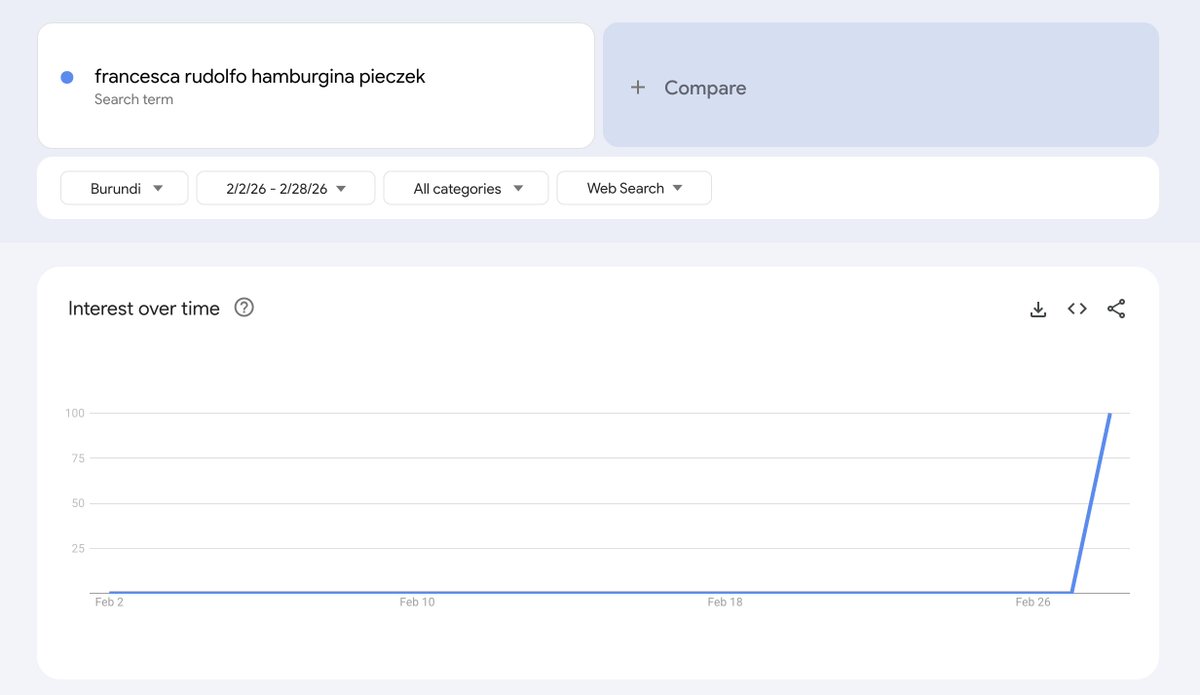
@babyjesusdaddy@memeticsisyphus P.S. I've found a search a few days ago for someone named "Francesca Rudolfo Hamburgina Piezcek" in the nation of Burundi. I wonder if she's a foreign aid worker or something.
@babyjesusdaddy@memeticsisyphus Multiple examples have in fact been given and I can give indefinitely more, but even a single one is sufficient to show that there are obvious false positives in their algorithm for incredibly low-volume searches, and that's all I need to debunk your ridiculous conspiracy theory.
@babyjesusdaddy@memeticsisyphus Search for my name on there enough times from enough IP's (or whatever they use to cache their results) and it probably will show up eventually. It's a lot more likely than "frambolga pargo," which is obviously not something anyone in Cambodia searched for a few hours ago.
@babyjesusdaddy@memeticsisyphus BTW, here's Google trends reporting Cambodian searches from early this morning for the phrase "frambolga pargo," a phrase I just made up five seconds ago. Do you think these actually happened?
@babyjesusdaddy@memeticsisyphus To debunk a conspiracy theory, you just need to show there's a perfectly plausible explanation that doesn't invoke the conspiracy and does invoke ordinary things everyone already agrees happen.
@babyjesusdaddy@memeticsisyphus That link doesn't imply there should only be false negatives. There are clearly false positives, as the gibberish result above shows. And public Google statements aren't the only source of evidence - you can draw from general knowledge of computer science.
@babyjesusdaddy@memeticsisyphus I doubt there's any way to implement Google trends at the scale they're operating on without using a probabilistic data structure like count-min sketch. Regardless, it's plausible that they do use such a thing and it would explain the results (just as it explains the gibberish)
@babyjesusdaddy@memeticsisyphus Google trends uses probabilistic data structures that randomly turn up false positives for low-volume search terms; refreshing the page will often immediately give different results. Here's an example of random gibberish showing up https://t.co/wTlNN4dIJh
@club922@OceangatePilot@laralogan do you think these are real spikes in searches for "ashdids naks" from NM and OK last night? keep in mind that they change when you refresh the page (see pic 4). try it yourself, type in some random gibberish and it usually includes random obfuscatory spikes of about this volume.
@Rongwrong_@L0m3z Gatekeeping is the issue here, and I don’t think there’s a plausible path to returning to it given the freedom of the internet and the fact that explicit hatred of gatekeeping (or at least real-life gatekeepers) is now a main focus of much of the populist right-wing psyche.