Upper tract urothelial carcinoma has almost no randomised evidence. POUT is the exception.
Adjuvant chemo after nephroureterectomy:
3-year disease-free 71% vs 46%. HR 0.45.
The kidney you removed is the one that decided platinum eligibility.
#UroOnc#TumourBoard
Permanently unresectable, liver-only colorectal metastases. BRAF wild-type. Chemo-responsive.
TransMet, n=94: 5-year OS 56.6% with transplantation vs 12.6% with chemotherapy. HR 0.37.
Four specialties have to agree before one patient qualifies.
#ColorectalCancer#TumourBoard
An ovarian mass in a woman with gastric cancer goes wrong in both directions.
Worked up as a primary until signet-ring cells appear. Or logged as incidental and never examined.
Same root: assigned to a specialty before it is assigned a diagnosis.
#GynOnc
HER2. MMR. PD-L1. Claudin 18.2.
One small endoscopic block, and every stain consumes it.
Ask them one at a time and the tissue runs out before the fourth decision arrives.
Not a pathology error. A sequencing failure.
#PatientSafety
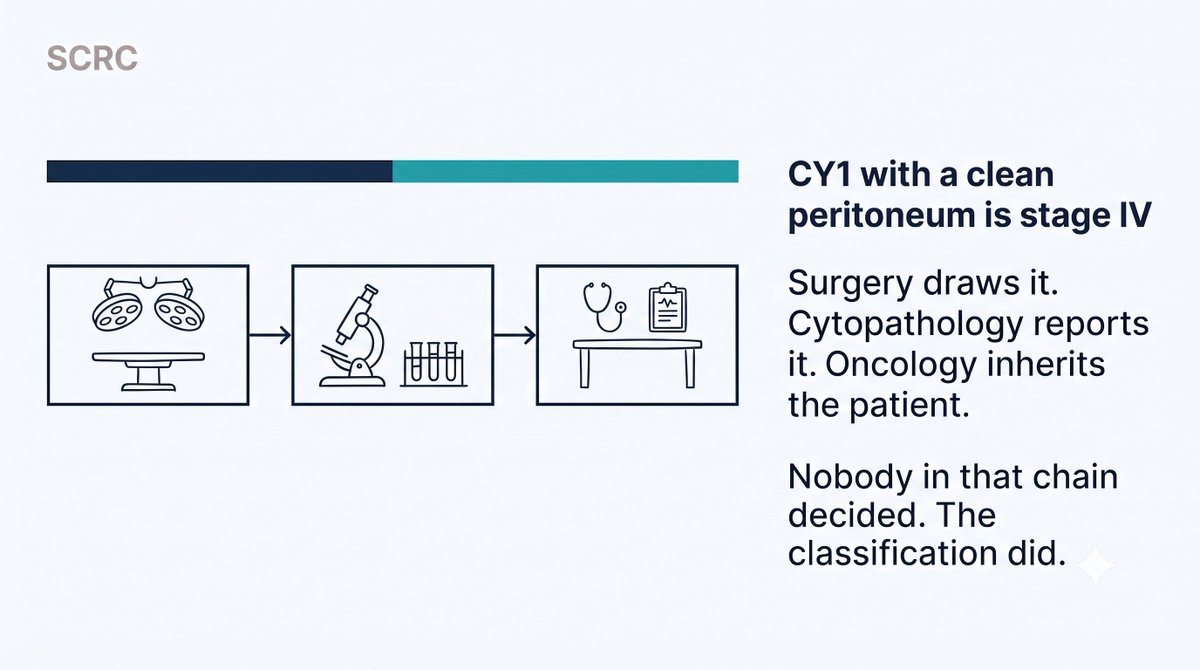
CY1 with a clean peritoneum is stage IV.
Surgery draws the sample. Cytopathology reports it. Oncology inherits the patient.
Nobody in that chain decided. The classification did.
Which is why the pathway is agreed before the case, not under the drapes.
#TumourBoard
JCOG0212 — mesorectal excision with or without lateral pelvic lymph node dissection for clinical stage II/III lower rectal cancer, Ann Surg 2017: https://t.co/pAzfpK6GoC | Imaging thresholds: Lateral Node Study Consortium, Ann Surg 2019.
JCOG0212: lateral node dissection missed non-inferiority. 5-yr RFS 73.3% vs 73.4%. Local recurrence 7.4% vs 12.6%.
Surgical target or radiotherapy target is settled on an MRI short axis, in millimetres.
Radiology decides first.
#RectalCancer
TESAR — adjuvant chemoradiotherapy versus completion total mesorectal excision after local excision for early rectal cancer, Lancet Gastroenterol Hepatol 2026: https://t.co/b2kWwwQTOm
TESAR, after local excision of early rectal cancer.
3-yr local recurrence 5.0% chemoradiation vs 1.1% completion TME. Non-inferiority not met.
Stoma rate 2.6% vs 45.4%. 3-yr survival 98.9% in both.
Two specialties own opposite halves of that trade.
#RectalCancer
CAIRO6: perioperative chemotherapy around CRS-HIPEC for colorectal peritoneal metastases.
OS HR 0.85, p=0.28. Major morbidity 26% to 36%.
Sidedness interaction p=0.044. Right-sided synchronous disease is the one group where we would still discuss it.
#Peritoneal
Randomised, oesophagogastric cancer surgery.
Six-minute walk distance from baseline to after surgery: +15.4 m with prehabilitation, -81.8 m with standard care. P<0.001.
Nutrition Week: who owns the four weeks before an operation?
Across 52 patients with colorectal peritoneal metastases, CT underestimated the peritoneal cancer index in 33%.
It under-reads small bowel and the low quadrants - the regions that decide resectability.
A CT is a map, not a verdict.
The scan estimates the depth. The specimen measures it.
EUS separates T1a from T1b at roughly 80-90% sensitivity.
The en-bloc specimen reports it in microns, with lymphovascular invasion attached.
Only one of those can decide against oesophagectomy.
Four molecular classes sat inside one histological label, and two of them wanted opposite treatments.
The PORTEC-3 molecular analysis sorted high-risk endometrial cancers into p53-abnormal, mismatch-repair-deficient and no specific molecular profile.
#EndometrialCancer#MDT