@leoba@ctschroeder I’m working on parts of this focusing on page flex and lighting effects on different manuscript components. It’s going slowly because I’m not great at model rendering but it’s been great for thinking materially.
Can confirm that @kringelberg and co are lovely to work with and be humans with, and that your pedagogy will change for the better when you teach alongside them.
Art History @elonuniversity has opened a search for a 1-year limited term faculty member w/ a preference for expertise in the Global South or/and ancient art/archeology. ARH@Elon challenges canonical art history and imagines a better way forward! Join us! https://t.co/OXQvTdUdM1
This is a lot, so we asked the amazing @johnrladd to develop tutorials on how to use these APIs, and he wrote three @observablehq notebooks showing what's possible—from basic tombstone data to machine learning:
https://t.co/B8yaBAobTE
Join me for a virtual data rescue session focused on music collections at cultural heritage institutions in Ukraine which may be at risk during the attack by Russia. For more info & to participate go to https://t.co/LPLU6lMAnO (@achdotorg@aseeestudies) Share widely!
I am so appreciative of DaliaRuth Halperin's color-coded diagrams of the Masoretic texts here — a great quick data visualization that makes the patterns and structures so clear. #OTST22
This is why we've got students in a fresco-making class this semester using RTI as a way to take a different look at their own use of a specific medium.
Processing RTI models of manuscripts while listening to @BillEndres talk at #OTST22 feels so appropriate. He's not talking about RTI (yet?) but I think the process of making this sort of model changes the way you approach looking in general.
Curious about why the Wikipedia NFT sale is listed as a “digital sculpture” as opposed to, say, a “digital architectural fragment” or something. https://t.co/NX3iMvmEdC
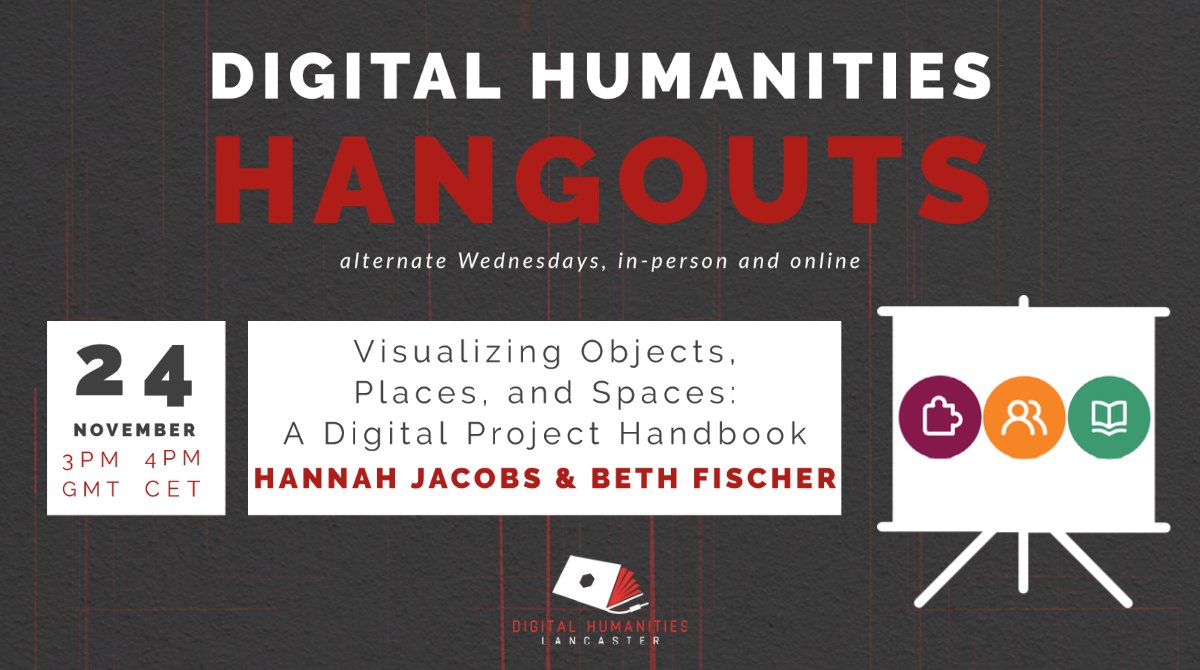
We're looking forward to welcoming @hannahljnc & @scribeth at our next #DHangout, speaking about 'Visualizing Objects, Places, and Spaces: A Digital Project Handbook'🧩🧑🤝🧑📖
🗓️24/11, 3pm GMT
🗒️Details: https://t.co/xGmS05htUA
🔗Join: https://t.co/m04i31FHQd
#DigitalHumanities
This tweet inspired by the great chat at the Digital Medieval Manuscript Expert Meeting, where it does help that we got all the presentations ahead of time.
Coming to the conclusion that the best aspect of online conferences is the side chat during presentations. A good one is like the best combination of questions, rebuttals, and live footnotes.
The theme of the Digital Medieval Manuscript expert meeting could be "the human in the digital manuscript." We've moved from crediting collaborators to interfaces that highlight physical experience to how to help students use digital models in a rich way. https://t.co/wGRF1KEs4g
Just a reminder that Williams is hiring a data science librarian — apply ASAP for full consideration! Master's degree required but paths outside the MLIS are warmly welcomed. https://t.co/ZAdaC6608Y
.@thomasgpadilla calls on us to recognize maintenance as a critical form of innovation, and to prioritize the amount of time/labor going into maintenance, not just scaling up all the time. #AEOLIAN_Network
Good to hear from @thomasgpadilla, who questions the values that appear in papers about machine learning and AI and advocates for NON-scalability as a need in ethical approaches. #AEOLIAN_Network
Love the output, including lesson plans, browsable law texts, code and extensive workflow details (and looking forward to the workshops on the process). @gislibrarian's presentation was a master class in talking about the expertise needed to create training sets. #Aeolian_network
Very active Q&A at #Aeolian_Network. Love the question in the chat about how close we are to making machine learning projects accessible to non-digital-expert staff for day to day use.