Some of my perspective on where the @ethereumfndn is going.
First of all, this is only my own view. The board is not just me, and I have no extra special powers on the board that the other board members do not. @aerugoettinea is the one executing much of this transition. My input has been largely on technical questions. The board is in the process of expanding, and my own power within the org will continue to decrease, which is honestly what I want.
The 2025 era brought many important improvements to EF and its ability to execute. Many issues were resolved, and EF continues to benefit from its improved efficiency and greater focus on concrete goals to this day. And so with those problems resolved, early this year, the largest remaining hole that I perceived was something different nagging at me: I would regularly spot people saying things like "vitalik says these beautiful things about ethereum needing to be decentralized, and have privacy, and be a sanctuary technology, but why do the EF's actions not reflect that?"
Now, you may have been hearing something different. You may not have been sensing a feeling of crisis at all, and maybe were hearing people saying that finally we were taking execution and BD seriously and the main task for us is to keep going that way and be even better and faster. Then probably there is genuine difference between you and me, in what kinds of criticism I take most seriously, and what kinds of critics through their criticism are most able to make me feel pain.
As an analogy, let's briefly switch over to a different domain.
One belief you can have about Google is that it is a success story, and has brought a lot of good to humanity in organizing the world's information. Another belief you can have about Google is that they had a beautiful idealistic beginning, but at some point the corruption of mainstream corporate attitudes seeped in, and they slowly bit by bit completely abandoned the "don't be evil" slogan.
My belief on Google specifically is probably somewhere between the two. BUT, if you had taken me back in time to ~2008, and offered me a button to press to make Google one or two standard deviations more "dogmatic", eg. give Richard Stallman permanent veto power over some key policies, I would immediately press it.
Why? Because a choice for one company is not a choice for the world, or even one country. Google existed and exists in the context of a technology industry generally drifting away from early idealistic don't-be-evil roots and toward greed for financial gain, totalizing visions of accelerated superintelligence, infiltration by sociopaths, and craven capitulation to (or worse, active participation in) government pressure for ideological control, surveillance and war. And so *one company* doing something different, positioning itself to be what George Bernard Shaw calls the Unreasonable Man, resisting the trend of the times, would have been better for freedom, balance of power and stability of society as a whole, than *all* large companies bending to dominant trends. This is a part of my version of pluralism.
This line of thinking is not just mine, but I also is not too far off from what Aya and others had in mind with the Mandate.
Now how does this all get to the role of the EF?
EF is not a "center of Ethereum", rather EF is "one node, with a defined purpose, alongside other nodes". We've always said that the EF should be the latter, but many in the Ethereum ecosystem (and even within the EF) wanted us to be the former. Now, we are taking action to ensure that we will be the latter.
This is particularly important because EF is a limited organization, with limited resources and limited organizational capacity. The EF has only ~0.16% of all ETH (less than many other individual ETH holders), whereas among other blockchains it's common for "the central foundation" to have 10-50%. Fiscally, the EF was originally designed to fulfill a limited work scope defined in the token sale docs and other pre-launch materials (building the chain software; getting through Frontier, Homestead, Metropolis, Serenity), which was fully completed in 2022; it was not designed to be an eternal steward.
And so today, the EF is choosing to use its remaining resources to pursue longevity over breadth (yes, this means we sell less ETH). The EF focuses *specifically* on those activities critical to the success of ethereum as a censorship/capture-resistant, open, private and secure system, that would not happen otherwise. This means making hard choices, and in some cases even activities that we highly approve of and people that we highly respect becoming outside of the EF. People of great technical talent, public respect and even alignment with the mission and CROPS being outside of the EF is in fact necessary if we want important tasks to be able to attract outside capital. This also means the EF taking opinionated stands culturally.
This is all intended in cooperation with all other parts of ethereum. We recognize that many other parts of the ethereum world highly respect CROPS and related values. But highly respecting is not the same as choosing to specialize and totally dedicate to a domain (Compare in a different domain: I think reducing animal cruelty is important, and I like vegan food, but am not full unconditional vegan myself)
EF is still in a transition period, and we expect its new long-term form to stabilize over the next few months. What are the guiding principles of this new form? Again, I am only one person, but I can give my answer from a technical perspective (there are also critical non-technical aspects).
At the core, *Ethereum must be impressive*. We are living in an age of highly intelligent AI and all kinds of other technological acceleration. "Status quo EVM, with a hard fork or two a year to optimize for short-term needs of users" is not interesting.
To some, "impressive" means: 250ms latency and 1M TPS. I think Ethereum trying to go that route is a mistake. Being as fast and as scalable as possible, and only a small epsilon more decentralized than the others, is a route to mediocrity, and if we try it we will lose.
I think Ethereum should scale. But I think Ethereum should strive the hardest to be deeply impressive in a different dimension: the CROPS dimension. This means things like:
* Provably bug-free Ethereum. This is a goal that all cybersecurity researchers would have thought is absurd and impossible, up until roughly 6 months ago. Now, it's on the cusp of being possible, thanks to AI-assisted formal verification. So we should be frontrunners in doing this.
* Available chain consensus. Ethereum is, and with lean consensus will cotninue to be, the ONLY chain that has both (i) traditional-BFT style properties that it's safe under asynchrony up to a high level of fault tolerance, and (ii) the bitcoin PoW-style property that under synchrony it's safe up to 49% attackers. As far as I can tell, literally no other chain has this or is planning for it; bitcoin goes for (ii) only and most other chains go for (i) only. Some will remember I fought hard for this, Unreasonably insisting that it is not OK for ethereum to rely on social consensus and hard forks to rescue ethereum from 34% of nodes going offline. It's OK for chains like hyperledger, bnb, solana, tempo, etc. It's not OK for bitcoin or ethereum or eg. zcash.
* Intermediary minimization. The fact that smart contract wallets, protocols like railgun, etc have to send transactions through intermediaries to get included onchain is honestly embarrassing, and it's a constant point of fragility. Hence the work on FOCIL and EIP-8141 (and 7701 and years of work before) to make transaction sending intermediary-minimized with public mempool and strong inclusion properties, in a truly general-purpose way, that covers not just eg. secp256r1, but also privacy protocols and much more. Kohaku is pushing intermediary minimization at the user layer, pulling Ethereum away from the dystopian status quo world where our wallets don't even verify the chain, send our private data out to a dozen third-party servers, and toward a brighter CROPS future.
Some of these goals are Unreasonable - maybe Ethereum would be "fine" getting only 50% of the way - what if we depend on intermediaries, but make it easy to switch? But going 50% of the way would not make Ethereum Deeply Impressive in the CROPS way. So we push for 100%.
Fortunately all these goals are compatible with high TPS, this is a major focus of research (esp. on scaling the state). Well-designed L2s can also help, especially L2s optimized for specific applications (eg. high-volume trading, privacy...). These goals are even compatible with significantly lower slot times, thanks to Raul's work on erasure-coded P2P, and many other optimizations.
The most high-value "product" of the ethereum blockchain, financially speaking, is ETH the asset. Ethereum secures $250 billion of ETH. The types of properties of Ethereum that I mentioned above are very good for ETH the asset. Nearly 90% of my net worth is in ETH, and most of the remainder is ~$40m of onchain fiat of which every dollar has already been allocated for some open-source biotech or software or hardware initiative. That said, there are aspects of supporting ETH the asset - *necessary* aspects even - that are outside the scope of the EF. This is where we need other heroes (some of whom hold more ETH than the EF does) to step in and help. EF has been recently thinking more about how it will relate to other such organizations, and give them needed initial support.
EF will be a smaller ship than in previous years, a more opinionated one - in some cases more opinionated in ways that might be difficult to comprehend - but a longer-lasting one, and one suited to making sure that ethereum brings something meaningful to the world. We are grateful to all those inside and outside the EF who are helping to make this happen.
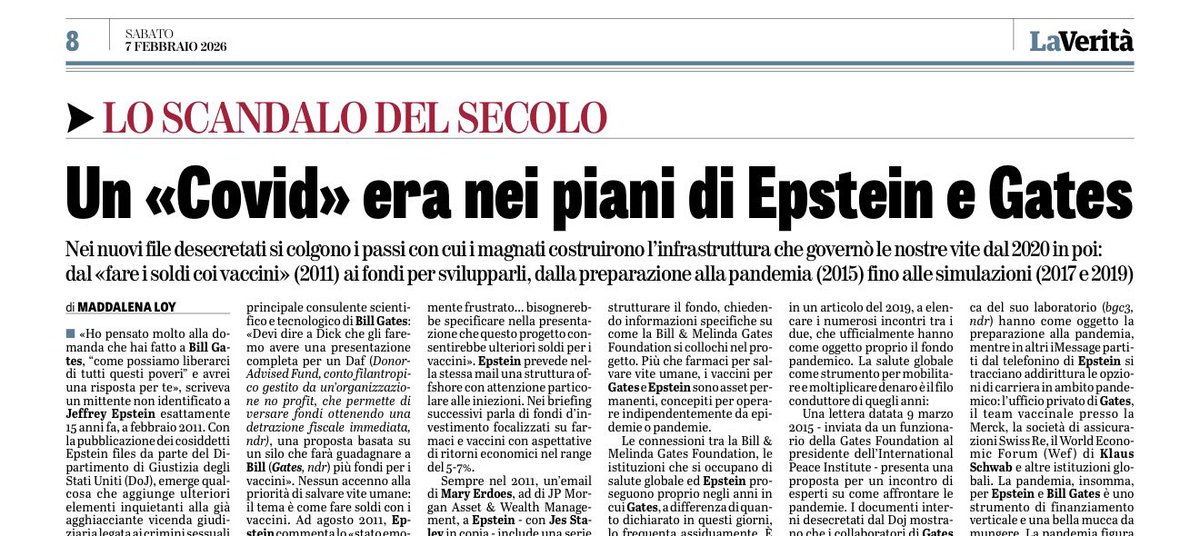
“Fare soldi con i vaccini”: di questo parlava Bill Gates con Epstein (oltre a mandargli mail con “le descrizioni del suo pene”). Per anni i due hanno trafficato trattando le pandemie come un vero e proprio “modello di business”, una categoria strategica di investimento permanente su cui costruire prodotti finanziari, strutture giuridiche e narrative consolidate, come documentano le mail degli Epstein files appena desecretati.
Oggi su @LaVeritaWeb
Quindi va arrestato e processato, non giustiziato per strada altrimenti dovrebbero morire tutti i maleducati, in più lui in questo momento non sta spaccando cose a caso ma attacca con i rischi che sapeva di correre, con violenza, un potere che ritiene scorretto. Si sta ribellando a qualcosa che trova ingiusto e per questo subirà una vera esecuzione, questo in democrazia non deve succedere. Hai ragione la stampa che lo dipinge samaritano fa falsa informazione tanto quanto quella che difende l ICE, che altro non è che un gruppo di esaltati mercenari narcisisti, e soprattutto non rispetta la ribellione di Pretti. Esistono tanti tipi di ribellione e molte, come ci insegna la storia, violente o non violente, trovano la morte ma aprono la strada al cambiamento. La probabilità che avanti così scoppi una guerra civile è altissima
"Smettete di pensare che una persona solo perché laureata in medicina sia eticamente irreprensibile e abbia lo stesso status morale di un prete che va a fare il missionario in Africa.
Sono i soldi che muovono il mondo, anche quello della sanità"
Prof. Roy de Vita
Primario CP
Istituto Nazionale dei tumori
Regina Elena Roma
P. S. Non serve un titolo di studio per riportare le parole del Prof. De Vita.
Basta il coraggio di guardare in faccia la realtà, che molti oggi preferiscono ignorare.
E serve la libertà di poterlo dire, senza che i guardiani del pensiero unico, spesso finanziati da Big Pharma, ti zittiscano.
Ci sono verità che sono di dominio pubblico nel mondo, ma che il mainstream e i cosiddetti esperti Italiani continuano a ignorare.
Il virologo Robert Redfield, ex Direttore del CDC durante la pandemia, ha dichiarato quello che molti hanno sempre sostenuto, ma che i piazzisti Italiani in camice bianco e i loro adepti, si ostinano ancor oggi a negare e a nascondere:
- il vaccino COVID non è stato progettato per prevenire la trasmissione
- di fatto non la previene e non la ferma
- il vaccino COVID non è un vaccino
- non va somministrato ai bambini
- non avrebbe mai dovuto essere un obbligo per lavorare o studiare (bisognerebbe dirlo ai giudici Italiani)
- gli effetti a medio-lungo termine sono ancora completatmente ignoti.
Basterebbe questo a svegliare chiunque e a pretendere che politici ed esperti siano chiamati alle proprie responsabilità.
E invece c'è chi si lamenta che "si parli ancora di vaccini dopo 5 anni".
Sono quelli che hanno una fottuta paura di scoprire di essere stati fregati o una fottuta paura di finire dietro le sbarre.
@La7tv Il vostro servizio sui cimiteri e sui cimiterò svedesi andato in onda poco fa spero sia stato un momento vostro di sbandamento, per favore, non battete dove il dente duole per piacere 😂 ma io non lo so! 😂
2026-30 predictions
-globalism is dead. resilience is the new god. countries and individuals are racing for sovereign compute and mineral sovereignty. if you can't produce your own energy, food, and intelligence locally, you're a vassal
-the winner in robotics is the company whose humanoids can navigate a messy, 70s built warehouse. general purpose labor becomes a purchasable SKU, starting in logistics and moving toward elderly care
-the west stops moralizing about mining and starts treating lithium, cobalt, and copper with the same ruthless blood for oil energy of the 20th century
-the line between peace and war permanently dissolves. conflict shifts to gray zone operations. constant cyber attrition, undersea cable "accidents" and satellite interference. no more grand declarations, just a baseline of chaos
-the internet officially splinters. you now have the "open web" (chaotic, bot heavy, western), the "fortress web" (highly censored, eastern), and the "sovereign web" (encrypted, boutique, and high trust)
-neuralink and its competitors move from clinical trials to high performance enhancement for the wealthy. the augmented vs natural cognitive divide begins to show its first cracks in the social fabric
-control over freshwater sources becomes the primary driver of regional skirmishes, replacing traditional border disputes
-corporations with bigger balance sheets than countries (the big 5) begin negotiating directly with governments for territorial autonomy to host their own data centers and energy grids
-the alliance between the New Tech Right and traditional populism fractures. SV realizes that nationalism is bad for the global talent flow they need for AGI. they pivot toward techno statehood and local city states.
-being unreachable is the new wealth. the always-on worker is seen as a low level cog
-content with errors, rough edges, and physical presence becomes 10x more valuable than polished, AI generated perfection
-the Ivy League degree finally loses its power for good. Proof of Work becomes the only resume that matters
-high performers begin taking analog sabbats. deleting all apps for a month to reset dopamine receptors. a requirement for mental elite status
-after a year of AI-slop, the low-fi aesthetic wins. grainy film, handwritten notes, and physical gatherings become the only signs of authenticity
-micro schools and high level apprenticeship guilds replace the bloated university model. learning becomes a high stakes, boutique experience
-physical neighborhoods begin self organizing around shared values (techno-optimism, homeschooling, fitness, etc) rather than just proximity
-infinite scroll is viewed with the same social stigma as indoor smoking
-massive cultural pivot back to the importance of circadian rhythms, mineral balance, and real world movement as the bio-hacks that actually work
-AI is no longer a tech trend. it’s a national utility like electricity. small, high IQ nations pull ahead by building proprietary national models, while large bureaucracies choke on regulation
-high production value is now synonymous with fake or corporate. the most viral content is raw, unedited, and intentionally flawed. if it looks like it could have been made by an AI, it’s ignored
@RobertoBurioni@heather_parisi@POTUS@ProfMBassetti Prima di partire tutti mi raccomando nel fagotto patate, gallette di emergenza e cereali e un bel booster covid RNA messaggero degli dei come Ermes ma più incisivo
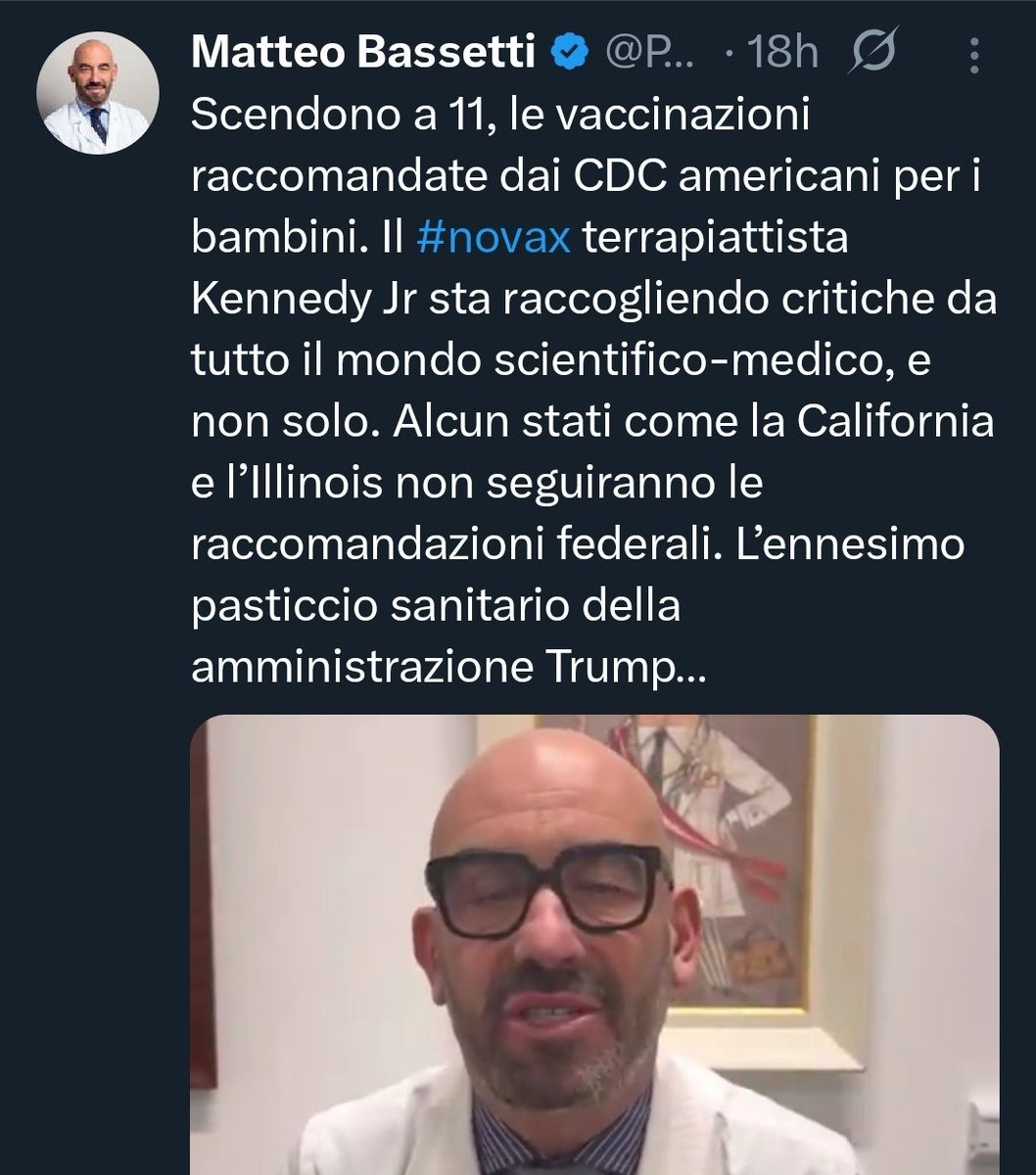
President Trump @POTUS mentre lei, con determinazione, si occupa di dittatori Sudamericani e dei loro loschi traffici, e mentre guarda con occhio vigile ai fanatismi mediorientali, dall'Italia, nostro alleato, un certo professor @ProfMBassetti arruolato dal governo Italiano addirittura in un ruolo ufficiale al ministero della sanità, aizza folle di webeti contro il nostro Ministro della Salute, @SecKennedy che lui definisce,
"ex tossicodipendente" e "terrapiattista".
Presidente, metta sul radar questo professore Italiano con la lingua troppo lunga e il curriculum troppo breve.
Valuti le opzioni, anche le più dure.
Lo metta al confino su substack come ha fatto con il suo collega di merende, lo affidi agli spietati servizi sociali Italiani, lo assegni a fare supplenza all'asilo.
L'America non si ferma ai grandi scenari. Sa guardare anche ai particolari più nauseanti.
Matteo Bassetti ancora una volta insulta pesantemente i colleghi del CDC ( centro di controllo malattie degli Stati Uniti) e Robert Kennedy Iunior, Segretario alla Salute, nel silenzio assordante dell’ Ordine Pofessionale di Genova . Gli Ordini dei Medici con tutta evidenza obbediscono al Presidente Nazionale Filippo Anelli. Filippo Anelli recentemente in Tribunale ha affermato che gli Ordini obbediscono alla politica e non al codice deontologico. La disobbedienza civile a questo punto e’ un dovere etico. Daniele Giovanardi.
This is what I worry Europe will get negatively polarized into: an ideology taking pride in a neat, sanitized online environment free of evil corporate and fascist pathogens.
I hope European govs do not go this way, and instead take a Pirate Party approach of user empowerment.
First, what's wrong with the tweet I'm quoting:
The idea that there should be "no space" for something you dislike is fundamentally a totalitarian and anti-pluralistic impulse. It's incompatible with being in an environment that you do not fully control.
This is especially true for categories that are subjective and controversial, because you end up trying to fully remove things you think are pathogens, when other people have good faith disagreements, and because you give yourself the maximalist goal of not even giving them breathing room, you create conflict and end up building the machinery of technocratic authoritarianism to impose your victory in the conflict.
So sorry, if you want to be a free society, you have to bite the bullet that some people, somewhere, will be selling things that you consider dangerous and saying things you consider disinformation and vicious lies.
What is the goal to shoot for?
You want to create an environment where those things don't dominate. This is the problem with twitter today: not that it's a safe space where 1000 people talk to each other in a corner about how heritage americans are the master race and putin is good or whatever, but that that crap gets shoved in our face on a mass scale, and the algorithms actively favor it.
The right metaphor is not castles and walls, but biological - think, why European forests don't have tropical lizards.
Having incentives for social media platforms to have less of those things instead of more is fundamentally reasonable, @audreyt has talked about how Taiwan has done something similar.
You also want to do this in a way where it's clear what the underlying principle is, so it's not a vehicle for imposing arbitrary and frequently changing expert-consensus agendas.
You also want to empower users, rather than working against them. People want to see and buy good things instead of bad things. Often the problem is that competition is too difficult in the current market. I actually supported the USB-C standardization mandate; it created more interoperability and thus improved competition and convenience. I would support incentivizing social platforms to be more open, and to be more transparent (eg. my proposal to require algorithms to be continuously published with a 1-2 year delay, with zk-proofs to ensure that the algorithm being used in real time exactly equals the one that gets published later)
Being able to better identify what messages are coming from what communities is also good, though I don't support the direction of banning anonymity of individual posters, rather I would want to see more macro-scale analytics, eg. seeing what communities are most strongly saying and amplifying content that semantically matches a particular idea; this can be done in privacy-preserving ways.
There is a real opportunity to reaffirm freedom of speech in a unique and different way, that emphasizes pluralism and pushes against unbalanced attempts to manipulate the discourse by individual powerful actors. We want to do this, not go down the dark path of having something that claims to support fundamental rights but actually is not trusted by anyone to be anything other than the fundamental right to follow the footsteps of a few technocratic experts.