In his Updated Fiscal Year 2027 Budget Priorities memo, Council President La Cava opposes “New revenue or fees on the backs of hard-working San Diegans.”
This is somewhat misleading since he voted to place the Empty Homes Tax / Measure A on the ballot, which (if approved) would go into effect on January 1, 2027.
While Measure A votes are still being counted, water and sewer rates will increase, as will a range of miscellaneous fees. Council President La Cava has yet opposed a large-portfolio homeownership speculation tax is headed to the November ballot.
https://t.co/5zepUMcQOT
California's gas and diesel taxes are increasing on July 1, the Newsom administration's Department of Tax and Fee Administration announced at the end of the day. New gas tax will be 63.4 cents per gallon.
https://t.co/TbRktEH6Ur
Good work, #SanDiego.
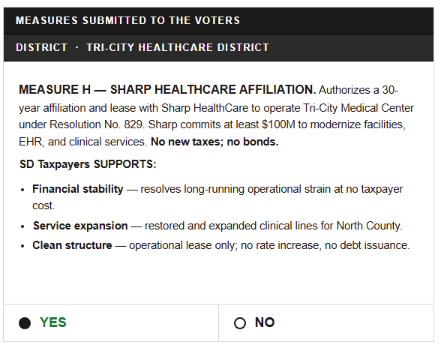
Looks like Measure H/Tri City Health Care has passed by a wide margin.
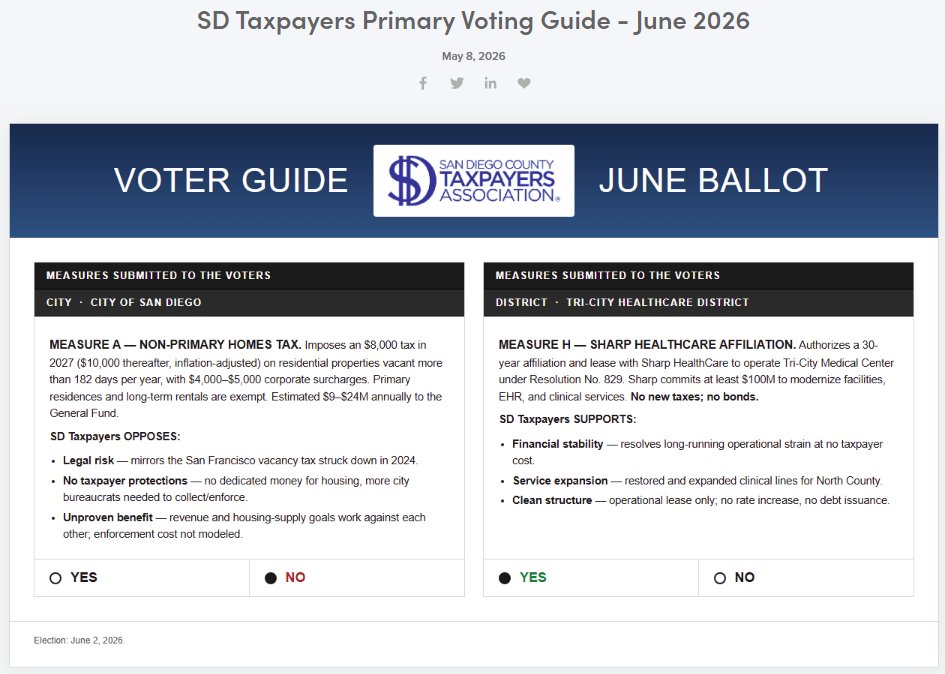
The health care provider affiliation and lease agreement was endorsed by SD Taxpayers.
Be sure to check in with us for the latest news and recommendations as the November elections approach.
https://t.co/3Xq8vLgH0V
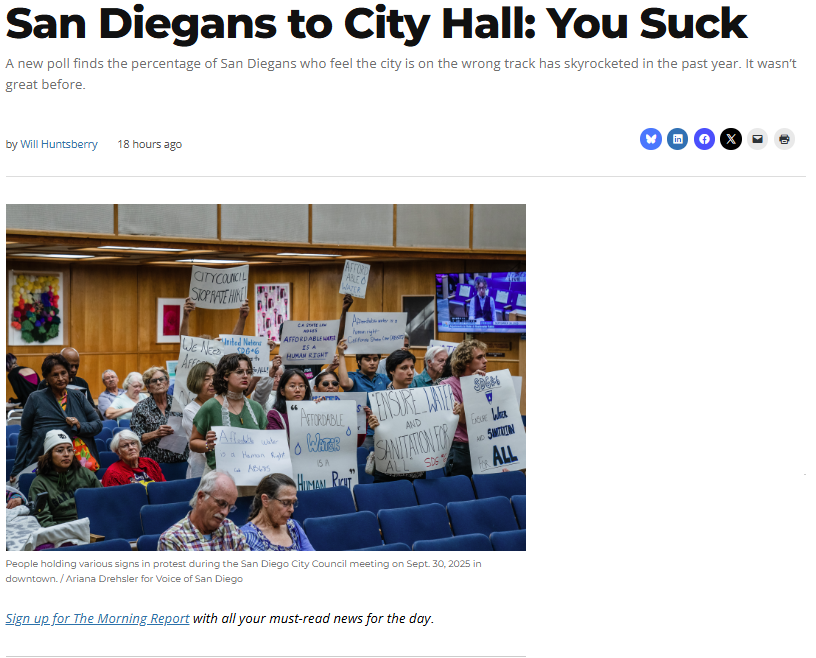
“The anti-tax-and-fees crowd was having a big moment . . . But the recent deal that locked in a trash fee and killed Balboa parking fees has now defused it.”
Don’t worry about the ‘anti-tax-and-fees-crowd’.
There is no shortage of new and increased taxes in the pipeline to rail against.
Measure A/the Empty Homes tax (on the ballot today) is characterized by uncertain legality, lack of taxpayer protections, and insufficient evidence of benefits to taxpayers.
Sales tax increases from the county, and the city of Santee are heading to the November ballot, followed by additional proposed sales tax hikes from the city of San Diego, SANDAG, and MTS over the next few years.
In fact, keeping up with all the taxes, fees, and school bonds 2026 ballot measures in San Diego alone is something of a full-time job.
https://t.co/BAip0ZBif3
https://t.co/rBpzMcIycy
Instead of a choice between less taxes/worse city services and more taxes/better services, how about “before raising taxes or fees (again) #SanDiego reduces the number of bureaucrats, stops wasting money on vanity projects, and obliges employees to contribute more to their pensions" option?
https://t.co/rBpzMcIycy
"Ten Reasons to Vote No on Measure A
Election Day is almost here.
Before you vote, remember what Measure A really does.
It is not a real housing solution.
It is a $10,000 tax, a new City Hall bureaucracy, and another risky scheme with no guarantee of lower rents or new affordable housing.
Here are ten reasons to vote No on Measure A.
1. It Is a $10,000 Tax on Homes
Measure A creates a tax of up to $10,000 per home, per year.
That is not a small fee.
That is a major new tax on housing.
2. The Money Goes to the General Fund
Measure A is being sold as housing policy.
But the money is not locked into a dedicated housing fund.
It can go into the City’s General Fund.
3. No Guaranteed Lower Rents
The City’s own analysis does not show that vacancy taxes lower rents.
Other cities have tried this.
The promised rent relief did not follow.
4. No Guaranteed New Affordable Housing
Measure A does not guarantee a single new affordable home.
It gives City Hall more money and more power — without a real housing plan.
5. The Burden of Proof Is on You
If you claim an exemption, you have to prove it.
Every year.
With paperwork.
Under rules City Hall has not even finished writing yet.
6. City Hall Does Not Really Know Who Will Get Caught
The City’s own report relies on limited proxy data to estimate who might be subject to the tax.
That means mistakes are likely.
And when City Hall makes a mistake, homeowners may have to fight their way out.
7. It Creates an Occupancy Bureaucracy
Measure A would require new forms, new rules, new audits, new appeals, new enforcement, and new City Hall control over how homes are used.
That is not housing policy.
That is bureaucracy.
8. It Invades Privacy
To enforce Measure A, City Hall would have to decide whether homes were occupied enough days.
That means records, audits, paperwork, tenant information, family occupancy proof, and more.
San Diegans should not have to prove how they use their own homes.
9. Other Cities Show It Does Not Work
Vancouver, Toronto, Ottawa, Oakland, Washington D.C., and San Francisco all show the same warning signs:
Privacy problems.
Wrong tax bills.
Costly bureaucracy.
Legal fights.
No real housing relief.
San Diego should not repeat those mistakes.
10. City Hall Has Not Earned This Trust
Measure A asks voters to trust City Hall with a complicated new tax system.
But City Hall does not know who will get caught.
The rules come later.
The money is not dedicated to housing.
And if something goes wrong, taxpayers and homeowners pay the price.
Remember to Vote — and Vote No
San Diego needs real housing solutions.
Measure A is not one of them.
It is flat.
It is unfair.
It is expensive.
It is risky.
And it gives City Hall too much power.
Remember to vote.
Vote No on Measure A."
https://t.co/KQ2UzDYmmy
A powerful argument against Measure A, from Jordan Marks the #SanDiego County Assessor-Recorder-County Clerk.
"While city councilmembers see Measure A as a tax to fill their budget, I see the families who will be hurt while trying to rebuild or preserve their family home.
That is why I am urging a 'No' vote on Measure A on June 2."
https://t.co/Y5eTRN2q2c
The city of #SanDiego has a history of losing money by rushing into poorly considered tax and fee increases.
Balboa Park paid parking decimated museum attendance and wasted funds installing and then removing meters.
Padding the trash collection fee resulted in a trail where the city was represented by outsourced attorneys.
A cannabis excise tax increase reduced sales and revenue (apparently, people will turn to less regulated markets to buy marijuana; who knew?)
And now, overly aggressive parking ticket enforcement has resulted in penalties totaling $millions.
Looking forward, Measure A (the ‘Empty Homes Tax’) promises even more legal costs and regulatory expenses for all residents.
https://t.co/0ztPxgEjN8
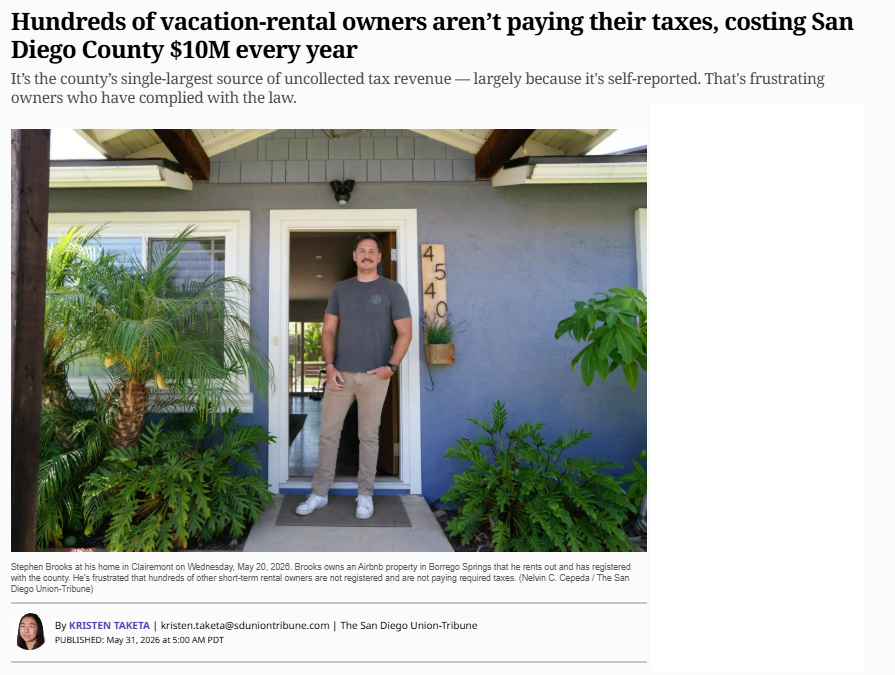
Instead of imposing a half-cent sales increase on all county residents, maybe the county of #SanDiego could enforce existing rules on vacation-rental owners?
Using vacation tax revenue for core county services, and not as a supervisors' discretionary fund wouldn't hurt either.
"The county’s transient occupancy tax revenue goes to the county’s controversial Community Enhancement Program, which lets county supervisors give grants to nonprofits and public agencies for services that promote tourism, economic development, cultural activities and quality of life."
https://t.co/A7S8yFmuxm
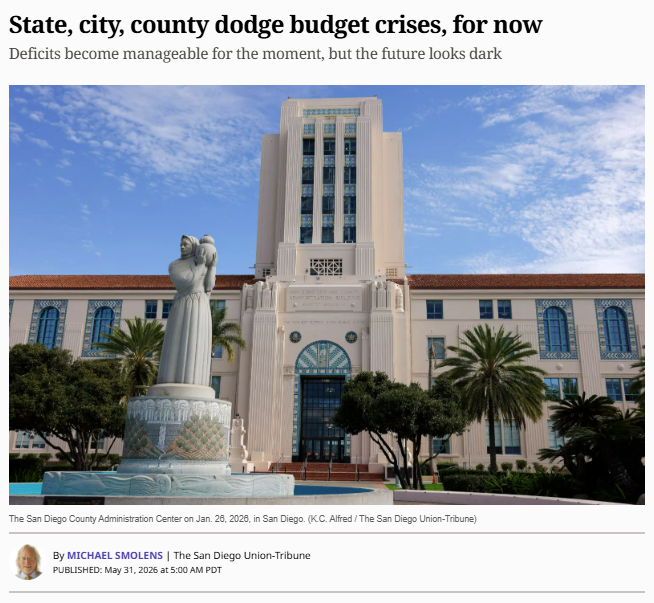
The California state and #SanDiego county and city budgets are only ‘balanced’ to the extent that current year expenses meet current revenue only after reserves have been drawn down.
Factor in ballooning infrastructure funding gaps, pension deficits, and potential revenue loss from stock market adjustments and the situation looks worse.
“Not surprisingly, red flags were still waving at the future for state and local governments.
"The ubiquitous term 'structural deficit' haunts elected officials year-round, but naturally it is uttered more frequently during budget season. It refers to a constant financial imbalance where an agency’s expenses regularly exceed its incoming revenues, pretty much in good or bad economic times.”
https://t.co/6sActm77JK
A powerful argument against Measure A, from Jordan Marks the #SanDiego County Assessor-Recorder-County Clerk.
"While city councilmembers see Measure A as a tax to fill their budget, I see the families who will be hurt while trying to rebuild or preserve their family home.
That is why I am urging a 'No' vote on Measure A on June 2."
https://t.co/Y5eTRN2q2c
Great time at the @sdcta School District Roundtable hosted by @SDCCD. Dr. Joel Peterson and CBOC Chair Mike Fratalli joined regional leaders to discuss bond transparency, oversight, and construction trends. Thanks to sponsors Gafcon, @KitchellCos and @Cumming_Group. #MeasureHH