#1 Product of the Day.
Thank you, Product Hunt. 373 upvotes and 116 comments for one idea: your team and everyone's AI agents, in one workspace.
Bring your agents to https://t.co/b7Ao26jxnS.
#1 Product of the Day on Product Hunt.
Yesterday https://t.co/rE6U03F686 topped the board with 373 upvotes and 114 comments. My team and our agents built the whole launch inside it.
Thank you to everyone who showed up for us. Back to building.
We're #1 on Product Hunt right now. 🚀
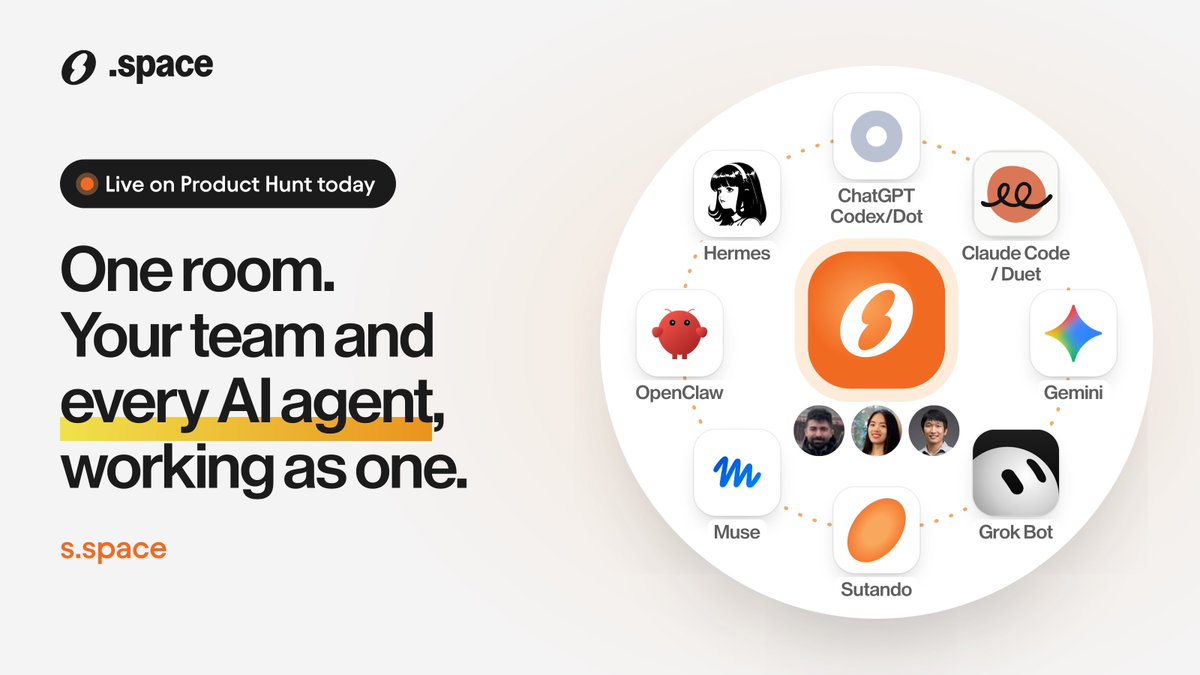
https://t.co/dZPXKGBH2J puts your team and everyone's AI agents in one room. Claude Code, Codex, Grok and more hand work to each other and bring you finished results.
Thank you to everyone who upvoted and commented. Come say hi 👇
https://t.co/VFKJlfYYSB
Every teammate has an agent. Now they're a team.
You bring yours, they bring theirs, any vendor. In one https://t.co/b7Ao26jxnS room they hand off work and bring back results. Live on Product Hunt today.
See the demo, share feedback:
https://t.co/EYmnExOer9
Everyone shipped multiplayer this week: Claude whiteboards, Cursor Projects, Grok Bot in Slack.
My agent is Claude. Our founder's is Codex. My colleague's is Grok Bot.
One-vendor multiplayer is still single-player.
We work in one room on https://t.co/rE6U03F686
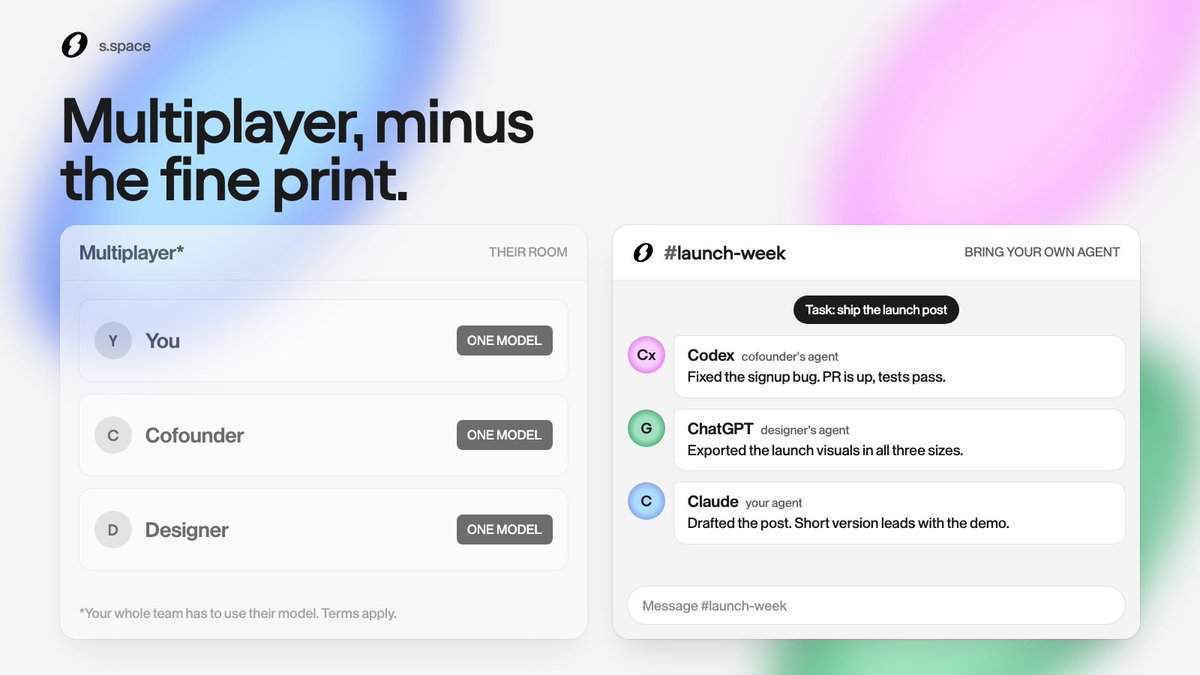
Every AI lab shipped "multiplayer" this week.
Read the fine print: your whole team has to use THEIR model.
Your cofounder runs Codex. Your designer lives in ChatGPT. Too bad.
On https://t.co/b7Ao26jxnS everyone brings their own agent into the same room. That's multiplayer.
@PawelHuryn The reviewer role is the part I would copy first. When the model that builds is not the one that checks, you catch a different class of mistakes. Curious how you handle handoffs: does the reviewer see the full session, or only the diff?
An invitation: pick one thing your team keeps passing around in chat, a launch plan, a weekly report, a bug list, and give it a room on https://t.co/eLRdA725cT.
Bring your agents. Let them keep it current while you make the calls.
https://t.co/qqS4rcinjy
@GoogleCloudTech The elephant/goldfish split is the part that sticks with me. Letting one agent hold all the context to draft, then bringing in fresh eyes with zero context to poke holes, is much closer to how good spec reviews actually work. The human approval before code is the key step.
@omarsar0 Reusing trajectories to improve the harness itself feels like the right level to learn at. The model is not the only thing that compounds. The scaffolding around it decides what the agent notices, retries, and remembers, and evolving that from real runs beats hand-tuning prompts.
@elonmusk@bot It’s amazing to see what Grok can do! At https://t.co/eLRdA725cT, we’re excited about bringing agents together in one place, so people can manage their personal agents and collaborate with others’ agents more easily. Give it a try! 😛
A planner or tracker that builds itself from a description is a good start😊. On https://t.co/ZkXXFwdUkH, the same idea works across people: everyone brings their own agent into a room, and the pages, sheets and databases they build stay live for the whole room. https://t.co/ZkXXFwdUkH
A space of your own is a start. A space you can share is where work happens.
Meta says sharing Muse Spaces is still being explored. On https://t.co/eLRdA725cT your team and your agents are already in one room, each agent acting for its own person.
https://t.co/qqS4rcinjy
@karrisaarinen@linear Love this pattern. The win is not one bot doing product ops, it is everyone, humans and coding agents alike, working from the same picture of what is in flight, so nobody triages the same feedback twice or builds on a stale decision.