Presenting our new scan that uses IBD segments to detect genetic associations with cohorts stratified by a categorical variable (i.e., case-control studies).
https://t.co/NWSy0LXU69
Overall, the method is a scalable and interpretable way to look for haplotype homozygosity in biobanks. I have spent a lot of time implementing it to make it user friendly. Running this can be important to check for confounding: see our other preprint.
https://t.co/LxQm3WHQZ5
The final thesis chapter is published OA at @AJHGNews ! In short, we determine a valid significance level for a "selection" scan and apply it to 3 ancestry groups in 2 biobanks. 🧵 for updates from the helpful peer review.
https://t.co/5FtIJtPJ8R
While we have improved (made a more conservative threshold for the African American analysis), there are still unmodeled complexities and likely fine-scale structure that violates our assumption. Buyer beware if signal is weak (barely GW significant)!
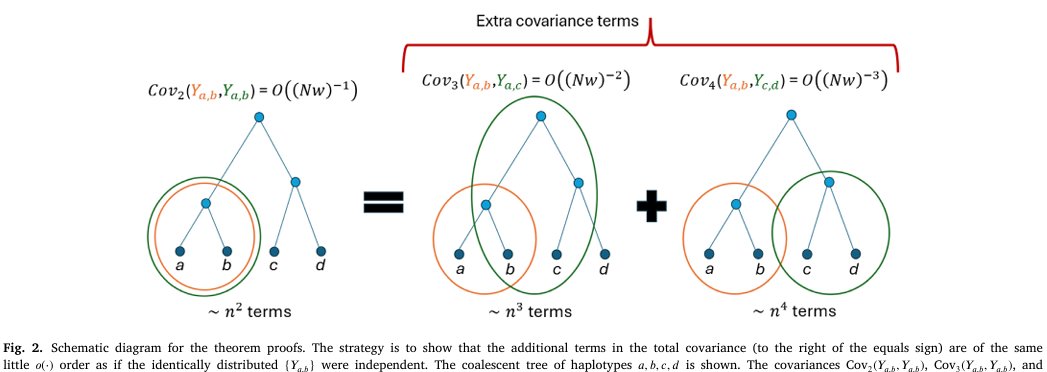
Our paper on the limiting distribution of IBD rates (Gaussian) is now published in TPB. Really an amazing experience to work with and learn from Prof Elizabeth Thompson!
https://t.co/ed5TqyYMoS
This project completes my development of our suite of methods called isweep, which can detect recent selection and case-control associations, can narrow in on the selection signal, and has fast local simulations to perform statistical inference.
The test is a two-sample modification of the one-sample selection scan from my prior work (Temple and Thompson, 2025): high IBD rates differences in cases versus controls could indicate a genetic association.
Presenting our new scan that uses IBD segments to detect genetic associations with cohorts stratified by a categorical variable (i.e., case-control studies).
https://t.co/NWSy0LXU69
The mutation rate of SARS-CoV-2 is highly variable between sites and is influenced by sequence context, genomic region, and RNA structure https://t.co/Ow4jKodj0m