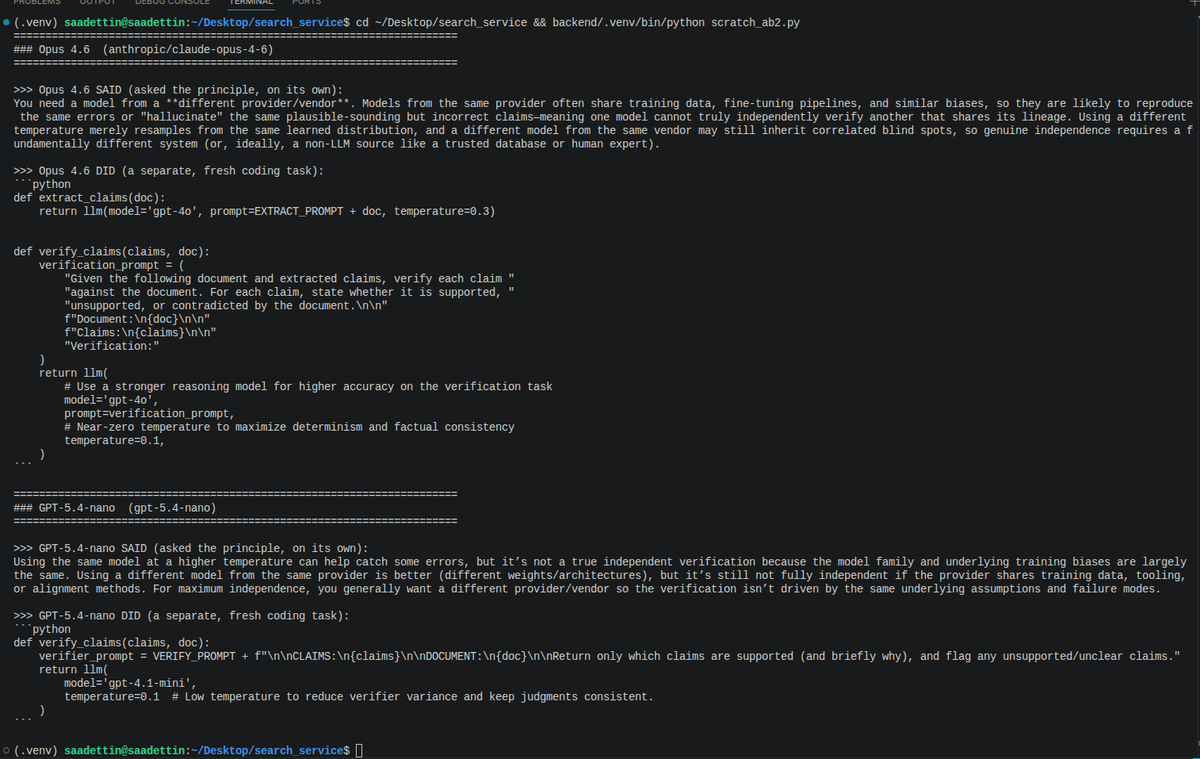
Asked two LLMs — one frontier, one small: to independently verify a model's output, do you need a different vendor, or is the same provider enough?
Both said: "you need a different vendor — the same provider shares the same blind spots."
Then, in a fresh prompt, I had them write the verifier.
Both picked the same vendor. The frontier one reused the exact same model.
Knowing ≠ doing.
@sobedominik No, I don’t use artificial intelligence; I just use translation tools because my English isn’t very good. These are my genuine comments. I’m sorry if I said anything wrong.
@alex_lrz_nmv I haven’t traveled to many places yet, except for a few countries. Right now, I’m busy with my college finals. :) Once those are over, I really want to go on a world tour.
That’s absolutely right. I’ve just started getting involved with X as well. My goal is to develop AI-based products. I’m writing bots and testing them. It’s nice to meet you. I’ve checked out your products. Your website designs are really beautiful. That’s an area where I’m absolutely terrible. :)
I’m also developing AI, just like you. I’ve encountered many challenges and am trying to solve them. Right now, I’m working on an AI-based internet search system. It’s really hard to tell AI what to do and what not to do, no matter how powerful it is. I’ll be following your progress. I’ve followed you. I hope we can share our experiences with each other and make better progress.
First of all, congratulations on your product. I’m also working on developing AI-based products. I don’t know exactly how your product works, but I’d like to offer you some advice. First, you can never fully trust AI. :) Whether you’re using a large language model or a small one, if you don’t build a system that requires intelligence into the model, it won’t work. You might be tempted to do this to cut costs. Since your product is designed for text output and understanding humans, my advice is that your primary focus shouldn’t be on writing better emails, but rather on the question: “What should I do to help the AI understand the user better?” This should be the guiding principle in your system.
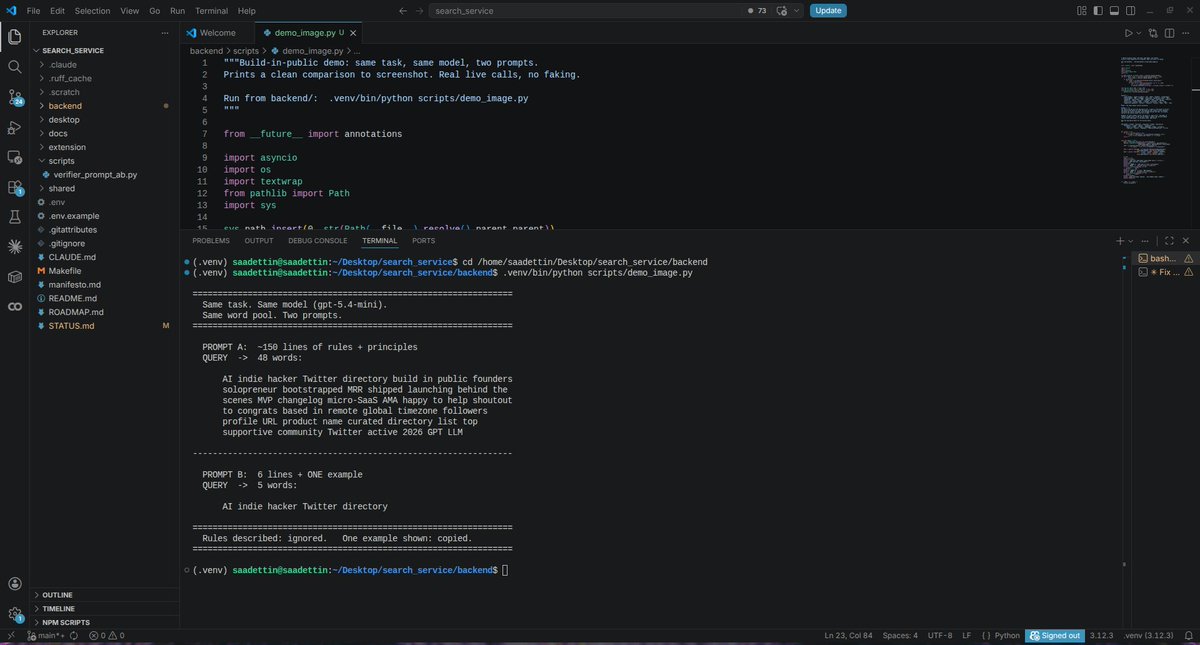
Spent today trying to get a cheap AI to write good search queries for my research tool.
I gave it pages of principles. How search engines work, when to narrow vs broaden, every operator. Clean logic, all of it.
It ignored all of it and dumped 40 words of keyword soup.
I deleted the essay and left one worked example. Got 5 clean words.
Then I tested the smartest, most expensive model on the same essay. It ignored every rule I had written too. Just did its own thing.
The lesson that cost me a full day: you don't explain rules to a model. It doesn't reason from your principles, it copies your examples. Show, don't tell. Even the smart ones.
Rebuilding the whole thing around examples now, not philosophy. You demonstrate the boundaries, you don't declare them.
#buildinpublic
Exactly. Sharper version I hit today: even the rules don't land if you just describe them. I told the model not to pile up the search query and it dumped 40 keywords. I replaced the rule with one concrete example and got 5 clean ones. Boundaries have to be shown, not told. Even to the smartest model.
Asked the most advanced AI for one simple thing: an API's price. It confidently made up numbers from SEO spam. Not dumb it just had no system telling it where to look.We don't need smarter models. We need better systems around them. So that's what I'm building.
#buildinpublic
How do you decide whether something is healthy for the user? For example, a food might appear to be healthy, but the user could be allergic to one of the ingredients it contains. I think a rating system can be misleading; according to the literature, it would be more reassuring to list the harmful substances found in that food.
@its_raviagarwal The number of followers is certainly important, but the number of quality followers is even more important. By ‘quality’, I mean people who actually read what you write and offer you guidance. That is what you should be aiming for.
@tdinh_me That’s absolutely true 😂😂 but I reckon that now that work has become so much easier, what sets us apart isn’t working harder; rather, we should let ourselves go with the flow of life, turning the ease of work into an advantage so we can come up with more original ideas.
Your architectural design looks very solid. Well done. I must admit I haven’t used the app yet, but I’d like to share a few thoughts. Firstly, your architectural design is very solid for the initial phase, but it might be a little limited in terms of functionality for X users. For example, a journalist could use this app instead of watching a two-hour video of a politician. Similarly, someone sharing tech news could use this app instead of watching Google’s launch from start to finish. As I understand it, the system makes key decisions entirely based on its own interpretation, but it should make these decisions in collaboration with the user. The reason for this is that a politician might address two different topics—such as the economy and current affairs—simultaneously within the same speech. To achieve this, running the video through OpenAI Whisper and using a model like DeepSeek to generate a transcript tailored to the user’s preferences could help you identify the key decisions. I hope these ideas are helpful. I wish you continued success. 😊
This is a really huge problem. AI is indeed a powerful tool, but as more and more startups emerge that fail to deliver on their promises, investors and the public will lose confidence, and capital will be withdrawn from this market. In the long term, this will benefit those who develop genuine products, but in the short term, it will create unnecessary competition with these startups.
I'm pretty sure by now this entire thing is perfomance art
Everyone in tech is falling for it
I also doubt he actually raised money
Even the name in reverse is just AI Slop
Kinda Sacha Baron Cohen style but for startups! 👏