Manindra Agrawal studied at @IITKanpur for nine continuous years, from 1982 to 1991, from BTech through PhD
During those years, he interacted with these people who studied on the same campus but later left for America:
→ Arvind Krishna: now CEO of IBM.
→ Rajeev Motwani: the Stanford professor who mentored Google's founders.
→ Arup Chakraborty: now an MIT Institute Professor, MIT's highest faculty rank.
→ Sanjeev Arora: He was AIR 1 in JEE. Now a professor at Princeton with two Gödel Prizes.
Every one of them left for America and conquered it. Not Manindra Agrawal. He stayed in the same building for the next forty years, as a professor and then as a dean.
In 2002, he solved a 2000 year old math puzzle that baffled the world: a fast, deterministic algorithm to test whether a number is prime. Now called the AKS primality test. A in AKS stands for Aggarwal.
This week, the Fellowship of the Royal Society came to him.
He slapped the heck out of the brain drain debate. This man built a global epicenter of scientific history in Kanpur.
You don't need a foreign passport to build a global legacy
This isn’t just an anthem.
This is pure soul.
Deaf children. Silent voices.
Yet every gesture screams louder than any song:
“Jana Gana Mana…”
No sound.
Only pure, unbreakable love for the nation.
Patriotism has no language.
Patriotism has no barriers.
This silent national anthem gave an entire country goosebumps.
To every Indian ,especially the ones who feel the tricolour in their heart without needing to hear a single note:
Happy Independence Day.
Jai Hind. 🇮🇳
#IndependenceDay
I don’t want to live the American dream, I want to live the Indian dream!
For 13 years, I’ve lived in the US and UK. Every single day in these 13 years, I wanted to move back to India, but it only got progressively harder as the years flew by.
I strongly believe that “no one will back you, if you don’t back yourself”
3 years ago, I decided to listen to myself and quit my job to move back to India.
I want to thank the architects of the Indian constitution for instilling “Freedom of Speech” as a core principle of India because of which I can openly speak out against brands and encourage them to do better. I am grateful to be living the Indian dream.
Jai Hind!
Satyamev Jayate! Truth alone triumphs!
Lagos, Nigeria, hosted the Commonwealth Fencing Championships, where Indian women fencers delivered a spectacular performance, dominating the podium.
In the Women’s Épée event, Tanishka Khatri made history by winning the Gold Medal. India’s Khushi Dabhade clinched Silver, while Prachi Lohan secured Bronze, completing a historic Indian medal sweep!
A salute to the incredible performance of these Indian women and their remarkable medal sweep!
Credits : nigerianfencing on IG
#IndianFencing #Gamechangers #SportsInIndia #CommonwealthChampionships #WomenInSports
[Gamechangers, Indian Women Fencers Medal Sweep, Tanishka Khatri Gold Medal, Commonwealth Fencing Championships India, Indian Women’s Épée Performance, India Fencing Medal Winners]
A tap in a Ladakh village was left running all winter. If you close it the water inside freezes, and the pipe bursts.
So it dripped all day, and the water pooled on the ground and turned into a sheet of ice.
A retired engineer sat in his garden looking at that ice, and worked out how to save the farms of Ladakh.
His name is Chewang Norphel.
He was born in Leh in 1935. He studied science at Amar Singh College in Srinagar and became a civil engineer with the rural development department of Jammu and Kashmir.
He worked there for about 36 years. He built roads, culverts, bridges, buildings and irrigation channels across Ladakh.
Then he retired, and the problem he had watched all his life was still there.
Ladakh gets almost no rain. It is a cold desert. Farming there depends entirely on water from melting glaciers.
The trouble is timing. The real glaciers sit very high up, so they only start melting properly in June and July. But a farmer has to sow in April. So the water arrives 2 months after it is needed, and then arrives in a rush nobody can use.
On top of that, the glaciers are shrinking. He has said the Stok glacier once covered half the mountain range he could see from his village. Now it is a thin cap at the top.
His idea came from the leaking tap.
If dripping water freezes into ice on its own, then water can be made to freeze on purpose, in a chosen place.
So he took the stream water that runs to waste in autumn and diverted it into a shaded side valley. He slowed it down with small check walls so it spread thin instead of rushing. Through winter it froze, layer on layer, into a sheet of ice.
The crucial part is where he built them. He put them low down the mountain, much lower than the natural glaciers. Lower means warmer, and warmer means it melts earlier.
So the water comes down in April, when the sowing happens.
He built about 15 of them. The biggest, at Phuktsey, is 1,000 feet long, 150 feet wide and 4 feet deep. It supplies water to a village of 700 people. It cost about 90,000 rupees.
Villagers carried the stone and cement up those slopes on their own backs to help build them.
Some villages that could grow 1 crop a year now grow 2. Potatoes and peas grow where they could not before, and those sell for more than barley. Young people who would have left for the cities have a reason to stay on the land.
He got the Padma Shri in 2015.
He has made one comparison more than once. India spends crores of rupees every day maintaining troops on the Siachen glacier. One day of that money, he says, could build 50 glaciers for the people of Ladakh.
A flight from Mumbai to Chennai last week gave me a rather uncomfortable glimpse of whom our society chooses to celebrate, and whom it doesn't even notice.
On one side of me sat a scientist working in Cryogenic Atom Probe Tomography, an extraordinarily specialised field with only a tiny pool of experts in India. You can count the specialists in this field on your fingers.
On the other side sat a social media/OTT personality who had recently started getting a few acting roles.
About 15 minutes after take off, something interesting happened.
A few members of the cabin crew arrived with chocolates, sweets and a card filled with words of admiration. Naturally, they went straight to the influencer. For much of the flight, one or two crew members kept hovering around him like butterflies, chatting, taking pictures and showering him with attention.
Meanwhile, the scientist who is from a rare field sat quietly on the other side.
And that contrast stayed with me.
If that influencer stop making content tomorrow, our lives would continue exactly as before. But if that scientists working in such highly specialised fields disappeared, laboratories, research programmes and critical projects will genuinely lose expertise that takes decades to build.
This isn't about blaming the cabin crew or the influencer. It is about what we, as a society, have trained ourselves to recognise.
Somewhere along the way, visibility became more valuable than knowledge, followers became a measure of importance, and being recognised became confused with being significant.
Poverty is the biggest curse inflicted upon humanity. Samdish recently visited a remote government middle school in Jharkhand.
Talking about the students, the teachers said that 70% of the students live alone because their parents are working in factories in Tamil Nadu. These students cook for themselves, take care of their cattle, and then go to school.
Just to earn ₹20,000 a month, their parents have to leave their children at home and work in factories thousands of kilometres away.
The teachers have to take care of these children whenever they are in need. If a child doesn't come to school for two consecutive days, the teachers visit their home to find out whether they are safe and well.
And what is a teacher's salary? Even after having 20 years of experience, they earn just ₹20,000 a month, and even that salary is often delayed by the government.
No matter how much noise we make about becoming a $5 trillion economy, the fact remains that millions of people are still struggling today to earn a mere ₹10,000–₹20,000 a month.
Yesterday I was trapped in a auto between two kawar trucks for a 2km stretch. Those who haven't crossed such a truck, you don't know what the base does to your heart rate. It's noise you can hear a km up the road. Men sitting on car windows, bodies hanging out (I have videos)
कल कांवड़ियों के लिए की गई (कु)व्यवस्था ने अधिकारियों की अदूरदर्शिता और संवेदनहीनता उजागर कर दी। सुबह जब लोग काम के लिए दिल्ली जा रहे होते हैं तब दिल्ली मेरठ एक्सप्रेसवे बंद करना मूर्खता थी। अगर वोट ही सब कुछ है यह नहीं भूलना चाहिए कि जो ट्रैफिक जाम में फँसे, वे भी वोटर हैं।
I have been living in Delhi NCR for more than 20 years.
In the mid-2000s, we used to see Kanwariyas walking on the roads of Delhi. They walked quietly on the side of the road and did not disturb anyone. At most, there were separate walking areas for them, with volunteers guiding them.
There were no loud DJs, no mini-trucks with people waving baseball bats, no fancy lights, no running on the roads, no highways reserved for Kanwariyas, and no flower showers from helicopters.
Back in my hometown, Bareilly, I had never even heard of this during my childhood. These things simply did not exist.
Cut to 2026. Now, Kanwariyas seem to get the highest priority on the roads of North India during these 15 days of Sawan. An office-goer paying taxes or a patient in an ambulance fighting for their life does not seem to get the same importance.
You have to change your travel plans. Schools are shut, offices ask people to work from home, and businesses lose customers. All this happens to accommodate people on the roads for these 15 days.
They seem to feel like the kings of the roads. They can argue with police officers, damage cars, and do whatever they want.
Unless ordinary people who suffer because of this government-supported event every year start raising their voices, nothing is going to change.
They can hold the city to ransom, each year? This mayhem is patronised by the state.
If citizens peacefully protest and seek accountability, that causes inconvenience.
Will rights be decided by looking at clothes, or will some freedoms still be decided according to the Indian Constitution?
Is this religion? Asking because now this is the only face visible publicly.
Thousands of trucks, mini trucks, Boleros, motorcyles...all equipped with a generator, DJ music system, speakers bigger than a room, a water tank, a gas stove/cylinder, banners. Blasting the most atrocious songs at volumes that can burst a dam. No helmets. Volatile, arrogant, dangerous.
Highways blocked. Exits jammed. Pitstops every 5 kilometre. Police bandobast. Big funding.
What is religious about this?
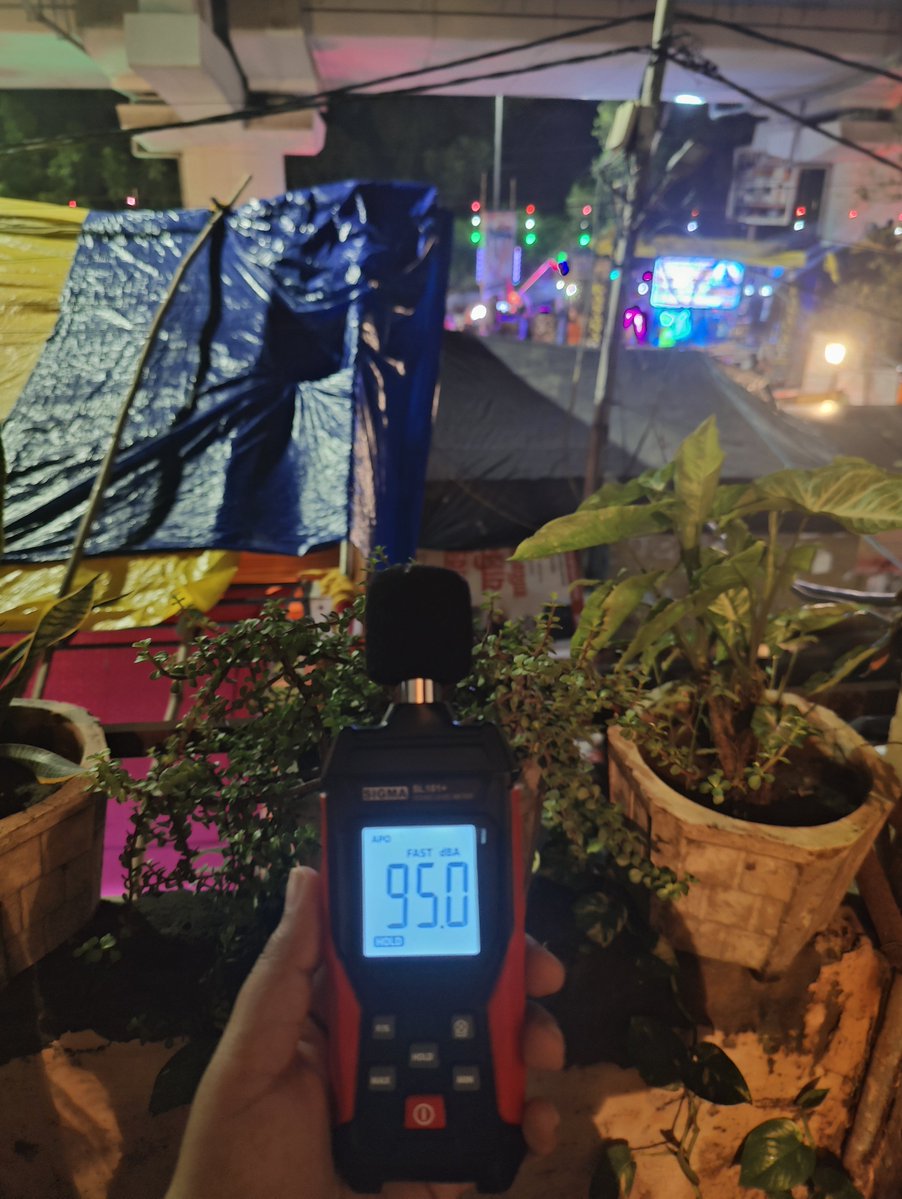
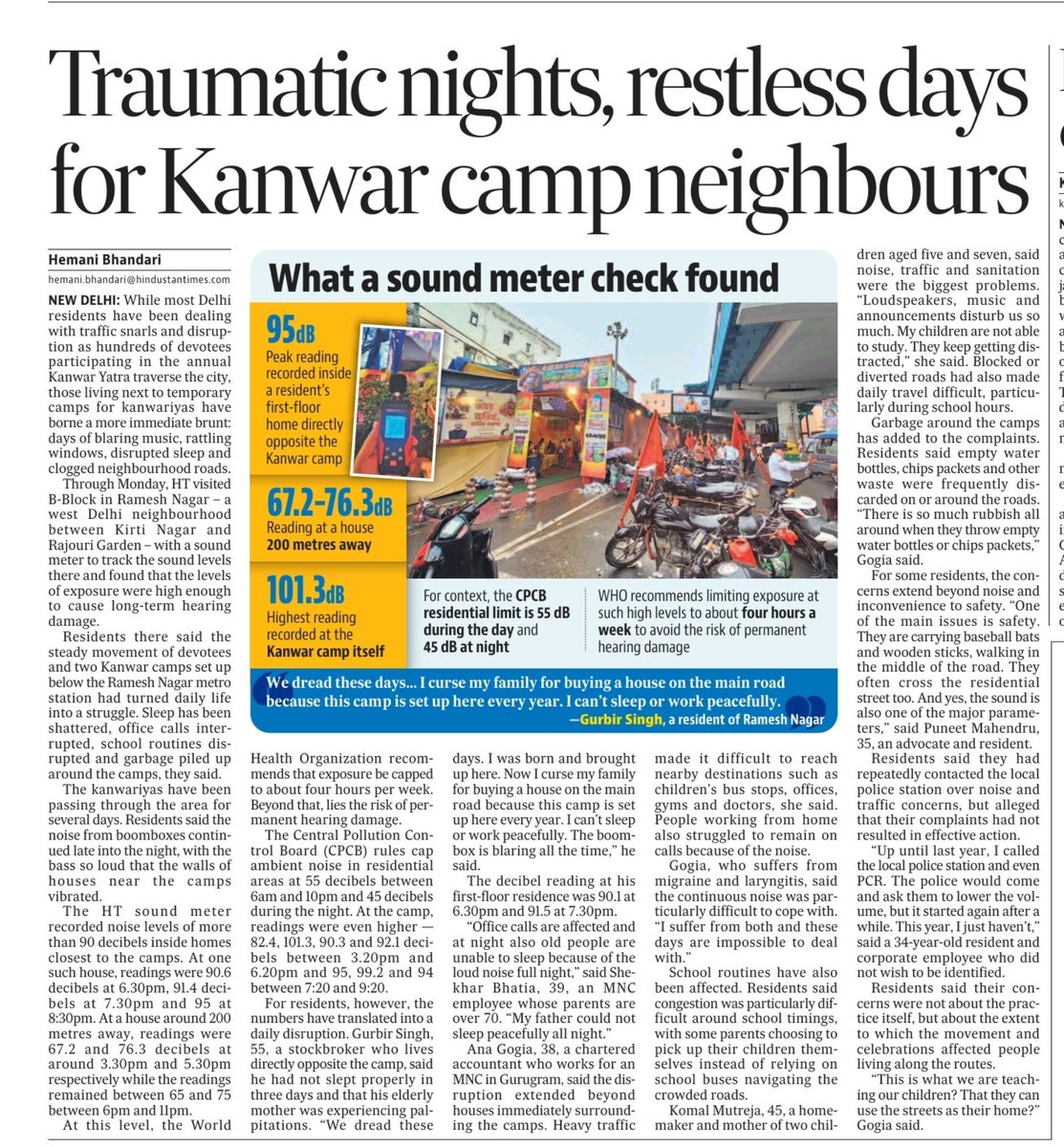
What it means to live in a locality next to a kanwar camp: Sleepless nights, constant vibration in home walls, can't open windows,face traffic jam at all times, garbage pile up.
Readings & videos below from a house right opposite camp.
Permissible-45
Reading-95
In @htTweets
The Sanatan concept of pilgrimage like kawad yatra specifically, in layman's terms, is to purify oneself and aspire to achieve moksha. It is about easing the pain Shiva bears by holding poison in his throat through pouring pure waters of Maa Ganga on him.. The goal is to share pain and miseries, not to create havoc on other creatures. The Kavad Yatra has become a nightmare for common people on the road. What you see now are not pilgrims but mob mentality. The huge DJs and blaring music, which have nothing to do with spirituality, are now a major menace. You will understand the power of noise when, in your vehicle, you pass next to these DJs; your vehicle shakes. Sometimes, they clear traffic like police pilot vehicles do for netas and bureaucrats- same entitlement of power and authority. God forbid if you touch any of the Kavadis; rest assured you will be beaten black and blue. Urgent reforms are needed in the execution of Kavad Yatra. No DJS, only on foot, and hooligans should be put behind bars. Enough is enough- each year, it is getting worse.
He could have stayed at Caltech. Instead, he came back to India and helped shape its scientific story.
This is the story of Prof. Deepak Dhar, a physicist whose work has earned some of the highest honours in theoretical physics.
After studying at Allahabad University and IIT Kanpur, he went to Caltech for his PhD, where he worked as a teaching assistant to Nobel laureate Richard Feynman.
He could have stayed in the US and built a celebrated career.
Instead, he returned to India in 1978 and spent decades helping strengthen the country’s scientific ecosystem.
In 2022, he became the first Indian to receive the Boltzmann Medal, the highest honour in statistical physics.
Now, ICTP has announced him as a recipient of the prestigious Dirac Medal for his contributions to theoretical physics.
Today, as a Distinguished Professor at ICTS-TIFR, Bengaluru, Prof. Dhar continues to inspire generations of scientists.
Credits: Ankit Maurya [@chillwithankit on X]
#DeepakDhar #IndianScientists #Trending #AwardIndia #ProudIndia
[Prof Deepak Dhar, Deepak Dhar Dirac Medal, Boltzmann Medal, Award India, Proud India]
What nonsense. 😡
All night, Kanwariyas blasted disco music on loudspeakers, literally shaking everyone's windows. Children have exams, people have work, and older people need rest.
This needs to stop. Immediately.
@DelhiPolice@dtptraffic
From a Hindi-medium upbringing in Pratapgarh, Uttar Pradesh, to studying at Caltech and working as Richard Feynman’s teaching assistant, Professor Deepak Dhar’s journey is remarkable.
Now, the 74-year-old physicist has won the 2026 Dirac Medal for his contributions to statistical mechanics, an honour associated with the biggest names in theoretical physics, including Stephen Hawking.
Born in 1951, Dhar’s curiosity was nurtured by his father, who brought home science magazines. He studied at Allahabad University, earned his MSc from IIT Kanpur and later completed his PhD at Caltech.
After graduating, he chose to return to India instead of staying in the US. At TIFR, he spent decades advancing theoretical physics and mentoring generations of researchers.
His work has earned him honours. In 2022, he became the first Indian to receive the Boltzmann Medal, followed by the Padma Bhushan in 2023.
What started with science magazines brought home by his father led to global recognition for the questions he chose to pursue.
#DeepakDhar #DiracMedal #IndianScientists #AwardIndia #Trending
[Deepak Dhar, 2026 Dirac Medal, Indian physicist]









![thebetterindia's tweet photo. He could have stayed at Caltech. Instead, he came back to India and helped shape its scientific story.
This is the story of Prof. Deepak Dhar, a physicist whose work has earned some of the highest honours in theoretical physics.
After studying at Allahabad University and IIT Kanpur, he went to Caltech for his PhD, where he worked as a teaching assistant to Nobel laureate Richard Feynman.
He could have stayed in the US and built a celebrated career.
Instead, he returned to India in 1978 and spent decades helping strengthen the country’s scientific ecosystem.
In 2022, he became the first Indian to receive the Boltzmann Medal, the highest honour in statistical physics.
Now, ICTP has announced him as a recipient of the prestigious Dirac Medal for his contributions to theoretical physics.
Today, as a Distinguished Professor at ICTS-TIFR, Bengaluru, Prof. Dhar continues to inspire generations of scientists.
Credits: Ankit Maurya [@chillwithankit on X]
#DeepakDhar #IndianScientists #Trending #AwardIndia #ProudIndia
[Prof Deepak Dhar, Deepak Dhar Dirac Medal, Boltzmann Medal, Award India, Proud India]](https://pbs.twimg.com/media/HPa_gmCa0AApjwJ.jpg)
![thebetterindia's tweet photo. From a Hindi-medium upbringing in Pratapgarh, Uttar Pradesh, to studying at Caltech and working as Richard Feynman’s teaching assistant, Professor Deepak Dhar’s journey is remarkable.
Now, the 74-year-old physicist has won the 2026 Dirac Medal for his contributions to statistical mechanics, an honour associated with the biggest names in theoretical physics, including Stephen Hawking.
Born in 1951, Dhar’s curiosity was nurtured by his father, who brought home science magazines. He studied at Allahabad University, earned his MSc from IIT Kanpur and later completed his PhD at Caltech.
After graduating, he chose to return to India instead of staying in the US. At TIFR, he spent decades advancing theoretical physics and mentoring generations of researchers.
His work has earned him honours. In 2022, he became the first Indian to receive the Boltzmann Medal, followed by the Padma Bhushan in 2023.
What started with science magazines brought home by his father led to global recognition for the questions he chose to pursue.
#DeepakDhar #DiracMedal #IndianScientists #AwardIndia #Trending
[Deepak Dhar, 2026 Dirac Medal, Indian physicist]](https://pbs.twimg.com/media/HPWezNKacAAzve9.jpg)


