Singaporean interested in history, international affairs, political reform, and statistics. Lots of statistics. BA Oxford; MPhil Cambridge. RTs =/= endorsements
Hello In this account, I strive to provide analyses of international affairs, with a focus on developments around my home country of Singapore. I very much intend to remain non-partisan in my commentary and intentions. Please avoid spam and/or rude comments.
I have disagreements with quite a lot of Zaid Ibrahim's analyses, but I think this is correct. DAP did in fact deliver around 88% of the Chinese vote to PH per my calculation (but on a turnout of only 61%) in Johor. But among Malays and Indians, PKR doesn't deliver the goods...
The problem with DAP cannot be understood without dissecting the PH components. The only party in the PH grouping that attracts significant political support is DAP.
Anwar is a prima donna, a personality and does not represent a movement. He survives on Umno support.
PKR is an Anwar supporters' club.
Amanah is colourless.
Today, DAP has no choice. It still has to live with its arch-enemy, Umno; hence the reforms in name, or at best,
Superficial reforms.
DAP has no Malay-based movement to support it; hence, it has to embrace a prima donna as its leader. PAS is not sophisticated enough for DAP. They say it's too extreme. The Green Wave is dangerous
In one word, it's arrogance that has brought DAP into the present flux. No Malay political movement /groups are good enough for them; one is too corrupt, and the other too extreme, whatever that means
If they are going to hold a Congress in August, this is a subject they should discuss. After all, they have many Malay intellectuals and sophisticated leaders in DAP
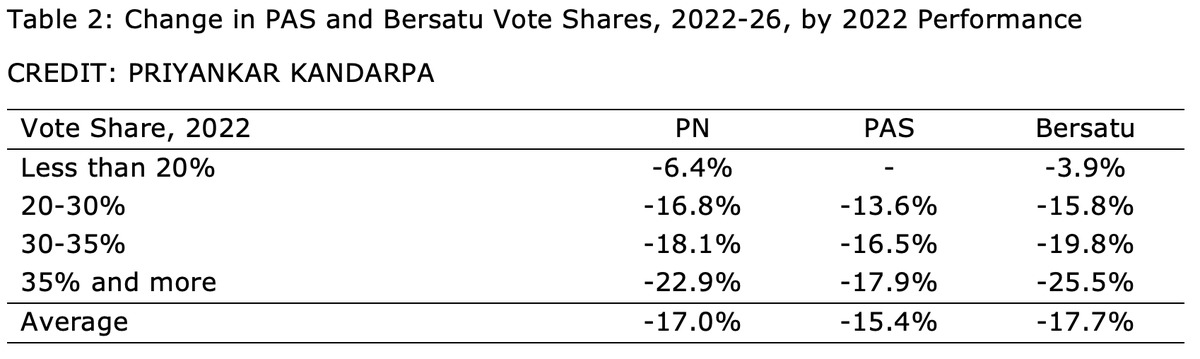
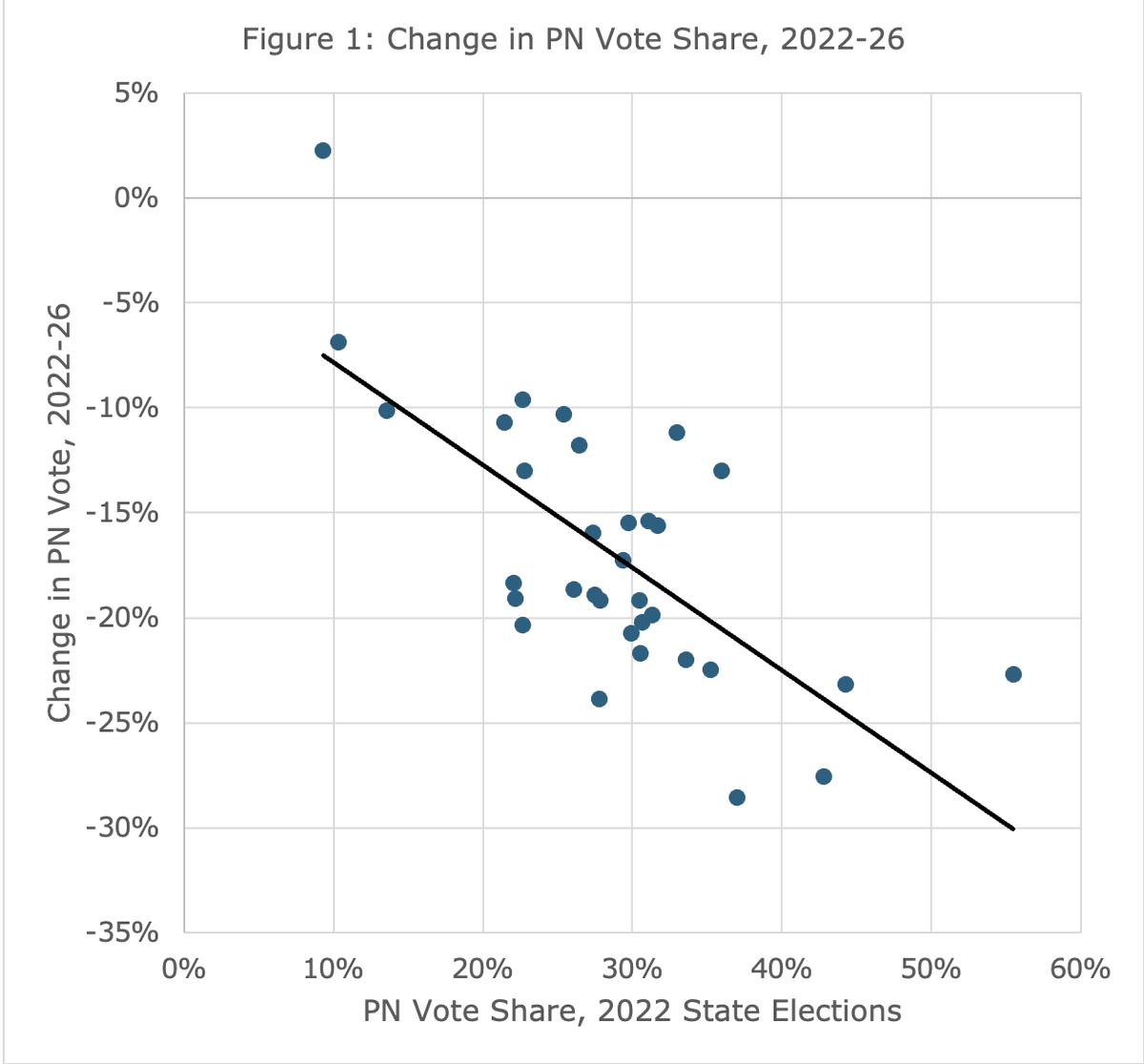
@The_Endie I think so. PN basically saw its vote slide consistently wherever it previously had some support as shown in the chart. Bersatu in particular fared worse than PAS within the coalition (though MIPP and Pejuang, not shown in the chart, saw the worst collapses compared to 2022).
And in truth, I think the answer is probably "No". If you can show me Bersama winning 30% of the Malay vote compared to PH's 25% in the 2018 'wave' and 11% in the 2022 election, I can start to pay attention. Till then, though, it's simply not going to make it.
Beyond being at risk of "mosquito party" status, Bersama/MUDA need to answer a critical question: can it really build an electoral coalition that can promote the politics of reform and multiracialism beyond what DAP gets (as discussed before, PKR adds very few votes these days)?
Its entire concept and figure out what the politics of "reform" are and can be, and how to make it appeal to a wider electorate. Because right now, Anwar is simply implementing the "managed decline" of what little remains of PH.
A point that DAP may want to make to PMX whenever they next meet. PH's votes are basically all DAP votes-Chinese and a minority of Indians in Johor, with very very low Malay support. There are some places where PKR may add Malay votes but not much else. In the electoral maths >>
DAP does all the heavy-lifting while PKR tries to get votes that are hard to win. And for PKR to do the latter, it very frequently antagonises DAP's efforts. At the same time, DAP's vote bank clearly isn't enough, as the Johor election showed. PH needs to fundamentally change >>
@amirulruslan I mean he'll want to stay in office and do as much as he can to leave a legacy given that it's fair to say PH is on its way out and, given the way things are, likely to be out of office (except in Penang and probably Selangor) for a long while...
This would be a surprise. In my view, PN will keep its strength/monopoly in the northern states and what seats they have in Selangor and Penang, and BN will gain in the South. GPS/GRS will share the Borneo seats among themselves. PH will be reduced to around 40.
I'm not sure I agree. On one hand, I think DAP will leave PH if PH does badly in GE-16. On the other hand, I have to say, PH's vote these days = just DAP votes. There are hardly any votes PH attracts outside of those DAP would earn-a small share of Malays, dubious Indian support.
I disagree; Rocket will not leave PH even if N9 falls to BN ....
1) The big prize is #GE16, not state elections
2) Rocket waited for half a century to get into power. Do you think they will simply throw it away because of one state election?
So NO, Rocket will stay and fight for #GE16 no matter what ...
Do you agree with me?
@Catblueey@jameschin110 I’m not so sure, my own view is that turnout among Chinese was lower. I estimate that there was a gap of about 15% (Ong Kian Ming suggests it was 19%) and so on election day, I think there were fewer Chinese voters than non-Chinese voters there. PH also did terribly among Malays.
@SyedJymalZahiid@imokman I did a similar exercise and while our numbers disagree somewhat (I expect the swing to be about 7% but we don’t have sufficiently granular data), among Indians-the swing is likely much higher
https://t.co/ZacGW1o9s2
https://t.co/x6G85OtXsL
@imokman has slightly different estimates of turnout and voting, with some difference in Chinese voters compared to my modelling. But confirms the broad trend we’ve seen. Will have to wait for saluran data to be more confident of findings.
@jameschin110 I don’t think BN can make a big comeback in Penang or Selangor whwre I think PN would do better. I think the worst case scenario for PH is if it fails to become competitive among malay voters, disappoints minorities, and on top of that there is extensive Malay “tactical voting”…
https://t.co/x6G85OtXsL
@imokman has slightly different estimates of turnout and voting, with some difference in Chinese voters compared to my modelling. But confirms the broad trend we’ve seen. Will have to wait for saluran data to be more confident of findings.
2/12 First, turnout differed sharply across ethnic groups. Estimated turnout: • Malays: 76% • Chinese: 61% • Indians: 58% This increased the Malay share of votes actually cast and reduced the electoral weight of Chinese and Indian voters.
@imokman has slightly different estimates of the ethnic voting, but confirms the broad trend of a serious erosion in Chinese turnout + a small swing to BN in this group + a sizeable turnout differential. But need to wait for saluran data to be sure
https://t.co/x6G85OtXsL
2/12 First, turnout differed sharply across ethnic groups. Estimated turnout: • Malays: 76% • Chinese: 61% • Indians: 58% This increased the Malay share of votes actually cast and reduced the electoral weight of Chinese and Indian voters.
@amirulruslan Agreed. In my view, Bersama will have a tough road ahead-needs to get a grasp of the issues on the ground in the states it goes into, and should have probably focussed on a few seats where it could capitalise on PH's unnecessary dramas (e.g., Skudai) to show it means business
Malays and people somewhat dissatisfied with UMNO-will be make/break in the election, along with turnout. Expect a very energetic but potentially toxic contest.
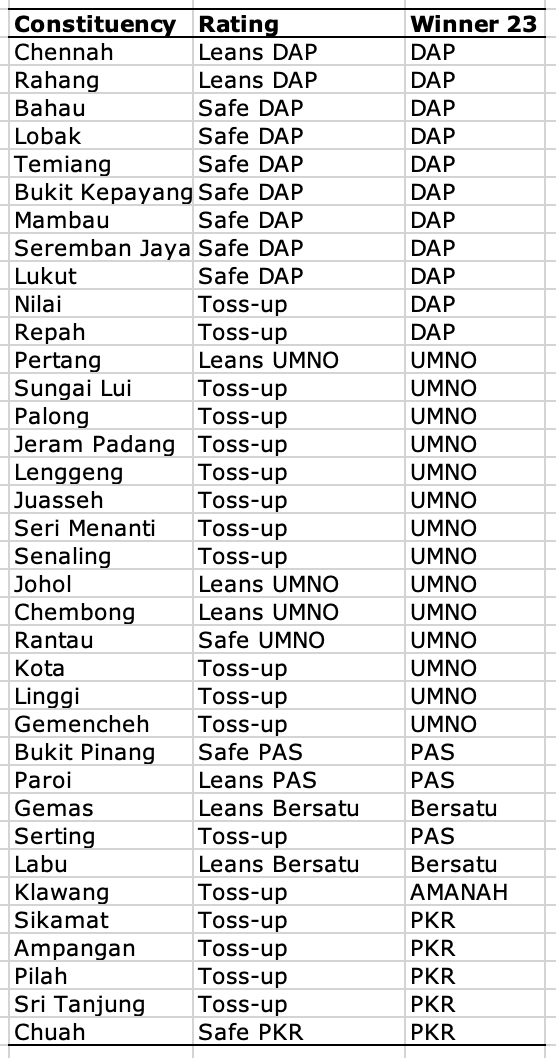
An early guess for where we are at for the Negeri Sembilan state election. Assuming UMNO and PAS compete for the Malay vote, and have a "wink and nod" agreement in PH-held seats, and PH continues to slide among Indian voters in particular.
The Indian vote will be very important-they make up a higher share of the electorate than Chinese in many seats, overall around 14% of the electorate (while Chinese are around 21% or so). Whether PN makes inroads among Malays-and there is evidence this is happening among younger