Fabregas intuitively understands where football is heading - more movement in attack.
He frames this movement as 'rotational' rather than 'associative', so that's interesting to keep track of.
No surprise he praises Spalletti's Juve in relation to this topic - a man of taste.
For modern Positionist coaches, the current shift to set-piece emphasis is inevitable.
Increased physicality means defences can 'constrain spaces' (go man-to-man) better and for longer.
Positionism requires these spaces to afford attacking combinations.
So, we have a problem. 🧵
🌟 What a workout! 🌟
29th September - #Calandagan and #Daryz work alongside each other on the gallops in Chantilly @GraffardRacing.
3 weeks later - one has won the Champion Stakes and the other the Prix de l'Arc de Triomphe. 🟢🔴
"I'm not a coach that I will say you'll stay here and you stay here and you stay here and you stay here. That's not me, okay? Because I was a player."
Cesc Fabregas
The goalkeeper, frustrated with his team, made an assist to himself from midfield using the goalpost and scored an incredible goal.
India / West Bengal region
Billy Gilmour, take a bow 👏
Lovely dummy from the Scotsman and then his deflected effort finds the corner to give Napoli the lead.
📺 @tntsports & @discoveryplusUK
Since the start of 2020/21, Bruno Fernandes has created 512 chances in the Premier League.
That’s at least 138 more than any other player:
🥇 Bruno Fernandes - 512
🥈 Kevin De Bruyne - 374
🥉 Trent Alexander-Arnold - 348
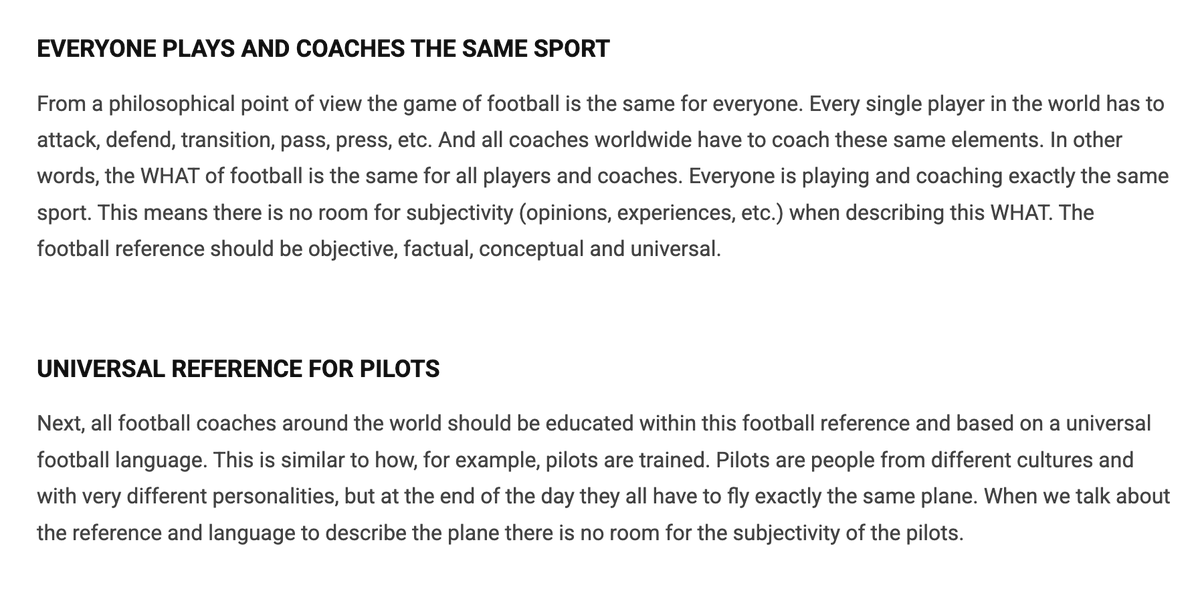
The quote on the left is from Raymond Verheijen's FC Evolution coaching website.
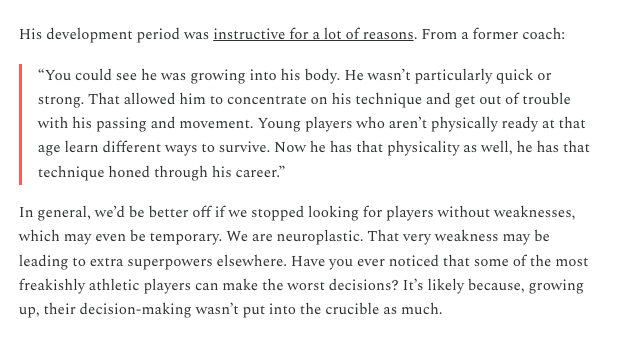
The quote on the right is from a recent article by Mark O'Sullivan and Matias Manna.
For me, this unipolar/multipolar framing represents the fundamental tension in contemporary tactical theory.
Wrote about how Eze's development story is an important one to remember when assessing others.
Identifying a weakness is easy, and almost meaningless on its own.
Does that weakness actually matter? Is it temporary? Has it directly led to other, more important strengths?