@brian_lovin maybe consider audio for alt solution to your stated chat usecases(my recent tweet link)? & learn from Meta's Workchat: Don't let post-focus = self-promo noise, response pressure > being left on read. channels are easier to navigate to specifics - feeds you can ONLY search/save
“I don’t do 1-on-1s, and almost everything I say, I say to everybody all the time.”
This reminds of the idea of designing in the open.
For example, I’ve seen before where you design in a silo. You then share your work to your immediate stakeholders. Then these stakeholders take it to their stakeholders for approval.
That’s a whole load of effort and risks your message being watered down by the time it gets to the decision maker.
Alternatively work in the open and flatten the hierarchy.
4pm, Saturday, 24 June, Moscow
While access to Red Square is blocked off, it’s calm around the Kremlin. Plenty of tourists still walking around, and business as usual, amid reports that Wagner forces are en route to Moscow
@AdhamDannaway Yes! Consistency is only valuable insofar as it leads to better solutions. The internal logic of designers is rarely evident to users - they mostly take every component on its own terms anyways. Better to optimize for "best" over "most consistent" when the two conflict
it’s a shame how narrowly some design managers evaluate prospective hires.
noticing a trend where designers only work in the same style role regardless of the company.
there are some of us who can be trusted to tackle anything - growth, core, design systems, ads/partnerships, b2b, etc.
My experience has repeatedly proven this Paul Graham quote to be true.
Three implications:
1. Writing cultures tend to learn faster than those that use slides, dashboards, or other mediums.
2. They learn faster because they present denser information to readers, but even more importantly because they help writers think more clearly.
3. As you become more senior, it is very dangerous to only review work from other people. You must keep writing yourself.
“So they’re just giving the engineers files without naming their layers. It doesn’t really impact the build but it’s something I would never do because I think the engineers might get confused and not know the image is an image or the button is a button”
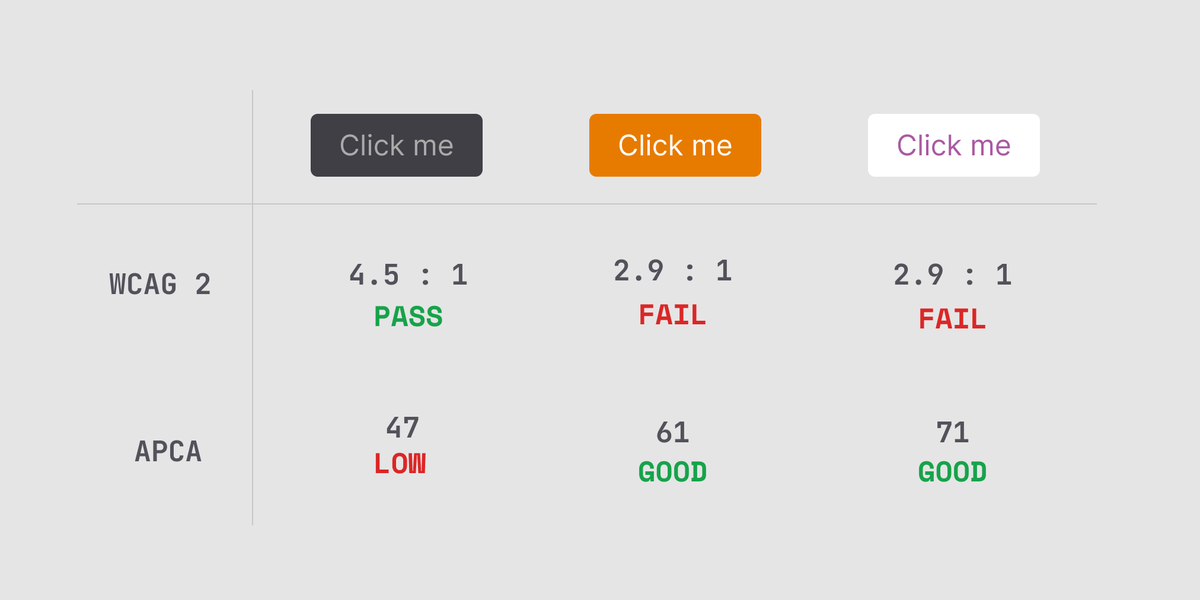
If you use WCAG 2.x for light mode, and then APCA for dark mode, then you have met legal requirements.
WCAG 2.x only requires ONE mode to meet 1.4.3. Regardless, APCA so completely stomps on WCAG 2 for dark mode, that should never have been a concern.
#a11y#color#colours
@AdhamDannaway Left is better. Better accessibility since it's more likely to pass the straw test. Eventually you will have larger or Fullscreen modals and right aligning ctas means some will not notice them on larger screens. Left is more in line with f pattern scanning.
@peterme There are plugins to suggest min touch targets. Human judgement is better for handling anything more complex IMO. Fitts law isn't really straightforward in application. A more granular tool might easily mislead some designers more than help them.
WCAG 3 will use a new color contrast method called APCA (Advanced Perceptual Contrast Algorithm).
It's a big improvement over the current system but there are a lot of changes to get your head around.
🧵