This Hubble image of a microlensing event, OGLE-2013-BLG-0341, shows how astronomers can use Hubble to distinguish lensing objects from background stars, allowing them to interpret future events that will be seen by #NASARoman: https://t.co/L71zlNzfua
For Roman, from Hubble 💌
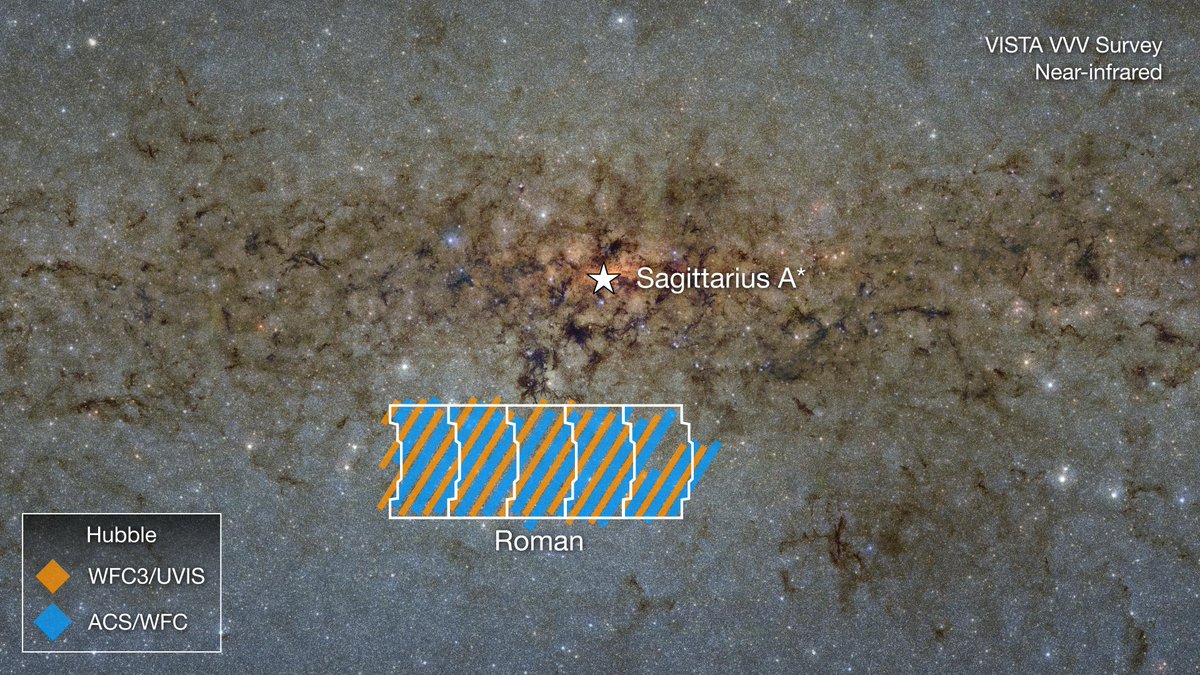
Before our next telescope teammate @NASARoman launches later this year, Hubble studied some of the same regions in our galaxy's center that Roman plans to observe.
The "Mother of Hubble," Nancy Grace Roman, was born 100 years ago today.
We take this day to remember NASA's first Chief Astronomer and her pioneering work advancing NASA's exploration of the universe. Ad astra ✨ https://t.co/Alyie96hWM
From final hardware arrivals to installations of the core instruments, so much is underway at @NASAGoddard.
Check out these Roman hardware highlights!
Stay up to date on the mission’s progress: https://t.co/yAZJc1IIIt
#UMD and @NASAGoddard scientists recently discovered a planetary system that may break the current record for the fastest exoplanet system, traveling at least 1.2M mph. https://t.co/vaYcAEpM2K
“I always want to showcase science in a way that helps people really understand what’s going on.”
Senior multimedia producer Scott Wiessinger grew up in a household where art and education were intertwined. Now, he blends the two for Roman.
https://t.co/bXWeaKqbxw
Big shout out to my collaborators (too many to name); Jean-Philippe Beaulieu, @MOA_Dave, Aparna Bhattacharya, @macyjhuston, Jon Hulberg, Naoki Koshimoto, @jlu_astro, @KVandorou
Excited to share that we may have discovered the highest velocity exoplanet system to date! The candidate signal comes from a microlensing star hosting a sub-Saturn mass planet.
https://t.co/ByxOeuDnL3
Astronomers have discovered the fastest known solar system, moving at a rapid 541 km/s – twice the speed of our own – through the middle of the Milky Way!
Story by me @SciAm
https://t.co/trqB1qLJlt
Milestone alert 🚨 The Roman mission is moving towards the next stage of construction, bringing all the components together!
Take a look at how we got there ⬇️
In six billion years the sun will expand into a red giant, consuming Mercury, maybe Venus and potentially Earth, too.
But astronomers spotted a rocky world orbiting a white dwarf, suggesting a future in which our planet outlives its star. https://t.co/v0USVSz6BZ
Roman is getting ready to catch some rays ☀️😎
The telescope's Solar Array Sun Shield completed critical assessments, including testing in the hot and cold temperatures and low-pressure environment it will experience in space! https://t.co/yAeUC6X20q