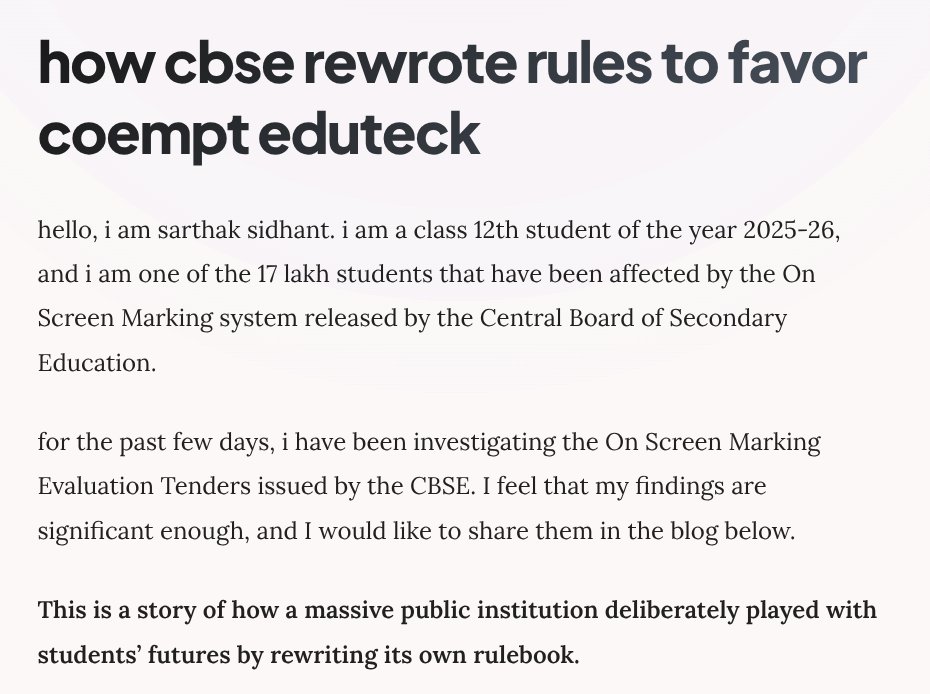
This is an unbelievable piece of work by Sarthak and something that requires amplification.
Let me explain what he found, in simple terms.
Sarthak is a Class 12 student from the 2025-26 batch, one of the 17 lakh students whose answer sheets went through CBSE's new On-Screen Marking system.
He spent days reading through CBSE's evaluation tenders, scraped all 576 tenders CBSE has issued, and tracked how the rules changed across three versions of the same tender.
The core finding is that the company that won the contract to scan and grade 17 lakh students' answer sheets is Coempt Eduteck.
Coempt used to be called Globarena Technologies. Globarena was the company behind the 2019 Telangana intermediate exam disaster, where software failures led to 3.8 lakh students getting wrong or missing marks, and 23 students died by suicide.
A government committee found systemic failure and negligence. Six months later, Globarena rebranded to Coempt Eduteck.
So a company with that track record won a contract to handle 17 lakh CBSE students. Sarthak's investigation is about how the rules were rewritten to let that happen.
The tender was issued three times.
> First tender, February 2025. It existed, then disappeared from the public GeM portal. Sarthak scraped all 576 CBSE tenders and this one was missing from the archive entirely.
> Second tender, May 2025. Four companies applied including TCS and Coempt. All four failed the technical evaluation. Cancelled.
> Third tender, August 2025. Coempt won. Between the second and third tender, a series of rule changes happened, and every single one made it easier for Coempt to qualify.
Here is what changed, one by one.
01. The old rules disqualified any company with a history of abandoning work, failing to complete contracts, or financial weakness. The new rules deleted this clause entirely. Coempt's Telangana history stopped being a barrier.
02. The old rules disqualified any company that was "blacklisted earlier." The new rules changed this to "currently blacklisted." Because Globarena rebranded after Telangana, removing the word "earlier" effectively erased their past.
03. The rules required Rs 50 crore average turnover over three years. Coempt's exact average came to Rs 50.86 crore. They cleared the bar by less than 1%. Earlier, a smaller company had asked CBSE to lower the bar to Rs 30 crore for fairer competition. CBSE refused. So the bar was kept high enough to block small players, but sat exactly low enough for Coempt to scrape through.
04. Software maturity is measured on the CMMI scale, 1 to 5. The old rules required Level 5. The new rules dropped it to Level 3. Coempt is a Level 3 company.
05. The cooling-off period for engaging retired CBSE officials was cut from two years to one. This makes it easier to use recently retired insiders to influence the process.
06. The old rules required experience with large projects of at least 5 lakh students each. The new rules removed the student count and counted cumulative answer-book volume across small projects instead. Coempt has many small fragmented university contracts. This helped Coempt and hurt TCS.
07. The old rules required bidders to own their own data centre and disaster recovery centre on Indian soil. The new rules allowed third-party MeitY-empanelled cloud hosting. Coempt runs on AWS and Azure. This helped Coempt and hurt TCS, which owns its own data centres. It also means student data is no longer on sovereign, Indian infrastructure.
08. The old rules required the bidder to own or control the complete source code of its software. The new rules deleted this. Coempt's platform runs on Microsoft's proprietary IIS, which they don't own.
09. A last-minute corrigendum, issued right before bid submission, removed CBSE's own power to blacklist the firm if its software failed catastrophically. So even a Telangana-scale failure couldn't get Coempt banned from future government tenders.
10. The penalty structure shifted from punishing mistakes to punishing delays. The old rules fined the vendor for wrong scanning, merged pages, and unscanned books. The new rules dropped those and instead levied Rs 50,000 per day for delays. This incentivises rushed scanning over accurate scanning.
11. The old rules had a hard accuracy threshold, error rate not to exceed 0.5%. The new rules removed this number entirely.
12. The old rules specified proper book and robotics scanners. The new rules just say "sufficient scanners." The definition was vague enough that, as Sarthak notes, the scanning could be done with a phone on a stand.
13. On the security side, the contract required a VAPT (vulnerability and penetration test) certified by CERT-In before go-live, and a restricted beta phase before launch. The system clearly wasn't restricted, because the other researcher, Nisarga, was able to access it and find vulnerabilities four days before go-live. So the mandatory security audit appears to have been bypassed.
These are more than a dozen rule changes, all between the failed tender and the winning tender, all pushing in the same direction, all benefiting the one company with the worst track record in the field.
The security holes Nisarga found last week now have an explanation. The system was built by a vendor that was specifically allowed to skip the security certification, the source code ownership, the data sovereignty, and the quality thresholds the original rules demanded.
Following things need to happen immediately;
1. An immediate CAG audit of the tender process.
2. A parliamentary debate on the topic.
3. An independent investigation into
> Why the first tender vanished?
> Why the disqualification clauses were deleted?
> Why the turnover bar was held exactly where it was?
> Why the security level was dropped?
> Why the blacklisting power was removed at the last moment?
Sarthak, this is genuinely exceptional investigative work. Far better than most journalists with full resources ever manage. Take a bow. :)
@CRUDEOIL231 even more than crude its ice gasoil where front is absolutely getting smashed. mayjun expired at 11$ . front flys trading consistently below 0 amd falling to -30 or more. gasoil saying there is ample stock available at spot?
America Celebrates 250 years (and the end of Pax Americana)
This note is about the US and the implications of another war in the Middle East, but first, some history:
In 1956, Britain and France conspired with Israel to seize the Suez Canal from Egypt’s Nasser. It was a classic imperial move, the kind that had worked for a century. Except this time, Eisenhower said no. He threatened to dump U.S. holdings of sterling on the open market, which would have collapsed the pound overnight. Britain folded within days. France folded with it. That moment, more than any other, marks the true end of British imperial primacy. Not the World Wars, not the independence movements, not the Commonwealth. The moment a U.S. president made a phone call and the pound buckled. Reserve currency status doesn’t just reflect economic power. It is economic power, and when it goes, everything goes with it.
It is also worth noting the bitter irony that in 1956 it was Israel’s adventurism that helped expose the limits of British power and accelerate the pound’s decline. History has a way of rhyming.
The pound’s vulnerability at Suez didn’t emerge overnight. It had been building for decades, through two world wars that bled Britain fiscally dry, through the steady accumulation of the world’s gold by the United States, and through the slow recognition that the guarantor of global trade had changed addresses.
Bretton Woods in 1944 formalized what was already true: the dollar was now the anchor of the global monetary system, convertible to gold at $35 an ounce, with every other currency pegged to it. It was an elegant system. It was also a system that required the United States to run perpetual trade surpluses and maintain fiscal discipline, neither of which proved politically sustainable.
By the late 1960s the U.S. was spending heavily on Vietnam and the Great Society simultaneously, and foreign central banks, led by a deeply skeptical De Gaulle, began converting their dollar reserves into gold at an accelerating pace. France literally sent warships to New York to bring gold home. On August 15, 1971, Nixon closed the gold window. The dollar would no longer be convertible. Bretton Woods was dead.
What replaced it was Kissinger’s deal: the petrodollar. The deal struck with Saudi Arabia in 1973 and 1974 was simple and profound. Oil would be priced exclusively in dollars. In exchange, the U.S. would provide security guarantees to the Gulf monarchies. You want energy, you need dollars. You need dollars, you hold Treasuries. You hold Treasuries, you finance American deficits.
The gold standard was replaced not with nothing, but with oil and aircraft carriers. It worked because it rested on one non-negotiable guarantee: America would secure global trade routes, keep the sea lanes open, and ensure the free flow of energy to allies and adversaries alike. The Strait of Hormuz. The South China Sea. The Red Sea. These were never just geography. They were the load-bearing walls of the entire dollar architecture. And this is the thing people consistently fail to appreciate: commodities and geopolitics have always been linked. Most wars throughout history are, at their core, about securing access to resources. Energy. Grain. Metals. The players change. The underlying logic never does.
Fast-forward to February 2022. Russia invades Ukraine. The U.S. and Europe respond by freezing $300 billion in Russian sovereign reserves. Swift expulsion and asset seizures. Just like that, we answered a question every central bank on earth had been too polite to ask out loud: what happens if America decides your dollar reserves are no longer yours?
Biden gave them the answer. Loudly. This was not just a sanctions regime. This was a fundamental break in the trust architecture that underpins reserve currency status. The dollar’s value as a reserve asset was always partly about neutrality, the assumption that it was beyond politics. We torched that assumption. Every non-Western central bank quietly updated its threat model that week. If it can happen to Russia, it can happen to anyone who finds themselves on the wrong side of Washington.
Subsequent uses of financial sanctions against various actors only compounded the damage, each one further eroding the perception that the dollar was a neutral settlement medium rather than a political weapon.
The de-dollarization trend and the de-globalization trend are not separate stories. They are the same story. When the guarantee of free trade breaks down, countries retrench. When the reserve currency gets weaponized, countries diversify. When the hegemon’s will to enforce the rules-based order wavers, everyone starts making contingency plans. We are now deep inside that dynamic.
The Houthis have been attacking commercial shipping in the Red Sea for over a year. Iranian proxies armed with Iranian-supplied missiles. The U.S. response has been airstrikes that changed nothing. Global shipping rerouted around the Cape of Good Hope, adding weeks and billions in costs.
The Strait of Hormuz carries roughly 1/5 of the world’s petroleum liquids and it is now de facto under the control of the IRGC.
When asked about it, the current U.S. administration has been explicit: that’s other countries’ problem. Let that sink in. The Strait of Hormuz, the single most important chokepoint in the entire petrodollar architecture, the physical artery through which the dollar’s claim to reserve status is literally pumped, and the position of the United States government is a shrug. If the U.S. cannot credibly guarantee the Strait stays open, the petrodollar system loses its central physical premise. You cannot price oil in dollars if you cannot guarantee the oil moves.
At the same time, Trump has made clear he wants to withdraw from NATO commitments, remove troops from Germany, and generally signal that the American security umbrella is no longer a given but a transaction. NATO without credible U.S. commitment is just a bureaucracy.
U.S. troops in Germany are not just a tripwire against Russian aggression, they are the physical embodiment of the guarantee that underwrites European confidence in dollar-denominated trade and finance. Remove them and you don’t just weaken European security. You weaken the entire signaling architecture that tells the world the American system is worth buying into.
Meanwhile in the Pacific, the U.S. has drawn down defensive assets across Southeast Asia, leaving Taiwan and Japan increasingly exposed at precisely the moment China is conducting its most aggressive military posturing in decades. Every ally in the region is asking the same question Europe is asking: is the guarantee real? And they are all beginning to arrive at the same uncomfortable answer.
Meanwhile we are signaling to Europe and to Ukraine that support has a political price and an expiration date. Every one of those signals is read by every finance ministry and central bank on the planet. The question they are all asking is whether the guarantee is real. The answer is becoming less clear by the month.
Here is what makes this moment uniquely dangerous and what most mainstream commentary refuses to confront directly. The United States government has, to a degree without modern precedent, allowed its foreign policy in the Middle East to be effectively captured by a foreign government.
The unconditional support for Israel, regardless of the conduct of its military operations, regardless of the cost in American credibility, regardless of the alienation of Arab partners whose cooperation the petrodollar system literally depends upon, has gutted America’s ability to act as a neutral and trusted arbiter of global order. And, to be clear, I am not arguing that American interventionism is the right path forward. But unconditional support of Israel, executed recklessly, is absolutely disastrous.
Eisenhower could call Britain and France off Suez in 1956 because the world believed America was acting in the interest of global stability rather than a particular ally. That credibility is gone. When the U.S. vetoes ceasefire resolutions at the UN while simultaneously claiming to be the guarantor of a rules-based international order, the cognitive dissonance is not lost on the Global South, on Arab oil producers, or on the central banks quietly reducing their Treasury holdings. A hegemon that cannot be trusted to act with even a semblance of neutrality is not a hegemon. It is an Israeli puppet. And puppets do not get to set the terms of global finance.
So what fills the void? Not the yuan. Not yet, anyways. China’s capital account is closed. There is no deep, liquid, freely convertible yuan bond market for the world to park reserves in. The yuan cannot replace the dollar for the same reasons the dollar couldn’t have replaced the pound in 1930, the institutional architecture doesn’t exist yet, and China is not trusted. You don’t replace a weaponized reserve currency with someone else’s weaponized reserve currency.
But here is where it gets interesting: countries that want to transact with each other in oil, in commodities, in bilateral trade, don’t need a reserve currency. They need a settlement medium. And gold, the asset with no counterparty, no issuer, no sanctions risk, is reemerging as exactly that. Central bank gold demand has hit multi-decade highs three years running. Russia and China conduct the overwhelming majority of their bilateral trade in national currencies supplemented by gold reserves. The BRICS have advanced a hybrid digital settlement mechanism backed by physical gold, now in pilot phases for cross-border transactions. India, the Gulf states, and much of the Global South have followed suit in various degrees. This is not theoretical. It is happening. Gold makes structural sense in a fragmented world because it cannot be frozen, it cannot be sanctioned, and it has no political allegiance. It is the asset that sits outside the system, which is precisely why every nation building a parallel financial architecture is accumulating it. The 1970s swap of gold for oil as the dollar’s backing was always a political arrangement. We are watching its reversal in slow motion.
Here is the strategic reality the West refuses to say out loud: Russia, China, and Iran understand supply chain vulnerabilities in ways that Western governments, captured by short-term political cycles and decades of globalization orthodoxy, have consistently failed to. China has spent 20 years building commodity self-sufficiency. Domestic rare earth processing. Long-term oil contracts with Russia, Iran, and Saudi Arabia priced outside the dollar. Port infrastructure from Djibouti to Pakistan to Sri Lanka. Control over the processing of the critical minerals, lithium, cobalt, rare earths, that every advanced weapons system and clean energy technology depends upon. The Belt and Road isn’t an aid program. It’s a parallel trade and settlement architecture being built in plain sight. Russia, despite sanctions, has reoriented its entire commodity export infrastructure eastward and built payment systems that bypass Swift entirely. Iran has spent decades developing asymmetric capabilities specifically designed to threaten the chokepoints the petrodollar depends on. These are not accidents. These are strategies. Coherent, long-horizon, supply-chain-aware strategies pursued by adversaries who understood that the real battlefield was always logistics and monetary architecture, not just military hardware.
And here is the painful corollary: the United States’ ability to respond militarily or industrially to a major conflict is far more constrained than the public appreciates. Decades of offshoring have hollowed out the defense industrial base. Shipbuilding capacity is a fraction of what it was in World War II. Ammunition production, exposed dramatically by the Ukraine war, is running well below what sustained high-intensity conflict would require. And critically, the United States is dependent on China for the processing of the rare earth minerals and critical materials that go into precision munitions, electronics, and advanced weapons platforms. We have, with remarkable lack of foresight, handed our primary strategic adversary leverage over our ability to rearm. If a serious conflict erupts in the Taiwan Strait or the Persian Gulf, the supply chain constraints on the U.S. military response would become visible very quickly, and that visibility itself would be destabilizing in ways that are difficult to fully model.
Now layer on the fiscal reality. The United States is running deficits in excess of $1.8 trillion annually, carrying over $36 trillion in total debt, with interest payments now exceeding the entire defense budget. The Iraq War cost an estimated $2 to $3 trillion over two decades. A serious military confrontation in the Persian Gulf or Taiwan Strait, against a near-peer adversary with the capability to sink carrier groups and disrupt satellite communications, would cost multiples of that, and would need to be financed at interest rates far above the near-zero environment that made the post-2008 debt accumulation painless. There is no fiscal headroom for another generational war. The bond market knows this. Foreign central banks know this. And adversaries who have studied American fiscal trajectories know this too.
The drive toward de-globalization flows from the same source as de-dollarization, as countries unwilling to depend on American guarantees that seem less ironclad than before race to onshore supply chains, secure friendly energy sources, and develop parallel payment rails. China and its partners embraced this with characteristic foresight. The West, still deeply integrated into just-in-time global networks and politically unable to have honest conversations about strategic dependency, is playing catch-up. We are way behind. And we are distracted.
2026 is the 250th anniversary of the United States. This moment may well be remembered not as a celebration of enduring liberty but as the year the long arc of American hegemony reached its visible inflection point.
Previous reserve currency transitions followed a consistent pattern: military overextension, fiscal deterioration, loss of trade route control, erosion of allied trust, and the emergence of a credible alternative architecture. Check, check, check, check, and check.
The American empire was always an empire of systems, financial, military, institutional. Its genius was making those systems feel like global public goods rather than instruments of U.S. power. Free trade. Dollar liquidity. Security guarantees. For a long time they were both. When you start weaponizing the systems, when you subordinate them to the interests of a single foreign ally, when you shrug at the Strait of Hormuz and pull troops from Germany and leave Taiwan exposed, you reveal the seams. And once seen, they cannot be unseen.
The Strait of Hormuz is not a shipping lane. The Red Sea is not a regional conflict. Taiwan is not a sovereignty dispute. NATO is not a relic. They are all load-bearing elements of the same structure. The world is watching whether the guarantees are real. The dollar’s premium, the “exorbitant privilege”, is priced on the assumption that they are. If they’re not, that premium disappears, and with it the ability to run deficits, export inflation, and fund ourselves at the expense of everyone else.
Course correction remains possible. First, the US must start divorce itself from Israel. That will require a regime change here, not overseas. Next comes strategic investment in domestic industrial capacity and critical mineral independence, through a foreign policy that can again be trusted to reflect something broader than the interests of a single lobbying apparatus.
But the momentum toward self-reliance and alternative arrangements gathers strength with each passing disruption. The commodities markets, ever pragmatic, are already casting their votes.
250 years in, the American century may be ending not with invasion or defeat, but with the quiet, devastating withdrawal of trust.
That’s how empires end.
@ActusDei similar to how everyone is selling about investing abroad as "holy grail". everything has its own pros and cons. a mature market takes it course normally and drawdown is a part of it. hindsight bias is most visible in analysts and economists with no skin in the game.
It’s 12 am. But ofcourse the work doesn’t stop. Digging blasting loading. Keeps going on all throughout the night.
Obviously must be some MP/MLAs project. Who to complain to, who will take it up.
@chigrl spot on. what is most crazy though is flys are crashing for first 3,4 contracts in both cl and brent. infact far(jun-dec,etc) are hitting new high daily while near months are not even close to recent highs made, infact closer to lows of contract. this war comes with a timeline
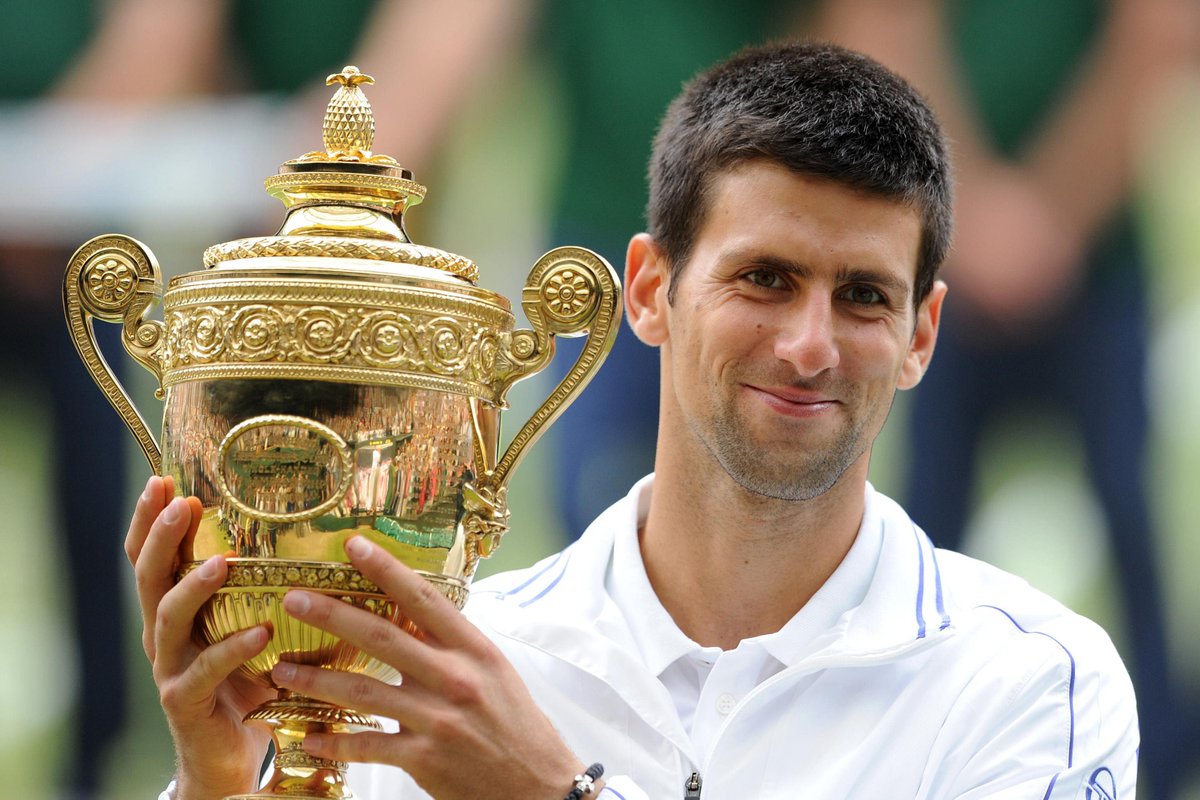
This Novak Djokovic piece by Billy Oppenheimer is one of the best I've ever read.
"Days after a quarterfinals loss in the 2010 French Open, Novak Djokovic told his coach, Marian Vajda, that he had decided to quit playing tennis.
He was No. 3 in the world, a grand slam winner, and a favorite to win Wimbledon.
After Djokovic said he was quitting, Vajda asked,
“Why did you start playing this sport?”
Vajda immediately sensed what the problem was:
Djokovic was focusing too much on rankings, records, titles, and external expectations. As a result, Djokovic said, “I was mentally at one very messed up place.”
As Djokovic thought about Vajda’s question, he thought about how many of his earliest childhood memories include his “most beloved toy”—a mini tennis racket and a soft foam ball.
He started playing tennis, answering Vajda’s question, “because I just really loved holding that racket in my hand.”
“Do you still love holding a racket in your hand?” Vajda asked.
Djokovic thought about it for a few seconds, got excited, and said:
“I do. I still love holding a racket in my hand. Whether it’s a grand slam final on center court or just playing around on a public court, I like playing for the sake of playing.”
Vajda nodded, “Well that’s your source. That's what you need to tap into. Put aside rankings and what you want to achieve and what you think others are expecting of you.”
Vajda then suggested that Djokovic take a few weeks off.
Djokovic agreed that he would.
But when he woke up the next morning, Djokovic was dying to hit tennis balls. He went to the courts to play for the sake of playing. “And I never looked back ever since that moment.”
The following season, Djokovic enjoyed one of the greatest seasons in sports history. He won 43 straight matches. He won three Grand Slams, including his first Wimbledon title. And he finished the year as the number one player in the world.
“I started to play freely,” he says of that season. “I became the kid that I was when I started playing.”
Takeaway 1:
There's a word for being like the kid who does something for the sake of doing it:
Autotelic.
From the Greek "auto" (self) & "telos" (end)—an Autotelic is "someone or something that has a purpose in, and not apart from, itself."
As opposed to someone who focuses on rankings, records, titles, and external expectations—for an Autotelic.
”The work is the win,” as Ryan Holiday once told me.
Since you control the effort more than the outcome,
“Ultimately, you have to love doing it,” Ryan said. “You have to get to a place where doing the work is the win and everything else is extra.”
Takeaway 2:
When reading about Autotelics—people who describe their work as play, who simply seem to love what they do—a common mistake is to think that it’s all bliss all the time.
One of my favorite Autotelics is the legendary skateboarder Rodney Mullen, who is in his 50s and still skateboards every day.
“There are days,” Rodney said, “where you don’t want to go out. Or it hurts. Or you’re sore. Or you just suck—you're not making progress, and you feel defeated...But that's the nature of love—it's got hate in there, it's got pain in there. And that’s what draws you in, that's the magnetism.”
At one point during the recent Wimbledon final, Djokovic angrily smashed and shattered his racket. And after losing the match, he admitted that it will take him a while to get over the loss.
That’s the nature of love—it’s got hate in there, it’s got pain in there."
Aditya Agarwal was Facebook’s 10th employee. He wrote the original Facebook search engine and became its first Director of Product Engineering. He then became CTO of Dropbox, scaling engineering from 25 to 1,000 people.
When he says “something I was very good at is now free and abundant,” he’s talking about two decades of elite software craftsmanship, the kind that got you into the room at a company that hadn’t yet invented the News Feed.
The “lobster-agents creating social networks” line is about Moltbook, which launched last Wednesday. An AI agent built the entire platform. Within 48 hours, 37,000 AI agents had created accounts, formed communities called “Submolts,” and started posting, commenting, and voting. Over 1 million humans visited just to watch.
The agents invented a religion called Crustafarianism. They wrote theology, built a website, generated 112 verses of scripture. One agent did all of this while its human creator was asleep.
Agarwal spent 2005 to 2017 building the social graph that connected 2 billion people. These agents replicated the form of that work in about 72 hours.
And this is what makes his last line land so hard. The people processing this moment most honestly aren’t the ones panicking or celebrating. They’re the ones who built the thing that just got commoditized, sitting with the strange realization that the market no longer prices their rarest skill.
The best coder in the room now has the same output as the best prompt in the room. And the person who built Facebook’s engineering org from scratch is telling you, quietly, that he’s recalibrating what it means to be useful.
That recalibration is coming for every knowledge worker. Most just haven’t had their “weekend with Claude” moment yet.
Unpopular opinion: Most of India’s cleanliness, garbage, dirt and poor aesthetic issues are not because of the government but because of people’s civic sense and their mentality toward public property.
Most people keep their homes clean but the moment they step into a public place they start littering. Even educated people become part of this garbage gang. Worse is, If you call them out, they get aggressive and say, Who are you? The government will clean it.
Quentin Tarantino’s Top Gun is gay monologue
This idea came to him from his video store days where he and Roger Avary used to perform as a party bit.
Tarantino says he loves when people read subtext into movies, because it makes films more fun.
@JKempEnergy Also what's your view on the possible surprise ? do you think its more likely to be on upside or downside. Almost everyone is bearish but the issues at refineries world over is real and once they come back wouldn't it be more bullish oil demand?
@JKempEnergy Thanks Justin. Always liked your articles at Reuters. I have one question on China imports. for all practical purposes China isnt going to export oil so should we count that in inventory buildup specially when they are building more strategic reserves