Parents of the Classes of 2027 and 2029, Here’s What You Need to Know About the Future of NCAA Division I Athletics
College sports at the Power 4 level is changing faster than at any point in decades. If your son or daughter is a rising junior or sophomore (or about to enter that window), the landscape they will recruit into looks different from the one current seniors are navigating.
What’s happening financially
Top athletic departments face permanent higher costs: direct revenue sharing with athletes, NIL support, facilities, and coaching. Many are turning to outside capital.
• LSU is reportedly closing a deal for $100M+ upfront in exchange for a share of future media rights.
• Utah already completed the first major single-school private equity partnership and created a commercial company around its athletics business.
• The Big 12 struck a private capital partnership that gives the conference and its schools access to significant capital without giving up ownership.
This is not fringe activity. It is becoming a competitive necessity for programs that want to stay at the highest level. Money is flowing more heavily toward football (and to a lesser extent men’s basketball) media rights and commercial assets.
What’s happening in Washington
Congress is advancing the bipartisan Protect College Sports Act. The goal is national rules on NIL, transfers, eligibility, and revenue sharing, plus limited antitrust protection so schools and conferences can enforce standards. It also includes language intended to protect women’s sports and Olympic/non-revenue sports from being cut. The bill has White House support and recent backing from major conferences, though final passage and exact language are still moving.
What this means for your athlete
1. The gap between the top and everyone else will likely widen. Programs with strong media rights and new capital will have more resources for facilities, staffing, NIL support, and recruiting. Mid-majors and lower-resource Power 4 schools will feel more pressure.
2. Football drives the money. Non-revenue sports (including baseball, softball, soccer, track, etc.) will still exist at most schools, and federal legislation is trying to protect them. But internal prioritization inside athletic departments will follow the revenue. Ask specific questions about how each program funds its non-football sports long-term.
3. Academics and the “right fit” matter more, not less. The professionalization of the top end makes the high-academic pathway and developmental programs even more valuable for many athletes. Not every player needs (or will get) the highest-dollar Power 4 offer. Strong academic institutions that treat athletics as part of the educational experience remain excellent options and often provide better long-term outcomes.
4. Transparency and control questions are real. When outside investors have a claim on future media revenue, incentives can shift. Good programs will still prioritize the student-athlete experience, but parents should ask: Who ultimately controls decisions on coaching, facilities, and sport sponsorship?
5. Recruiting timeline and evaluation stay critical. The 2027 and 2029 classes will still be evaluated on talent, character, academics, and projected development. The difference is that the financial resources available to programs will vary more widely. Visit campuses, talk to current athletes and parents in the specific sport, and look at roster continuity and academic support — not just the newest facility renderings.
Bottom line for parents
The old model is gone. Direct athlete compensation and outside capital are here. Federal legislation is trying to put guardrails around the chaos. Your job is the same as it has always been, just with more variables: find the place where your child can develop as an athlete and a student, graduate on time, and leave with options. The loudest money is not always the best long-term fit.
Stay informed, ask hard questions !
I’ve been getting so many messages from parents of 2026, 2027, and 2028 athletes that sound almost identical… and my heart just aches for every single one of you.
A typical one looks like this:
“My 2028 son went to a D1 mid-major camp in July. The head coach told him he liked him and planned to call on August 1. The assistant independently reached out and said, ‘We like him and will probably go after him Aug 1.’ They even called on July 30 just to make sure they had the right number. And then… nothing. Completely ghosted. What’s going on?”
If this is your story (or something painfully close to it), please hear me:
You are not crazy. Your athlete is not “not good enough.” And you did nothing wrong.
What you’re experiencing is the very real fallout of two massive shifts in college sports that collided at the worst possible time.
First, the House v. NCAA settlement (approved in June 2025) changed everything about roster spots and money. Schools can now pay athletes directly, but they also have much tighter roster limits. Thousands of spots that used to exist for developmental high-school players simply disappeared. Mid-major programs especially are stretched thin. Coaches now have to choose between an 18-year-old with potential and a 21- or 22-year-old transfer who can play right now. Too often, the high-school kid gets pushed down the list.
Then, just days ago, federal court rulings (especially the big Colorado injunction on July 31 / August 1) granted an extra year of eligibility to the entire Class of 2022. Suddenly, hundreds of experienced players who thought they were done are back on the market. Transfer portal windows opened almost overnight. Coaches who were planning to call your son or daughter on August 1 are now scrambling to lock down veterans before fall camp starts.
So the interest was real. The July 30 phone call was real.
And the silence that followed is also real — because the entire landscape shifted under their feet in a matter of hours.
This is the new reality for our kids. Coaches are casting wider nets earlier than ever because everything is so uncertain… and then having to pivot the second a court ruling or portal wave changes their math. It feels personal. It hurts. But in most cases, it isn’t about your athlete’s talent or character.
If you’re one of the many parents living this right now, here’s what I want you to hold onto:
• Keep showing up. Keep sending film. Keep being polite and persistent.
• Widen the net — D2, D3, NAIA, and junior colleges still have real opportunities.
• Protect your child’s heart. Remind them daily that one (or even several) unanswered calls do not define their worth.
• You’re not alone. There are so many of us walking this same confusing path right now.
To every parent who’s texted, messaged, or called me with a version of this story in the last few days: I see you. I hear the frustration and the worry in your words. And I’m right here with you.
Our kids are still growing, still developing, still capable of incredible things. The system is messy and unfair at the moment — but it does not get the final say on their future.
Hang in there. Keep loving them through this. And know that a whole community of parents is walking beside you.
Congratulations to our Reserves Legion team on their great season! A special thank you to Coach Stirtz, Coach Lynam, and Coach Horn for your dedication and for instilling the Titan Way in these young athletes. @PLSTitansBB
Today I was working with one of my players.
He was making contact..
But he wasn't making adjustments.
Every foul ball looked the same to him.
Every miss looked random.
And because of that, he was struggling to become more consistent.
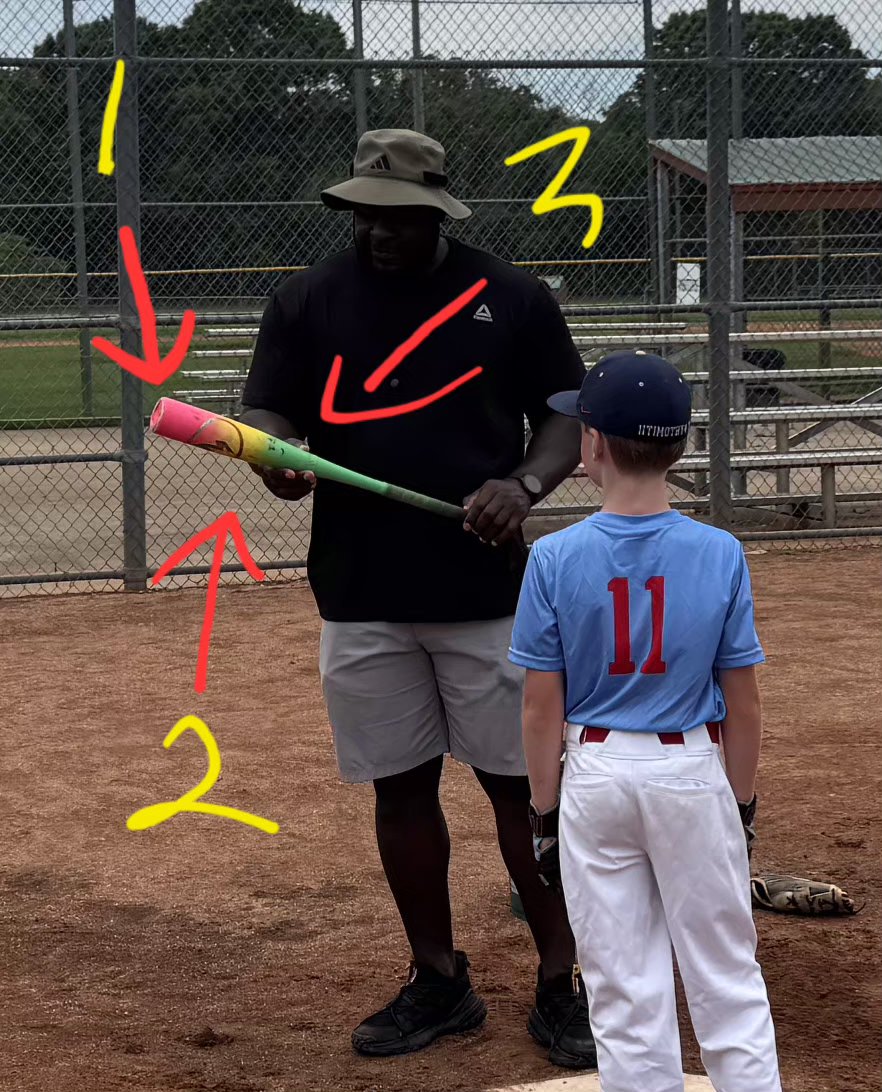
So I cleaned all the ball marks off his bat.
Then I showed him 3 spots.
1️⃣ End of the bat
Usually means you're too early.
2️⃣ Sweet spot
That's where we want to live.
3️⃣ Near the hands
Usually means the ball got too deep.
After every swing, I'd ask him:
"What is the bat telling you?"
At first, he didn't know.
But after a few rounds, something started to change.
If he hit it near his hands, he'd say:
"I need to be earlier."
If he hit it off the end, he'd say:
"I need to let the ball travel."
Then something really cool happened.
I stopped telling him.
He started telling me.
That's when everything changed.
His adjustments got faster.
His line drives became more consistent.
He started hitting the ball harder.
And he improved faster because every swing became information.
Not emotion.
Most players think great hitters make fewer mistakes.
I don't.
I think great hitters make better adjustments.
-Pitch to pitch.
-Swing to swing.
-At-bat to at-bat.
The game is constantly giving you feedback.
The question is:
Are you listening?
Try this tonight.
Wipe the marks off your bat.
After every swing, look where the ball hit.
Then ask yourself:
"What is the bat telling me?"
Most players swing and hope.
The best hitters swing and learn.
Every swing is feedback.
The faster you learn from it, the faster you'll improve.
Thank you for reading,
Jermaine Curtis
P.S. - If you enjoyed this, share it. This tells me you want more content like this.
NCAA Transfer Portal
Previously at Fort Hays State University (D2)
35 IP 26 Ks 16 BB
FB 89-92 T92.9
Cutter, Curveball, Change
Weekend starter and Bullpen experience
@CoachKirkClark@BUncommitted@FlatgroundApp
A buddy of mine snapped this picture while I was watching my son play baseball last night. Honestly, it probably captures something I didn’t even realize in the moment.
Like many parents, I sometimes get wrapped up in these games. I think part of it comes from knowing these moments won’t last forever.
Deep down, we know we’re living through moments we’ll someday miss more than we can explain.
These games become more than wins and losses. They become memories.
And while I know there’s still plenty of baseball left, I also know there will come a day when I’d give just about anything to sit in a folding chair one more time and watch my kids play ball again.
When did chirping get this bad in Baseball?
Travel. High School. College.
Feels like every year it gets worse.
Playing with edge is one thing…
constant noise is another.
Any Ideas? Thoughts on why?
High School Playoffs.
Winning a high school state championship is special.
The players go to school with each other, in most cases for years, parents know each other, and it means something to the community.
High school athletics bring people together and form a bond forever.
High school athletics can't be replaced.
Since being diagnosed with ALS in 2018, @SarahNauser has leaned on her unwavering love for the @Royals as an outlet during her fight.
"It's so much more than a game to me. I tell you this because I want you to truly feel the purpose in the game you get to play." 💙
@kcroyalstv
The NAIA Ball Team Of The Week is Bellevue (NE)
The Bruins continue to surge up the national polls and pushed their win streak to 10 games in a row and opening up conference play outscoring their opponents 38-17 across their four games
@BUBruins@BUBruinBaseball#NAIABall
Brock Purdy shares what it means to be Mr. Irrelevant and how to win with an underdog mindset.
"My whole story has been just being overlooked. Not good enough."
Overlooked in high school. Recruited late. Third string at Iowa State. Drafted last.
"All these people tell me you're not gonna be good enough. But deep down inside, this whole time I'm like: just wait. Just wait until I get an opportunity to compete. I'm not gonna look back with it, man."
You have to believe, but you also have to show up consistently and do the work.
1. Be the best version of yourself.
2. Own the process.
3. Take advantage of your opportunities.
4. Compete every day.
Being overlooked doesn't mean you're not ready - it means they're just not watching yet.
(🎥 Built 4 More Podcast)
Everyone represents each other.
When a player plays travel ball he's representing his high school, high school coaches and high school teammates.
When a player plays high school ball he's representing his travel ball organization, travel ball coaches and travel ball teammates.
and
The player is always representing the name on the back of their jersey and family.
What kind of representative are you?