Projects like the aluminum smelter in Oklahoma are exactly the kind of project our state needs more of. When I’m Governor, I will strongly support this project, and I will work with the Trump administration to bring more projects like it to Oklahoma. President Trump (@POTUS) is bringing jobs and investment to the USA and I HAVE HIS BACK!
https://t.co/d5zJRA3tkq
A lot of people tried to get GLP-1s banned when they first started making waves
They claimed all sorts of insane side effects we now know to be unreal, from cancer to bone shredding
But we had more than a decade of data when they took off, so the good news can outpace the lies
What theyre not telling you:
Most UNION contracts are pegged to minimum wage.
If Minimum Wage goes up, it gives the union a non-negotiated raise.
They dont give two shits about the burger flippers.
Their goal is union raises.
Because we get asked a lot.
The Technological Republic, in brief.
1. Silicon Valley owes a moral debt to the country that made its rise possible. The engineering elite of Silicon Valley has an affirmative obligation to participate in the defense of the nation.
2. We must rebel against the tyranny of the apps. Is the iPhone our greatest creative if not crowning achievement as a civilization? The object has changed our lives, but it may also now be limiting and constraining our sense of the possible.
3. Free email is not enough. The decadence of a culture or civilization, and indeed its ruling class, will be forgiven only if that culture is capable of delivering economic growth and security for the public.
4. The limits of soft power, of soaring rhetoric alone, have been exposed. The ability of free and democratic societies to prevail requires something more than moral appeal. It requires hard power, and hard power in this century will be built on software.
5. The question is not whether A.I. weapons will be built; it is who will build them and for what purpose. Our adversaries will not pause to indulge in theatrical debates about the merits of developing technologies with critical military and national security applications. They will proceed.
6. National service should be a universal duty. We should, as a society, seriously consider moving away from an all-volunteer force and only fight the next war if everyone shares in the risk and the cost.
7. If a U.S. Marine asks for a better rifle, we should build it; and the same goes for software. We should as a country be capable of continuing a debate about the appropriateness of military action abroad while remaining unflinching in our commitment to those we have asked to step into harm’s way.
8. Public servants need not be our priests. Any business that compensated its employees in the way that the federal government compensates public servants would struggle to survive.
9. We should show far more grace towards those who have subjected themselves to public life. The eradication of any space for forgiveness—a jettisoning of any tolerance for the complexities and contradictions of the human psyche—may leave us with a cast of characters at the helm we will grow to regret.
10. The psychologization of modern politics is leading us astray. Those who look to the political arena to nourish their soul and sense of self, who rely too heavily on their internal life finding expression in people they may never meet, will be left disappointed.
11. Our society has grown too eager to hasten, and is often gleeful at, the demise of its enemies. The vanquishing of an opponent is a moment to pause, not rejoice.
12. The atomic age is ending. One age of deterrence, the atomic age, is ending, and a new era of deterrence built on A.I. is set to begin.
13. No other country in the history of the world has advanced progressive values more than this one. The United States is far from perfect. But it is easy to forget how much more opportunity exists in this country for those who are not hereditary elites than in any other nation on the planet.
14. American power has made possible an extraordinarily long peace. Too many have forgotten or perhaps take for granted that nearly a century of some version of peace has prevailed in the world without a great power military conflict. At least three generations — billions of people and their children and now grandchildren — have never known a world war.
15. The postwar neutering of Germany and Japan must be undone. The defanging of Germany was an overcorrection for which Europe is now paying a heavy price. A similar and highly theatrical commitment to Japanese pacifism will, if maintained, also threaten to shift the balance of power in Asia.
16. We should applaud those who attempt to build where the market has failed to act. The culture almost snickers at Musk���s interest in grand narrative, as if billionaires ought to simply stay in their lane of enriching themselves . . . . Any curiosity or genuine interest in the value of what he has created is essentially dismissed, or perhaps lurks from beneath a thinly veiled scorn.
17. Silicon Valley must play a role in addressing violent crime. Many politicians across the United States have essentially shrugged when it comes to violent crime, abandoning any serious efforts to address the problem or take on any risk with their constituencies or donors in coming up with solutions and experiments in what should be a desperate bid to save lives.
18. The ruthless exposure of the private lives of public figures drives far too much talent away from government service. The public arena—and the shallow and petty assaults against those who dare to do something other than enrich themselves—has become so unforgiving that the republic is left with a significant roster of ineffectual, empty vessels whose ambition one would forgive if there were any genuine belief structure lurking within.
19. The caution in public life that we unwittingly encourage is corrosive. Those who say nothing wrong often say nothing much at all.
20. The pervasive intolerance of religious belief in certain circles must be resisted. The elite’s intolerance of religious belief is perhaps one of the most telling signs that its political project constitutes a less open intellectual movement than many within it would claim.
21. Some cultures have produced vital advances; others remain dysfunctional and regressive. All cultures are now equal. Criticism and value judgments are forbidden. Yet this new dogma glosses over the fact that certain cultures and indeed subcultures . . . have produced wonders. Others have proven middling, and worse, regressive and harmful.
22. We must resist the shallow temptation of a vacant and hollow pluralism. We, in America and more broadly the West, have for the past half century resisted defining national cultures in the name of inclusivity. But inclusion into what?
Excerpts from the #1 New York Times Bestseller The Technological Republic: Hard Power, Soft Belief, and the Future of the West, by Alexander C. Karp & Nicholas W. Zamiska
https://t.co/8igjazz1On
OMG this right here. I grew up in Wichita KS, unless you go to college and get a decent job at Koch or Boeing. There is ever present depressing mood among the locals. I moved away 20 years ago. I am better person for it
I'm convinced that one of the most sure-shot ways to deeply handicap yourself in life is to be geographically inflexible.
There's a LOT to be said for staying light on your feet, especially in the USA.
I notice many very disgruntled people, especially here in Upstate NY, who simply refuse to ever even entertain the idea of leaving. Some are sentimentalists, some are in a kind of hostage situation with their family, some are mired in garden-variety inertia.
All of them would be well-served by leaving; maybe just for a while, maybe forever. But it's the last thing they'd ever consider doing.
Far from being a bunch of quaint "localists," these people are often delaying having families, descending into dysfunction, and if they do have children, are generally causing their bloodline to degenerate. Most of them exhibit a "woe-is-me" attitude to boot. Welfare, heavy boozing (or pot or pills), and dead-end jobs are their life. It's honestly just sad.
But I've seen a handful of kids from such families move out to Pittsburgh or Texas or whatever to very good effect. Literally as soon as they leave the miasma of sorrow they grew up in, things get better for them. But the crabs-in-a-bucket mentality is the greatest barrier to any of them ever doing this.
Even amongst people who are from less poor backgrounds or who hail from more functional areas, I think it's still good to leave and start over once in a while. Keeps you lean, freshens the perspective, codes high-openness, high-optimism, dynamic.
Our ancestors left their villages in Europe for a reason, it seems. Americans have to keep that energy going or else we just rust out and lose our spirit.
Liftoff.
The Artemis II mission launched from @NASAKennedy at 6:35pm ET (2235 UTC), propelling four astronauts on a journey around the Moon.
Artemis II will pave the way for future Moon landings, as well as the next giant leap — astronauts on Mars.
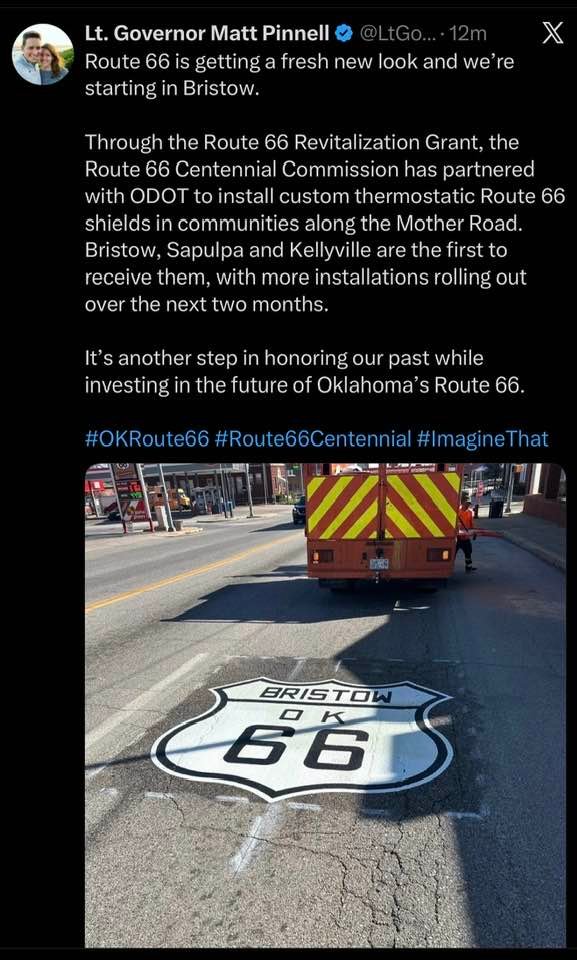
Oklahoma Taxpayers Deserve Real Roads — Not Route 66 Photo Ops and Bureaucratic Smoke and Mirrors
While Lt. Governor Matt Pinnell tweets glossy pictures of shiny new Route 66 shields being installed in Bristow, and praise for yet another taxpayer-funded “revitalization grant”, Oklahoma’s actual roads are falling apart at the seams. The latest Consumer Affairs study just dropped a bombshell: Oklahoma now has the 5th-worst roads in the entire United States, plunging a staggering 29 spots from 34th place just last year. Rural roads and small-town streets in unincorporated county areas are getting hammered hardest, exactly the kind of back-road infrastructure that real Oklahomans rely on every single day to get to work, haul crops, take kids to school, or drive to church. But instead of fixing potholes that swallow trucks, the establishment is busy marketing nostalgia to out-of-state tourists while our county roads slide backward into disgrace.
This is classic Oklahoma City priorities upside down. Governor Kevin Stitt loves to brag that Oklahoma now has some of the “best bridges in the U.S.”, and technically he’s right… if you only count the shiny state and federal highways that ODOT maintains and parades for photo ops. Those rankings conveniently ignore the thousands of county bridges and local roads that everyday Sooners actually use. The quickest and cheapest way for bureaucrats to “fix” a structurally deficient bridge? Just reclassify it as something else — a culvert, a low-water crossing, anything that gets it off the official bridge list and out of the embarrassing statistics. It’s accounting trickery at its finest, and it leaves rural families driving on crumbling infrastructure while the Governor cuts ribbons on interstate overpasses.
And don’t get us started on the ODOT County Improvements for Roads and Bridges (CIRB) program. Created with good intentions to help counties fix their own roads, it has ballooned into a bureaucratic black hole that wastes millions on “additional right-of-way acquisition” and endless “utility relocation” studies before a single shovel of gravel ever hits the ground. Taxpayer dollars that should be filling potholes and replacing dangerous bridges are instead padding the pockets of consultants, engineers, and utility companies while county commissioners beg for scraps. The CIRB five-year plan throws around hundreds of millions, yet rural road conditions keep getting worse. Enough. It’s time for a full forensic audit of the CIRB program and a hard pivot back to basics: fix the roads Oklahomans actually drive on every day.
Oklahoma families aren’t asking for neon signs and Instagram-worthy Route 66 billboards. They’re asking for roads that don’t wreck their vehicles, endanger their children, or strangle local economies in rural counties. The establishment can keep tweeting about “honoring our past” all they want. Real conservatives demand they stop the waste, quit the reclassification games, and start delivering safe, drivable roads for the taxpayers who actually live here, not just the tourists passing through. It’s time to re-examine every dime going into flashy marketing schemes and force ODOT and the Legislature to put rural Oklahoma first.