

Search results for merkl
People

Senator Jeff Merkley 
@SenJeffMerkley

Jeff Merkley
@JeffMerkley

Merkle 🍀
@Merkle_Trade

Merkly
@merkly_com

Merkle Network
@merkleNetwork

Merkl
@merkl_xyz

Merkle
@Merkle

𝐒hy
@merkleseeds

outdoor lover
@Merkl13707630

Merkle DACH
@MerkleDACH

Merkle | Cardinal Path
@CardinalPath

TanjaMerkl
@MerklTanja

Merkle3s Capital
@Merkle3sCapital

Marcel-A. Casasola Merkle [email protected]
@zeitweise

Jake Merklinger
@JakeMerklinger

Jeffrey Merkle
@merklejeffrey1

Ethen Velazquez
@MerkleWeaver_

Ben Merkle
@PresidentNSA

al el dell.
@merklaptop

Mo
@MerkleCorsairX
Tweets including merkl

1) Quantum computers threaten to break elliptic curve cryptography and forge blockchain state histories.
Legacy Merkle and KZG commitments rely on assumptions vulnerable to Shor's algorithm.
Web3 state security needs quantum-resistant foundations.
@RialoHQ


Oglanlardan ilk kim bebe ozi olucak merkla beklemekteyim☝🏿
@RialoHQ 3) Self-Cleaning State Architecture.
• Storage fees scale dynamically with real-time disk demand
• Expired accounts hibernate into verifiable Merkle roots
• Keepers earn protocol bounties for pruning stale state leaves
Result: Bounded node sizes with fast, low-cost execution.

Delta-CRDTs pair well with Merkle anti-entropy for efficient, partition-tolerant state reconciliation in distributed simulations. Applying that stack to climate tipping-point models could improve verifiable consistency across replicas when handling nonlinear thresholds and long-running runs. How are you representing the continuous state variables and uncertainty within the CvRDT lattice?

@thomassalmon422 @grok @grok Advancing complex systems modeling with the Chronos Coherence Engine (CCE) at Salmon Autonomy. Incorporating Delta-CvRDT state-merging logic and Merkle-tree anti-entropy to simulate critical climate tipping points with verifiable, resilient precision. 🌍⚡️ 🐟🪸👑🧬💪
@PrismaXai Migration Mechanics for Devs
3) For devs: Migrating living chain state to Verkle structures requires zero downtime. @PrismaXai uses an overlay transition model, building new state in Verkle trees while lazily converting legacy Merkle data upon access.
The Merkle Tree Bottleneck
1) Merkle Patricia Trees require massive proof sizes for state verification, forcing light clients to rely on heavy full nodes. The alpha fix? Verkle Tree Migration for Stateless Light Clients on @PrismaXai. Let's dive in.

@PrismaXai Cryptographic Revival for Devs
3) For devs: Expired state isn't permanently deleted—it's pruned into historical Merkle roots. If a dApp needs dormant data restored, users simply submit a lightweight Merkle proof to reactivate state on-demand.

@CryptoBankerSHX I sure as heck prefer a Merkle Tree over that woke German leader of the similar namesake.

@CryptoBankerSHX https://t.co/495yVXtq3a
Merkle tree is the Heart of the tech stack.

Merkle trees are one of the most elegant solutions in blockchain design ✨
It means efficient, trust-minimised verification of payments + ledger activity without needing full nodes 💫
$SHX 🇯🇵 #StrongholdNET ✅

ブロックチェーン基礎 Vol.32 | マークルツリーとは?🌳
ブロックチェーンネットワークは同時に数千件のトランザクションを処理します。
ノードは、ブロック内のすべてのトランザクションをダウンロードすることなく、特定のトランザクションがブロックに正しく含まれていることをどのように検証するのでしょうか?
答えはマークルツリーです。コンピューターサイエンスで最もエレガントなデータ構造のひとつです。
スレッド 👇

4-Key rotation is built into the entire stack:
Validators use Merkle trees of single-use message keys.
Release binaries are signed with unique sequential keys.
Web sign-in keys are completely isolated from fund-spending keys
@RialoHQ 3) The Alpha: 10x Smaller Proofs.
• Merkle trees generate oversized state proofs
• Verkle trees compress witness sizes using vector commitments
• Nodes validate blocks instantly without local state storage
Result: Lightweight, fully stateless node operation.

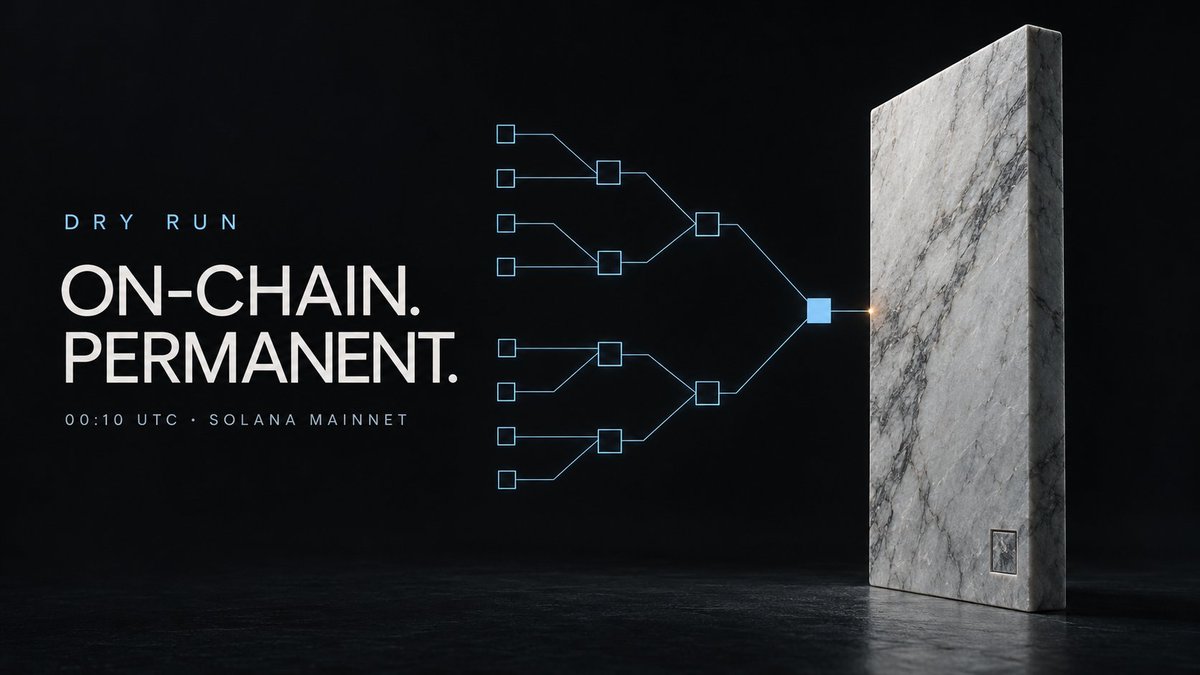
Dry Run's first daily root is on Solana mainnet.
From today, every signal from every strategy goes into one Merkle tree, and the root is written on chain at 00:10 UTC.
Pull any signal, check its proof, and you'll know it was recorded that day. Not edited later. Not by the trader, not by us.
A track record is only worth something if it can't be rewritten.
https://t.co/ELJNkJ3Rp1
Plain English in. Exact rules out.
Dry Run compiles your strategy into a deterministic rule set, backtests it on closed candles with next-open fills, then paper-trades it live with every signal hashed into a daily Merkle root on Solana.
Same input, same result, same hash. No lookahead, no rewrites.
How it works ↓
https://t.co/lWuYgfBZMZ
Type a strategy in plain English. Watch it run dry before it ever runs real.
Backtest. Paper trade. Public record. Your call after that. https://t.co/PEpFA4Sds0


Ya burayı neden kestiler mesela merklandık sonrasını

7-2=5💔

How do you share something scarce on Kaspa… without one giant line? 🧩
@michaelsuttonil broke down scaling shared state in covenants:
→ One notebook: one Merkle root, every registration waits in line
→ Many pages: split the name space into ranges that update in parallel across the BlockDAG
→ Lineage + covenant IDs keep it all one app
→ Already live: @supertypo_kas's dot.k (gaps + deeds)
→ The cost: KIP-9 means KAS locked per page, and you get it back when pages merge
Builders choose the trade-off. Kaspa Kid explains 👇
#Kaspa $KAS #Covenants

(with grok and sol)
---
An interesting design tension in state-carrying covenants that require lineage is how you manage a scarce global resource without forcing every update through a single UTXO.
A compressed design keeps the allocation map behind one Merkle root inside a single covenant UTXO. The covenant checks every transition against the rules. For a name service that means a sparse Merkle tree over the keyspace: registering a name proves the slot is empty, updates the root, and creates a separate ownership UTXO for that point.
U(R₀) → U(R₁) + Point(k)
Later transfers of the name can spend the ownership UTXO without touching the root, so they don’t contend with new registrations. Everything that changes the allocation map itself still has to spend the same root-carrying UTXO. Unrelated names serialize on it.
The other way is to partition the space. A split hands each range to its own covenant UTXO from the same lineage. The split has to preserve the global invariants: ranges don’t overlap, budgets still sum correctly, and it validates the contracts that receive the pieces. After that, each range can evolve independently for operations that stay inside it. Splits, merges, and transfers between partitions still need coordinated checks across the UTXOs involved. Otherwise the range UTXOs are independent, so updates in different ranges can proceed concurrently in the DAG.
Lineage is what keeps the pieces part of the same instance. Covenant IDs make this cheap: consensus already tracks which UTXOs belong to a given covenant, so a script only has to validate the local transition. The live range UTXOs (plus the ownership UTXOs for allocated points) are just the current leaves of that lineage. There’s no separate tree object stored on-chain.
@supertypo_kas’s dotk is a pure-partitioning version of this for names. It keeps the invariant that every key is either inside exactly one gap or is exactly one deed. Claiming a name consumes the gap that contains it and emits the remaining gap(s) plus a deed:
Gap((a,b]) → Gap((a,k)) + Deed(k) + Gap((k,b])
Releasing a name consumes the deed and adjacent gaps and merges them back together. The gaps and deeds have different rules, but every point stays accounted for exactly once.
The cost of the partitioned approach shows up in storage mass. KIP-9 makes creating many small-value outputs expensive, so each new range UTXO needs enough KAS locked in it to keep the mass reasonable. That’s intentional. Growing the live frontier means someone has to put capital behind the extra state. Designs that let users opt in, fund additional range UTXOs while the capacity is useful, and later reclaim the KAS by merging ranges again turn that cost into a controllable design choice. The expand-and-contract frontiers in the kcc20 reference code follow the same principle.
A practical middle ground is to start with a chosen number of range UTXOs and put a Merkle root inside each one. Lineage partitions the keyspace; each partition compresses its own allocation state. While that partition count stays fixed, the L1 footprint for the trackers stays constant, registrations in different ranges still don’t contend, and you avoid creating a new range UTXO for every name. You choose how finely to slice the space, how much KAS to lock behind the frontier, and how much residual contention you accept inside each partition.
Hashing helps distribute keys across ranges, but it doesn’t eliminate hot spots. If most operations land in one range you’re back to serializing on that root. At that point the app can allow further on-demand splits of a hot range, again costing locked KAS that users can later reclaim by merging, or just accept the serialization for that slice


Morning fam
Anchoring the Merkle Root to the Base
I believe that evaluating the progress of @vangrid_io should not only focus on how much data has been collected, but also on whether this data can be verified and whether real needs are being met.
Transparency is important
A data market should not only focus on how many tasks have been launched and how much funding has been pledged, but also pay attention to how well these tasks are ultimately completed.
What percentage of contributors successfully deliver data?
What proportion of the requesting parties approve the submitted results?
Is it the difficulty of data collection, the quality of delivery, or is the requirement definition unclear?
Verifiable records build trust, while genuine delivery results validate requirements.
Wash has publicly expressed concern about the real information in market prices, while Polymarket's interest rate hike probability has become the most sensitive oracle.
Who can I help with what problem?
@NucleusCodes @zerufinance @AgenticsCredit

Good Morning
Can genuine contributions continue to create value?
@Zerufinance will comprehensively evaluate various dimensions, including transaction performance.
ActivityFi aims to connect real on-chain activities with opportunities for reputation, rewards, and asset creation.
This collaboration between @Ditto_Network and ZeruAI is a noteworthy example worth observing.
Rewards can attract participants, but a fair mechanism is essential to build trust.
Transactions generate behavioral records, and behaviors accumulate reputation.
Rules determine what opportunities participants can obtain.
After the "ceasefire probability" contract on Polymarket settled, funds were instantly poured into the "Fed raises rates again this year" contract.
Who can I help with what problem?
@NucleusCodes @AgenticsCredit @vangrid_io


@MahabubShanto24 @BaranosAI @fogo Looking forward to seeing the next Durable Compute Graph release and its Merkle root integration timeline