Singapore’s Foreign Minister, Dr Balakrishnan casually explaining how he built his own AI agent (a 2nd brain for diplomacy) using Claude & WhatsApp integration etc. on a Raspberry Pi
“You cannot govern a technology you have only been briefed on.” 🇸🇬
A London-based robotics startup says it has built an AI 'brain' that can teach humanoid robots new physical skills in days rather than months, as the race to put humanoids to work in factories and warehouses accelerates
Every long-context demo you’ve seen so far…
was a number on a box.
→ 1M tokens
→ 2M tokens
→ looks good in docs
accuracy collapses way before that
SubQ actually holds at 12M
#subq@alex_whedon@subquadratic
OpenClaw for the masses... If you don't have your own OpenClaw yet, go to the Create Kimi Claw page at https://t.co/PsuO3CpJ7k to create your OpenClaw...
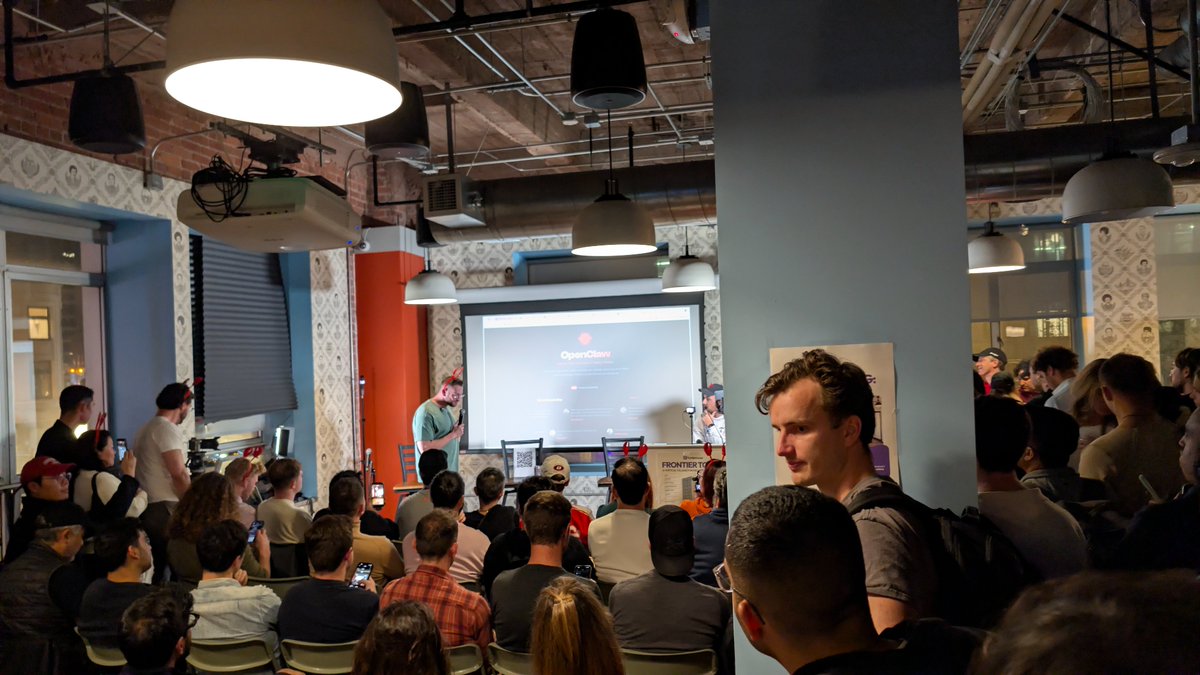
I've been building and using my OpenCalw @lulubotagi for just over a week and in that time so much has already changed / evolved / exploded ...then last night, attending the first ever @openclaw ClawdCon with literally hundreds of other people who are exploring what's now possible...was absolutely wild!
I decided to take some actual time to sit down with my thoughts on this rapidly evolving space and write down where my head is currently at.
In the spirit of thinking in public this year - I hope you enjoy this read.
It just seems implausible this is what we are made of, essentially, nanotechnology about a billion years beyond anything we can design or make ourselves.
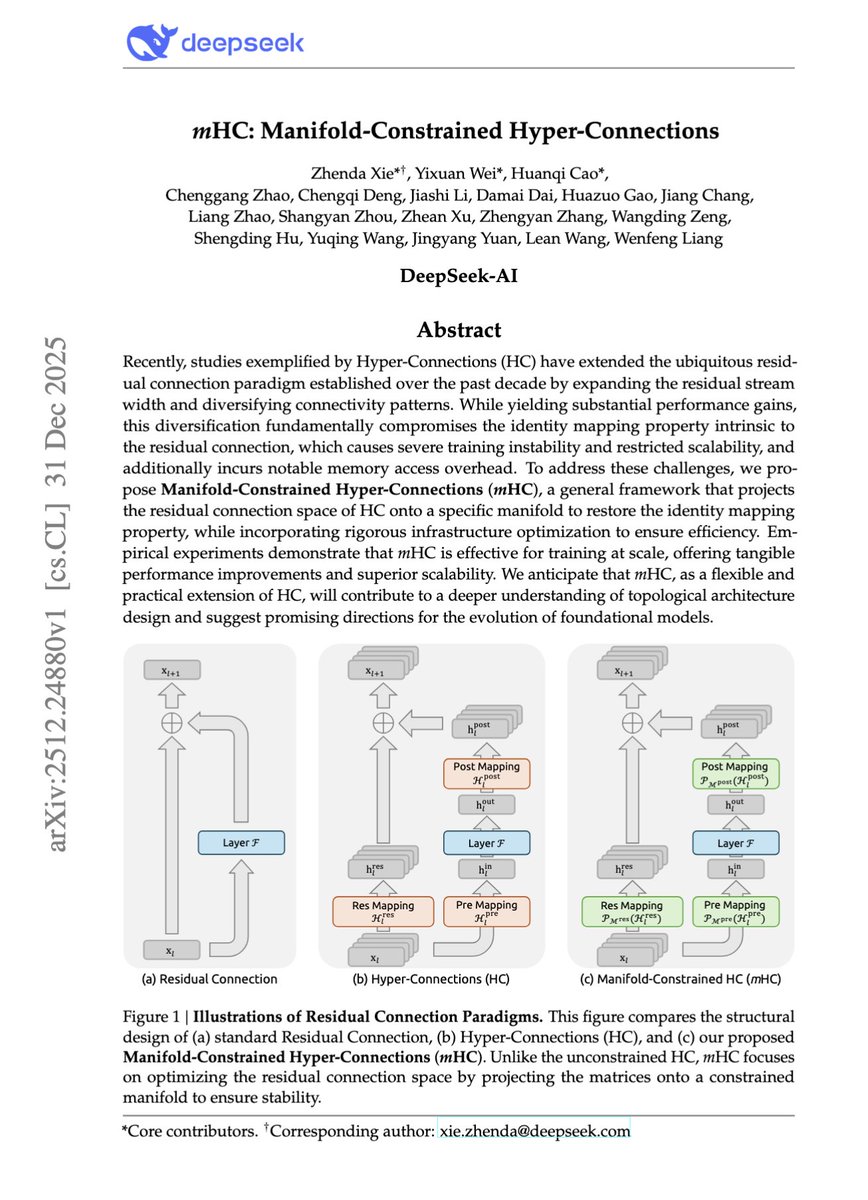
DeepSeek just fixed one of AI's oldest problems.
(using a 60-year-old algorithm)
Here's the story:
When deep learning took off, researchers hit a wall. You can't just stack layers endlessly. Signals either explode or vanish. Training deep networks was nearly impossible.
ResNets solved this in 2016 with residual connections:
output = input + what the layer learned
That "+" creates a direct highway for information. This is why we can now train networks with hundreds of layers.
Recently, researchers asked: what if we had multiple highways instead of one?
Hyper-Connections (HC) expanded that single lane into 4 parallel lanes with learnable matrices that mix information between streams.
The performance gains were real. But there was a problem:
Those mixing matrices compound across layers. A tiny 5% amplification per layer becomes 18x after 60 layers. The paper measured amplification reaching 3000x. Training collapses.
The usual fixes? Gradient clipping. Careful initialization. Hoping things work out.
These are hacks. And hacks don't scale.
DeepSeek went back to first principles. What mathematical constraint would guarantee stability?
The answer was sitting in a 1967 paper: the Sinkhorn-Knopp algorithm.
It forces mixing matrices to be "doubly stochastic," where rows and columns each sum to 1.
The results:
- 3000x instability reduced to 1.6x
- Stability guaranteed by math, not luck
- Only 6.7% additional training overhead
No hacks. Just math.
I've shared link to the paper in the next tweet.
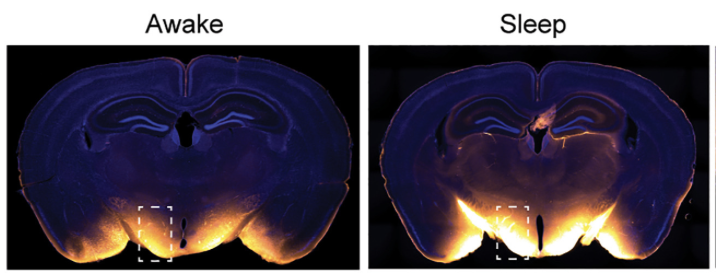
New Cell paper from the team that discovered glymphatic clearance (how your brain removes waste during sleep).
Sleep hours DIDN'T predict brain cleaning. Neither did REM or deep sleep.
They found what actually matters - and why some sleeping pills might undermine it 🧵
https://t.co/ixsH6i37C5 is now live. Download latest #free and #OpenSource TARILIO desktop app for running GGUF #LLMs on consumer grade Windows hardware! Local Server for #AI on your LAN. Download models from #HuggingFace or migrate from LM Studio. 😍
https://t.co/3bNh5yJbrM
Create your own plugins for TARILIO! Complete 'how to' use TARILIO's Plugin Architecture to index data #TARILIO can't index out of the box - custom databases - data from external API's. #OpenSource#csharpprogramming
https://t.co/BqV84KzPvw
New TARILIO release - downloads from @huggingface Local server runs GGUF LLMs over a Windows network with TARILIO desktop clients - no need for browser UIs. Combines AI chat with traditional search. Free download. Open Source. 🚀
https://t.co/vEaEd9JcHS #AI#LLMs