PhD Candidate @JHUPoliSci and Incoming Postdoctoral Fellow PLAS @Princeton | Past: @cps_journal | Historical Political Economy of Democracy and State-Building
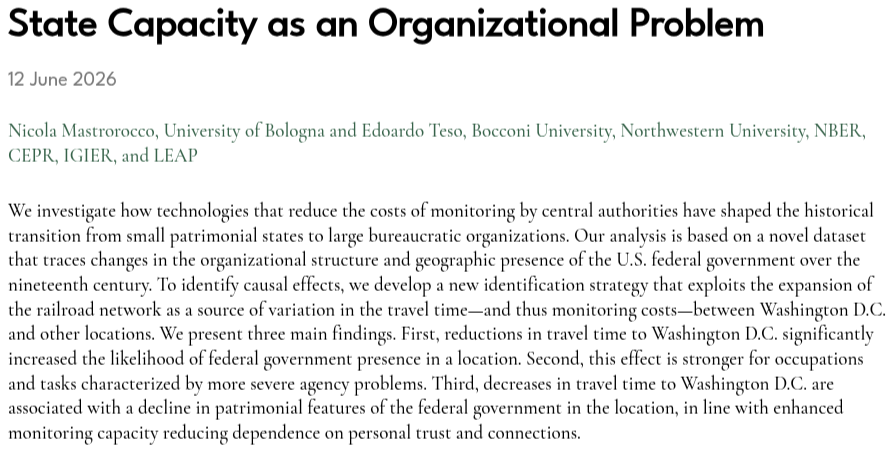
The expansion of the railroad network was a crucial driver of growth and organizational change of the federal bureaucracy in the XIX century U.S. Decrease in the costs of monitoring bureaucrats was a key mechanism
New paper by @edoardoteso & @mastrorocconick#REStud#EconX
Need help with Difference-in-Differences? Meet ChatDID: a GPT specialized in modern DiD methods and the de Chaisemartin–D'Haultfoeuille estimators and software packages.
Try it here:
https://t.co/nl2fiqBP7z
🚨New NBER working paper alert 🚨
🤔2021–2024 was the worst U.S. inflation in four decades. The question: Did voters react to the rising prices, or to the shrinking paychecks?
😱We approached this paper with one major surprise: there is no official measure of inflation at the county level in the U.S.
🌟To study the relationship between inflation and electoral outcomes during, we first had to construct local inflation measures using county-level data on family budget costs and incomes.
The answer? -> Check it out! 👇
🔗 https://t.co/itZi8KOZfS
This figure by Leandro Prados de la Escosura (@LdelaEscosura), from his new paper “Accounting for the Reversal of Fortune: Spain and Britain, 1501-1800,” is striking.
Something very fundamental broke in Spain around 1560. Having a GDP per capita slightly above Britain's around 1560, Spain fell to less than 50% of it by 1790/99. Part of this was a drop in absolute level: Spanish GDP per capita was around 10% lower in 1790/99. But most of it was due to Britain taking off while Spain did not. Leandro argues that the evidence points to low input efficiency in Spain (plus ça change, plus c’est la même chose).
Spain’s economic performance during the 19th century and the first half of the 20th century was not much better. You cannot understand Spanish history, or even current events, without appreciating its centuries of stagnation and decline.
The figure also shows the growing consensus among economic historians: modern economic growth started in Britain around 1650, much earlier than conventional accounts of the Industrial Revolution suggest.
Link to the paper: https://t.co/gtZPulzVPK
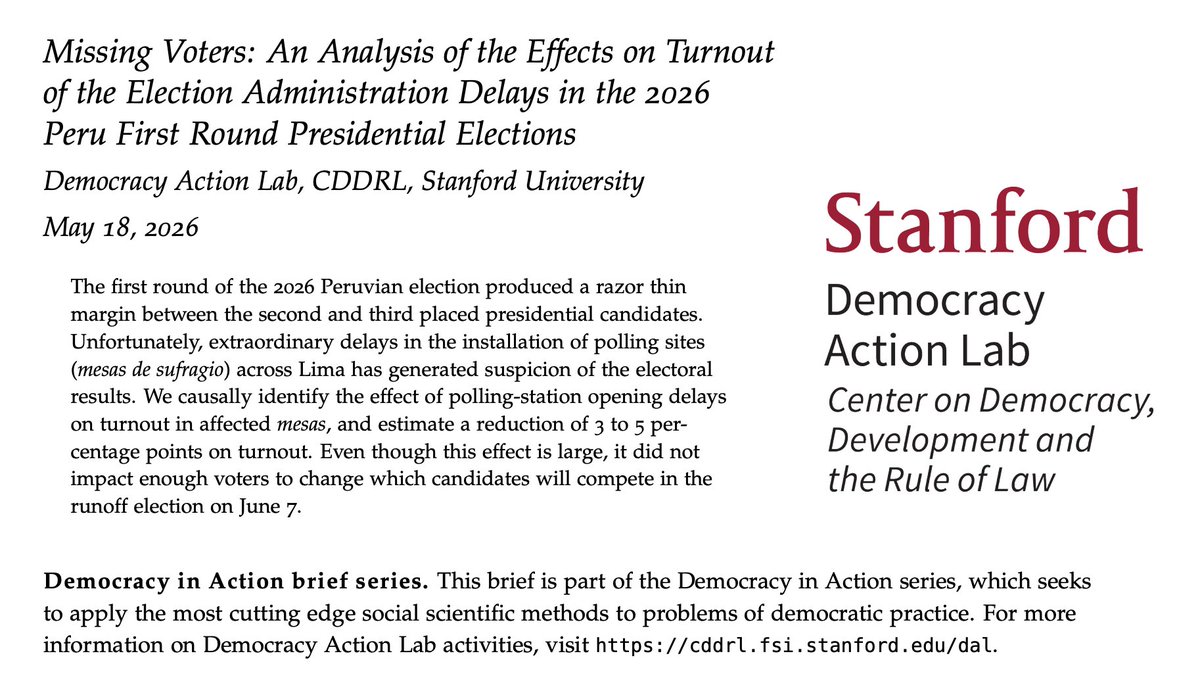
La Univ. Stanford publicó el análisis de demoras en las elecciones Peruanas más riguroso al día de hoy.
Junto con @diazcayeros,@BMagaloni y C.Dann, analizamos todas las actas en Lima con un análisis causal que responde la pregunta que nos hacemos en Perú:
¿Cambió el resultado?
@danyscht El sueldo importa casi nada en ma medida que no tengas civil service, el empleo publico es el patrimonio de los políticos en vez del plantel estable del estado. Todo lo demas es biri biri
Very grateful to @EliasDinas, @simonjhix, and everyone at the EUI Political Behaviour Colloquium for the incredibly thoughtful engagement, questions, and feedback.
Gran desempeño de nuestros alumnos en las admisiones de programas en Europa, EE. UU. y Canadá 🇪🇺🇺🇸🇨🇦. Es un orgullo compartir que este año el 43% ha sido admitido en universidades del Top 15 global 🌍.
¡Felicitaciones!
🔗 Mirá el placement histórico: https://t.co/4gB51Mh1zn 🎓✨
¡Felicitaciones a los 16 alumnos de la Maestría en Economía de @utditella que continuarán sus estudios en los más prestigiosos programas doctorales de EEUU y Europa! Celebramos con mucho orgullo este gran logro. 👏🎉
Mirá nuestro placement histórico: https://t.co/9UE4wlnzhx
Mucha gente dice que los planes sociales desincentivan el trabajo.
Si te doy plata, para qué esforzarse, e' o no e'?
En el #EstoNoEsEconomía de esta semana te muestro qué no necesariamente es tan así.
#Planeros (ES SARCÁSTICO TODO HAY QUE EXPLICAR):
https://t.co/BiQwo33tqM