🎉 Exciting News! 🎉
We're thrilled to announce the stable release of embodied agents v1.0, an open-source toolkit for running SOTA multimodal transformers on robot hardware or simulation with just a few lines of code!
https://t.co/mLQPX6ahV7
At mbodi we're committed to fostering open data collection and sharing among roboticists. Key updates include:
1. Motor Agent: Now supports OpenVLA
2. Dataset Recording: Improved automatic dataset-recording capabilities.
3. Remote Inference with Gradio: Agents now have access to all of HuggingFace spaces.
Get up and running with robotics transformers today 🚀
Stop taking on every custom deployment request.
Define your target tightly:
"High-variability boxing of rigid items."
or
"Small-item manipulation under unstructured light."
One robot learns a new workflow, and every robot on the floor updates. It works like a Slack channel, but the important updates never get buried under 800 other messages.
The best knowledge about how a factory runs lives on the shop floor. When frontline workers can teach robots directly, companies build real-world expertise right into their machines, creating a much stronger form of human-robot teamwork.
The best way to teach a robot may turn out to be the same as how we teach people:
1. Explain the task
2. Show an example
3. Correct the mistakes
4. Try again
The best way to teach a robot may turn out to be the same as how we teach people:
1. Explain the task
2. Show an example
3. Correct the mistakes
4. Try again
This article from the CMO of @RoboStrategy does a great job laying out the scope and scale of the physical AI and robotics revolution, which is only just getting started.
https://t.co/u6cGtlOAMu
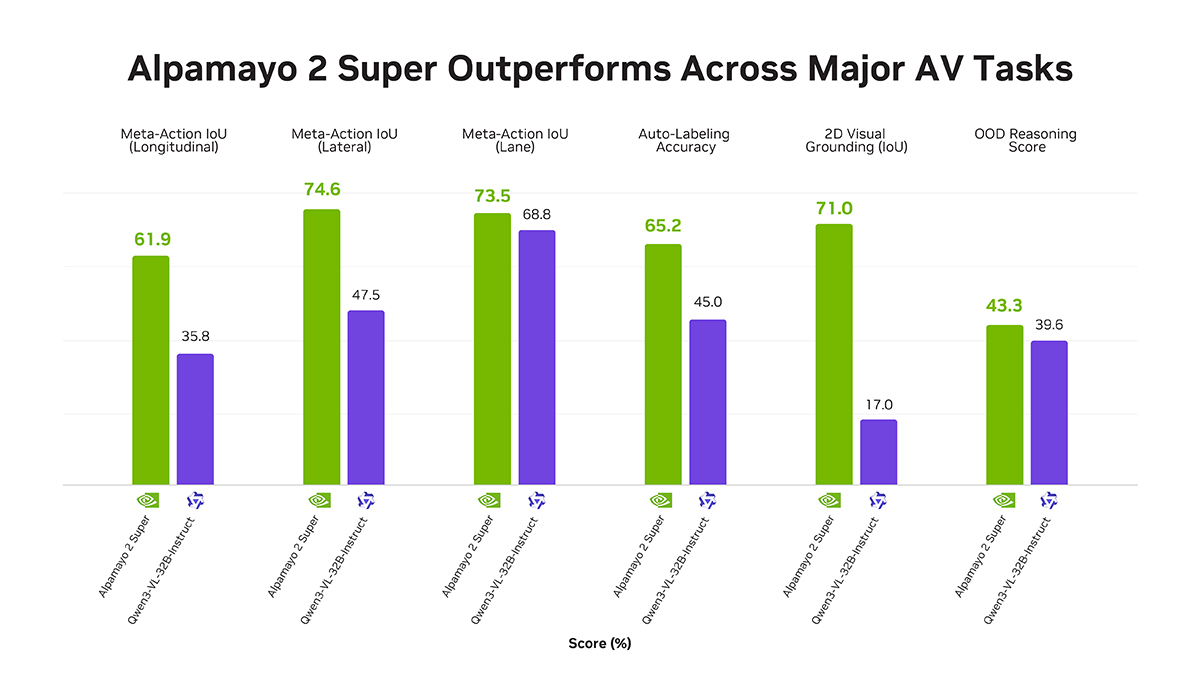
Today, we’re launching Alpamayo 2 Super, our frontier open reasoning model for autonomous vehicles.
Beyond seeing, Alpamayo understands and reasons through the complex world - thinks before it acts.
It’s a powerful backbone for robotaxis, trucks, shuttles, delivery vans, tractors and the long tail of mobile robots—billions of autonomous machines someday.
We’re releasing it for commercial use under OpenMDW-1.1 so teams can inspect it, fine-tune it and deploy it—open models advance safety and security.
The next wave of AI is robotics—and it starts with autonomous vehicles.
Great work, Alpamayo team!
https://t.co/2PYCCXWjZh
This article from the CMO of @RoboStrategy does a great job laying out the scope and scale of the physical AI and robotics revolution, which is only just getting started.
https://t.co/u6cGtlOAMu
"In an era where both distribution and ideation are commoditized, the valuable complement becomes establishing provenance. Whoever is able to establish a claim that they originally came to an idea wins." — Sachin
This is not only true for accreditation but for interpreting streams of sensor data in robotics and even just shipping good tech grounded in real business needs. Thanks to @Borthwick for the source.
Source: https://t.co/OhXeMf4uHJ
A company is really just a network for moving information between people, and job titles are the routing table. Once anyone can tag an agent to prototype, analyze, write, and ship, that routing flattens — the org starts to behave like one adaptive system instead of a chain of handoffs between departments. These archetypes are what's left after the handoffs go away.
As engineering, product, design, DS, etc. melt into a new kind of role, I was reflecting on what roles might look like in the future. For example, when I look at the Claude Code team I see what I think is five archetypes:
1. Prototyper: comes up with brand new ideas; churns out many ideas, most of which don't ship
2. Builder: quickly turns a prototype/idea into production-grade product/infra
3. Sweeper: cleans up the UI, simplifies the code and system, unships, optimizes performance
4. Grower: takes a product that has been built and iterates on it to improve Product-Market Fit
5. Maintainer: owns a mature system to make it secure, reliable, fast, and efficient as it scales
Many people span across 2 roles, and sometimes 3 roles. I also notice that these roles are not really tied to job function -- eg. across Anthropic, some designers match category 1, some 2, some 3; same for engineers, PM, DS.
A healthy team needs a mix of these, depending on the product:
- A product that is new and pre-PMF needs people that are strong at 1+2+3
- A product that is growing and has found PMF needs 2+3+4 and some 5
- A product that has strong PMF needs 3+4+5 and some 2
Maybe product roles of the future will look more like this, and less like the domain-specific roles of today?